
 Need help?
Do you have a question about the Ingersoll-Rand 231 and is the answer not in the manual?
How to specify and order replacement parts.
Guidelines for operating compressors above 200 psig.
Installation and function of the optional switch.
Importance of starter for motor protection.
Wire sizing and electrical connection advice.
Control via pressure switch.
Operating checks, lubrication, motor care.
Function, cleaning, and pressure indications.
Function, settings, and replacement of safety valves.
Procedures for adjusting the pilot valve.
Oil level checks and frame oil changes.
How the system reduces starting load.
Importance and cleaning of the air intake filter.
Detailed procedures for valve cleaning.
Breathing air suitability and toxic vapors.
Voltage, flammable vapors, and static.
Risks from moving parts, pressure, and heat.
This document serves as an instruction manual for Ingersoll-Rand Air Compressors, covering models 231, 41, 7T2, and 15T2. These compressors are designed to supply high-pressure air for various applications, with the specific models offering different pressure ranges and air delivery capacities. The models 231, 41, and 7T2 are compact, two-stage reciprocating compressors, while the model 15T2 is a three-stage reciprocating compressor. All models are engineered with properly proportioned compression ratios and efficient intercoolers to ensure a dependable source of high-pressure air.
The basic principle of operation for the two-stage compressors (Models 231, 41, and 7T2) involves a two-stage compression process. During the suction stroke of the first-stage piston, atmospheric air enters the first-stage cylinder through an inlet filter and inlet valve. This air is then compressed to an intermediate pressure during the compression stroke and discharged through a valve into the intercooler tubing. The heat generated during this first stage of compression is removed by the beltwheel fan, which circulates cool air over the intercooler's finned tubes. Subsequently, the second-stage piston draws this cooled air through its inlet valve into the second-stage cylinder, where it is compressed to an even higher pressure. Finally, the air is forced out through an air-cooled aftercooler and condensate separator into the external system.
The three-stage compressor (Model 15T2) extends this process with an additional compression stage. After the second-stage compression, the air is forced into a third-stage steeple cylinder through the second-stage discharge valve, second-stage intercooler, condensate trap, and third-stage inlet valve. The third-stage steeple piston then compresses the air to its final pressure, and it is forced out through the air-cooled aftercooler and condensate separator into the external air system.
A key feature of these compressors is the use of finned tube intercoolers and aftercoolers, which are crucial for dissipating heat from the compressed air and condensing contained moisture. This condensate is then collected in specially designed traps. All compressors are equipped with a complete starting unloading system that automatically relieves pressure from cylinders, intercoolers, and the aftercooler when the compressor stops, in addition to draining condensate from the traps. This system allows the compressor to start against a light load, thereby increasing the life of the driver and belts and reducing the possibility of tripping the overload relay.
The manual outlines several usage features, including different regulation types. The "Automatic Start and Stop Control" is suitable for applications with small or intermittent air demand where continuous pressure is required. This system uses a pressure switch to start and stop the driving motor, maintaining air receiver pressure within defined limits. The "Constant Speed Control" loads and unloads the compressor while the motor runs continuously. An inlet solenoid valve, actuated by the pressure switch, controls this operation by closing the compressor inlet when the desired pressure is reached, allowing the compressor to run continuously without compressing air. The "Dual Control" combines both automatic start and stop and constant speed control operations, suitable for models requiring constant control.
For models operating above 200 psig, an "Intermittent Duty Formula" is provided, recommending pump-up times between 10 and 30 minutes, with shut-down periods at least equal to the pump-up time. This formula is crucial for protecting valves and air heads from high operating temperatures, preventing rapid valve carbonization, and ensuring sufficient operating time to evaporate condensate and prevent rusting of internal parts.
Maintenance is a critical aspect emphasized in the manual to ensure satisfactory operation and longevity. Regular operating checks include daily inspection of the frame oil level and monthly inspection and cleaning of the air inlet filter. The frame oil should be changed every 500 hours of operation or every 90 days, whichever comes first, preferably when the oil is hot for maximum impurity removal. The manual provides specific oil capacities for each model and recommends using a non-detergent petroleum lubricating oil with rust, oxidation, and anti-foaming inhibitors. The viscosity of the oil should be selected based on the ambient temperature where the unit operates.
Motor lubrication and care depend on the motor type. Ball bearing motors with grease fittings require repacking with grease once a year, while prelubricated-for-life motors do not require lubrication. Monthly cleaning of motor windings with a jet of air is recommended to prevent dirt accumulation.
The air inlet filter/silencer must be kept clean at all times, as a dirty filter reduces compressor capacity. Cleaning involves vacuuming or washing the filtering element in mild detergent and water at least once a month.
Intercoolers and aftercoolers also require maintenance. The air flow to these tubes must never be obstructed, and their surfaces should be cleaned whenever oil, dirt, or grease deposits are observed, using a non-flammable safety solvent. During overhaul, tubes should be inspected internally and cleaned if necessary. Condensate drain legs and valves, if fitted, should be drained periodically. The intercooler gauge pressures are important indicators of compressor operation, and any significant deviation from initial readings should be investigated.
The manual also details the maintenance of air valves, which vary by model. For Model 231, stainless steel finger valves are easily serviced by removing the air head cap screws, valve plate, and cleaning the valve and seat with a stiff bristle brush and non-flammable safety solvent. For Model 41, valve capscrews are removed to expose the valve assembly, which is then lifted and cleaned with care to avoid damaging seating surfaces. For Models 7T2 and 15T2, concentric ring valves require disconnecting unloader tubing (if applicable), removing air head capscrews, and disassembling the valve for cleaning. Careful reassembly and proper torque application are essential for all valve types.
Belt installation and adjustment are also covered, emphasizing the importance of proper belt tension to prevent slipping, heating, wear, and bearing overload. A visual method and a more accurate spring scale measurement method are provided for checking belt tension.
Safety valves are critical safety features. Each intercooler is equipped with a safety valve, and a discharge safety valve is standard on all models. If an intercooler safety valve blows for more than a minute, the compressor should be stopped immediately as it indicates a problem in the next higher pressure cylinder. The manual strictly warns against removing, changing, or substituting safety valves with non-genuine parts.
The pilot valve adjustment is crucial for the starting unloading system. Detailed steps are provided for adjusting the pilot valve for Models 231, 41, 7T2, and 15T2, ensuring proper operation and preventing air leakage.
The breather tube, which connects the interior of the frame to the inlet filter/silencer, must be maintained to vent pulsations and prevent pressure buildup within the frame.
An oil consumption check is provided as a rule of thumb, considering consumption at or above 25 horsepower-hours per ounce as acceptable.
The manual includes a comprehensive trouble guide with common issues like oil pumping, knocks, air delivery drop, safety valve pops, and motor overload, linking them to specific check points and causes.
Finally, the document includes typical wiring diagrams for automatic start and stop control, constant speed control, and dual control, with and without timed condensate solenoid valves, to assist with electrical installations and troubleshooting. Safety precautions are highlighted throughout the manual, warning against hazardous voltage, high-pressure air, flammable vapors, and hot parts, and emphasizing the importance of proper safety equipment and procedures.
 General
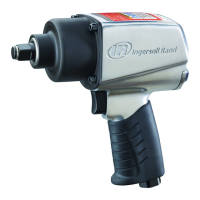
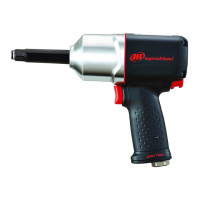
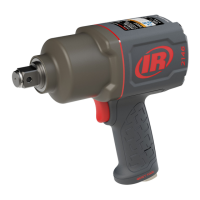
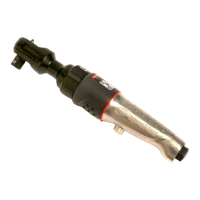
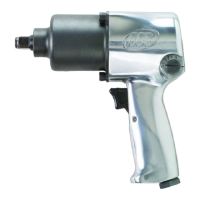
| Drive Size | 1/2 inch |
|---|---|
| Max Torque | 600 ft-lbs |
| Free Speed | 8000 RPM |
| Air Consumption | 4.2 CFM |
| Impacts per Minute | 1200 |
| Air Inlet | 1/4 inch NPT |
| Weight | 5.8 lbs |
| Length | 7.3 inches |



 To Next Page
