
 Need help?
Do you have a question about the Ingersoll-Rand EU and is the answer not in the manual?
Instructions for securely mounting the winch to a surface.
Details on choosing the appropriate wire rope based on load and size.
Step-by-step instructions for attaching wire rope to the drum.
Information on the required air supply for optimal motor performance.
Essential checks before placing the winch into service.
List of recommended lubricants for Ingersoll Rand products.
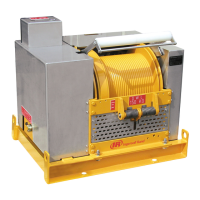
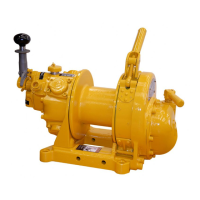
This document describes the EU and EUL Air Winches, which are industrial material handling products manufactured by Ingersoll Rand.
The EU and EUL winches are powered by a radial piston air motor. The motor's output is transferred to the drum via a series of connected spur gears, forming a reduction assembly. Since spur gears are not inherently self-locking, a brake must be applied whenever a load is supported by the load line. These winches are designed for pulling and lifting/lowering applications, depending on the configuration and safety factors applied.
The winches come in two main models:
Air System:
Drum Specifications:
Wire Rope Specifications (Recommended):
Mounting: Winches must be mounted with the longitudinal center line horizontal and the vent cap at the top vertical center. The winch will not function properly if tilted more than 10° or if the vent cap is more than 20° off top center. For vertical or inverted mounting, the motor case can be rotated to one of four positions to ensure the vent cap remains on top. Welding to any part of the winch is prohibited. The mounting surface must be flat (within 1/16 inch or 2.0 mm) and strong enough to handle the rated load plus equipment weight. Grade 8 or better self-locking mounting bolts are required, torqued to specification. A fleet angle between the sheave and winch of no more than 1-1/2° must be maintained, with the lead sheave on a center line with the drum, at least 1.6 feet (0.5 meter) from the drum for every inch (25 mm) of drum length.
Wire Rope Installation: At least 3 tight wraps of wire rope must be maintained on the drum at all times. Wire rope should not be used as a ground for welding, nor should a welding electrode be attached to the winch or wire rope. The rope should be installed to come off the drum for overwind operation (normal application). The fused end of the wire rope is fed into the anchor hole, past two anchor screws, and positioned beneath the drum surface. The first wrap must be tight and flush against the drum flange. The wire rope should be applied to the drum so it overwinds when the drum rotates clockwise (facing the drum end) or counterclockwise (facing the motor end), as indicated by an arrow on the gear case.
Controls:
Brakes:
Free Spool Clutch: A jaw-type clutch connects the gearing and drum, allowing the wire rope drum to be disengaged from the motor for manual unwinding. The clutch is engaged or disengaged via a lever on the gear case cover. The lever locks when engaged to prevent disengagement. The free spool clutch feature should not be used in combination with an automatic brake due to severe injury, death, or property damage risks.
Air Supply: The air supply must be clean, free from moisture, and lubricated for optimum motor performance. An air filter, lubricator, and moisture separator are recommended. The air line lubricator, filter, and regulator should be installed as close as possible to the air inlet, with the lubricator no more than 10 ft (3 m) from the motor. Air supply lines should be purged before final connections and kept as short and straight as possible. The air line lubricator should be replenished daily with 6 to 9 drops per minute of ISO VG 32 (SAE 10W) oil. An air line strainer/filter with 20-micron filtration and a moisture trap is recommended before the lubricator.
Natural Gas Operation (Optional Feature): The winch can be run using natural gas, but motor and valve modifications are required. Natural gas will reduce motor life, and exhaust must be piped away from the winch. All fittings and connections must be tight and inspected with leak detection equipment.
Initial Winch Operating Checks: Before placing the winch into service, perform the following:
Storage: When storing the winch, it should be in a no-load condition, wiped clean, and lubricated to prevent rust. For storage from an air source, place a small amount of 20 weight oil at the air inlet port. Mufflers and breathers should be removed and replaced with threaded plugs to prevent dust and moisture. Manual band brakes should be stored in the disengaged position.
Lubrication:
Recommended Lubricants:
Motor Oil Capacity: 3 pints (1.44 litres). Oil should be level-checked daily and drained/refilled as needed, especially in freezing temperatures.
Wire Rope Maintenance: Follow the wire rope manufacturer's instructions. At a minimum, clean the wire rope with a brush or steam to remove dirt. Caution: Do not use acid-based solvents. Apply a wire rope lubricant (Ingersoll Rand Lubri-Link-Green® or ISO VG 100 (SAE 30W) grade oil) weekly or more frequently depending on service severity.
Natural Gas Lubrication:
Inspection: Frequent and periodic inspections are crucial. Frequent inspections are visual examinations by operators or Ingersoll Rand trained inspectors during routine operation. Periodic inspections are thorough inspections by Ingersoll Rand trained technicians. Inspection intervals depend on component criticality and usage severity. Deficiencies must be reported and corrected.
Wire Rope Reports: Maintain records of wire rope condition as part of a long-term inspection program.
Frequent Inspection (Beginning of each shift):
Winches Not in Regular Use:
 General
| Brand | Ingersoll-Rand |
|---|---|
| Model | EU |
| Category | Winches |
| Language | English |



 To Next Page