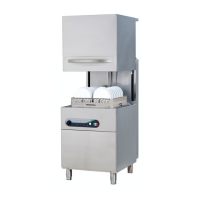
This document provides comprehensive instructions for the installation, operation, and maintenance of Italinox Undercounter Glasswasher-Dishwashers, specifically models DMG007 and DMD009. These appliances are designed for commercial use, offering efficient and durable performance even in busy environments.
Function Description
The Italinox Undercounter Glasswasher-Dishwasher is an appliance designed for washing dishes, plates, forks, and spoons. It features an automatic cleaning system that activates when the door is closed, with a two-way active arm system for both the top and bottom of the cabin. Optional automatic rinse aid and detergent dosing pumps are available, ensuring optimal cleaning results. The machine is designed for consumer-friendly energy consumption, even with intensive use.
Important Technical Specifications
The manual details two models:
- DMG007: Designed for a 400 x 400 x 100 mm basket.
- DMD009: Designed for a 500 x 500 x 100 mm basket.
Both models operate on a 220/230 1N~ input voltage at a frequency of 50-60 Hz.
Key electrical and power specifications:
- Electricity Consumption: DMG007 consumes 3.8 kW, while DMD009 consumes 6.75 kW.
- Power Supply Cable Section: DMG007 requires 3 x 1.5 mm, and DMD009 requires 3 x 2.5 mm.
- Washing Motor Power: DMG007 has a 0.26 kW motor, and DMD009 has a 0.6 kW motor.
- Total Heating Power: DMG007 provides 3.5 kW, and DMD009 provides 6 kW.
- Net Weight: DMG007 weighs 50 kg, and DMD009 weighs 60 kg.
- Dynamic Water Pressure: P.min. 200 Kpa (2 bar), P.max. 400 Kpa (4 bar).
- Maximum Water Temperature: T.max. 45 °C.
- Maximum Water Hardness: 12°F and 1000mS/cm (25 °C) conductivity value. Exceeding these values may cause breakdowns not covered by warranty.
- Noise Emissions: The noise generated by functional components does not exceed 60 dB (A).
- Electrical Connection: The device must be connected to a 16A fuse and suitably earthed. The leakage current of 20A-30 Ma is connected to the relay, and the main board should have an 16A insurance system.
- Water Inlet: Must be connected to a drinking water supply with a pressure of 4 bar.
- Water Drainage System: The drain plug is located on the left. The waste water flows through a line that must be above the level. The drain hose should be free of folds and pinching to prevent water accumulation.
Usage Features
The control panel includes:
- A - On-Off Button: Powers the machine on and off.
- B - Power Lamp: Illuminates when the machine is on.
- C - Heat Lamp: Illuminates when the water heating process is complete and the dishwasher is ready for loading.
- D - Washing Lamp: Illuminates during the washing process.
- E - Rinsing Lamp: Illuminates during the rinsing process.
- F - Drainage Button (Optional): Activates the drain pump on models equipped with it.
- G - Washing Button: Initiates the washing cycle.
Operating Procedure:
- Turning On: Press the On-Off button (A). The Power Lamp (B) will illuminate. Ensure the door is closed. The machine will begin to fill with water, then heat it. The Heat Lamp (C) will light when the water is at the correct temperature, indicating readiness for loading.
- Loading: Open the door, place soiled dishes into the basket, and close the door. Avoid placing dishes exceeding 300 mm interior cabin height or with rough waste.
- Washing Cycle: Press the Washing Button (G). The Washing Lamp (D) will illuminate. After washing, the machine waits 5 seconds, then activates the rinsing process for 15-20 seconds, during which the Rinsing Lamp (E) illuminates.
- Completion: Once rinsing is complete, the Rinsing Lamp (E) turns off. Open the door and remove clean dishes.
- Dosing Pumps: Built-in automatic rinse aid and detergent dosing pumps (optional) operate automatically. Ensure the pump buttons are switched on and hoses are plunged directly into the liquid boxes. Use high-quality detergents and rinse aids.
- Turning Off: At the end of the day, press the On-Off button (A). The Power Lamp (B) will turn off. Empty the water by pulling out the waste plug (or pressing the Drainage Button (F) on models with a drain pump). Do not replace the plug until all water is drained. For long-term storage, disconnect the electricity.
Safety Precautions:
- Never open the front door during a wash cycle.
- Do not cover the top of the appliance during use.
- The appliance must only be used by trained staff.
- Children or individuals with limited physical, sensory, or mental abilities should not use the appliance without supervision.
- Switch off the appliance if it breaks down or malfunctions.
- Repairs must only be carried out by authorized service centers using original spare parts.
- Do not wash the appliance with jets of water.
- Do not use chlorine-containing products (bleach, hydrochloric acid, etc.) to clean steel surfaces.
- Do not use corrosive substances (muriatic acid) to clean the floor underneath the appliance.
- Use Personal Protection Equipment (PPE) as summarized in the manual (e.g., safety shoes, gloves, glasses, earmuffs, masks, safety helmets) during transport, unpacking, assembly, daily use, cleaning, maintenance, and disassembly. Heatproof gloves are recommended for removing hot materials.
Maintenance Features
Routine Cleaning (Daily):
- General cleaning of the machine and surrounding area.
- Check the suction filter daily; remove it by turning clockwise, clean under water, and replace it.
Monthly Maintenance:
- Check mechanical protection devices for deformation, loosening, or removed parts.
- General cleaning of washing arms (disassemble and clean jet nuts and inside with water).
- Periodically check and clean the upper and lower washing arms, as dirt accumulation or hard water can clog the jets, affecting washing performance.
Yearly Maintenance:
- Check mechanical parts for breakage, deformation, or loose screws.
- Check readability and condition of words, stickers, and symbols.
- Check and replace the electrical connection cable and plug if necessary.
- A general control of the device should be performed periodically (at least once a year) by a qualified technician.
Servicing:
- Components requiring routine maintenance access can be reached by opening the front of the lower trunk lid and the top cover. This should only be done by qualified service personnel.
- The resistance temperature safety thermostat (manual reset type) is mounted under the frame and cuts power if necessary. It can only be reset by qualified technicians.
- The washing motor thermal protection thermal fuse shuts off the device in case of overheating. Commissioning and problem diagnosis must be done by an authorized service technician.
Troubleshooting:
- No or insufficient hot water: Possible causes include resistance failure, resistance contactor failure, thermostat failure, or switch failure.
- Continuous water intake: Possible causes include pressure switch metering issues or pressure switch failure.
- Dirty dishes after wash: Possible causes include low network pressure (below 2 bar), obstructed rinse arms, inappropriate chemical product use, or low water temperature.
- Foaming: Possible causes include the boiler water temperature reaching the desired level at the start of washing or using the wrong type of detergent.
- Machine shuts down: Possible causes include engine overheating or issues with the main control circuit board.
Environmental Safeguarding:
- Packaging: All packaging materials are environmentally friendly and recyclable (Polyethtlene, Polypropylene, Expanded polystyrene).
- Use: To minimize energy consumption, avoid using the appliance under no-load conditions or with the door open. Preheating the appliance immediately prior to use is recommended.
- Cleaning: Clean the appliance (externally and internally) with products that are at least 90% biodegradable to minimize harmful substance emissions.
- Disposal: Appliances are made from 90% recyclable materials (stainless steel, iron, aluminum, galvanized sheet steel, etc.) and should be disposed of properly at a conventional recycling plant according to local regulations. Cut the power cord and remove any closure devices to prevent children from becoming trapped. The symbol on the product indicates it should not be treated as domestic waste but disposed of correctly.



 To Next Page
 General