8
Treble adjustment
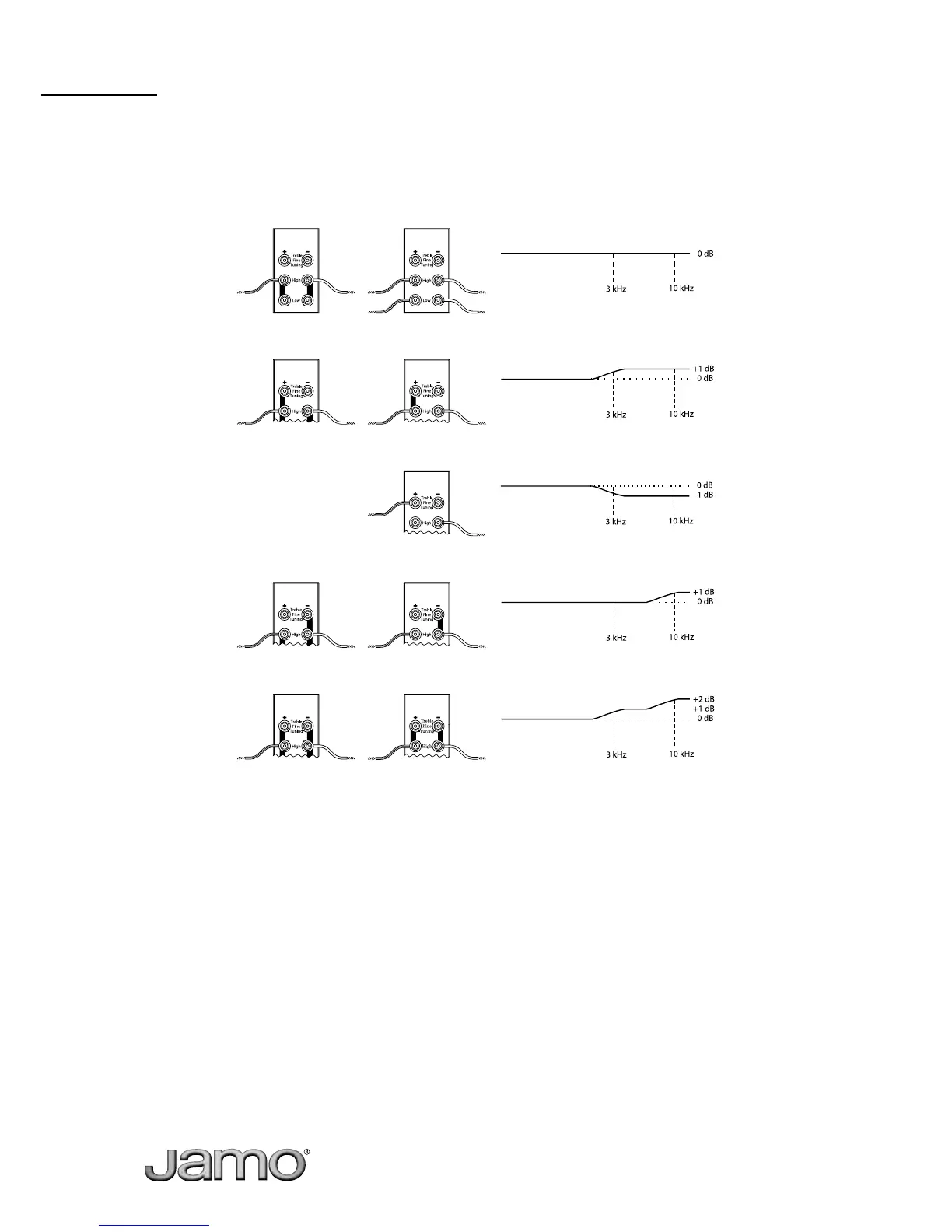
D 870 is equipped with an extra set of terminals for fine-tuning the treble level to your listening room characteristics and your personal taste.
On the following illustrations you can see the different possibilities.
Single wiring Bi-wiring Resulting
treble reproduction
The Acoustics of the Listening Room
Reverberation
The reverberation time of a room is the time it takes before a given sound impulse has died out. You have probably tried to clap your
hands in an empty room and heard how long it takes for the echo to disappear (long reverberation time), and then tried it after installing
furniture, etc., and found that now the echo is significantly shorter (short reverberation time).
It is obvious that a loudspeaker will sound different in these two rooms.
Therefore, in the development of loudspeakers, other than special measurement rooms, Jamo also uses a room that complies with the
IEC norm 268-13, which, briefly stated, recommends a reverberation time of 0.4 of a second for the frequency area between 250-4000
Hz and 0.8 of a second for the area below 250 Hz.
Of course it is very difficult to determine if your living room at home has exactly the right reverberation time, but by using the hand clap
test in different rooms, you can easily get an impression of whether or not your listening room is well dampened.
Obviously, your listening room must suit your personal music and taste, but if you think the acoustic character of the room is too hard
(which is the typical problem), you can find some solutions to this problem in the following section.
GB


 To Next Page