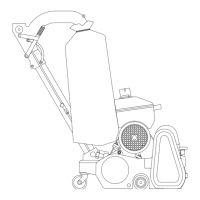
The document provided is a user and maintenance manual for the "Tiger" belt sander, manufactured by Janser GmbH. This machine is specifically designed for sanding wooden floors.
Function Description
The Tiger belt sander is a robust machine intended for the preparation and finishing of wooden floors. Its primary function is to abrade the surface of wooden floors using an abrasive belt, achieving a smooth and even finish. The machine is designed for professional use, emphasizing safety and efficiency in sanding operations. It features a dust collection system to manage sawdust, which is crucial for safety and cleanliness in the work environment. The design allows for adjustment of sanding pressure and belt centering, enabling precise control over the sanding process. The machine can be dismantled into three main parts (motor, suction tube, and base with roller) for easier transport by one person, or moved by two people without dismantling.
Important Technical Specifications
The manual provides detailed technical specifications for the Tiger belt sander, categorized for clarity:
Abrasive Belt Dimensions:
- Size: 750 x 203 mm
- Roller Width: 200 mm
- Roller Diameter: 185 mm
Roller Speed:
- At 50 Hz: 1800/2000 rpm
- At 60 Hz: 2000/2200 rpm
Motor (A12 European / A11 USA):
- European (230V, 50 Hz): 2990 W
- USA (230V, 60 Hz): 3000 W
Controls:
- Control Lever: Operated from the handgrips.
- Level Control: By means of a cam on one wheel.
- Safety Motor Protection: Features a heat cutout. In case of power failure, the motor does not restart without manual reset.
Wheels:
- Diameter: 112 mm and 87 mm (replaceable)
Bearings:
- Lifelong lubricated radial bearing.
Roller Pressure Adjustment:
Machine Dimensions:
- Overall: 1045 x 382 x 980 mm
Weight:
- Net Weight: 85 Kg
- Package Dimension: 760 x 536 x 830 mm
- Gross Weight: 95 Kg
Standard Equipment:
- Dust bag
- Electric plug
- Use keys
- Use and maintenance manual
Usage Features
The Tiger belt sander incorporates several features to enhance its usability and ensure safe operation:
- Operator Safety Instructions: The manual emphasizes the importance of reading and complying with DANGER, WARNING, and CAUTION notices to prevent injury or damage. It specifically warns against using the machine without proper assembly, with damaged power supply components, or without guards and covers in place.
- Electrical Connection: The machine requires a three-wire electric system connected to an electrical earth and protected with a differential earth fault interrupter. It is crucial to match the machine's voltage and frequency requirements and use approved cables of suitable length and cross-section (e.g., HO5VV-3x2.5 mm² for Europe).
- Portability: For single-person transport, the machine can be disassembled into the motor, suction tube, and base with the roller. For two-person transport, designated handles (handle hand-grip and handle 1) are provided.
- Setup Procedure: The setup involves placing the dust bag, connecting to a compatible and earthed power socket (20 amp fuse), winding the cable, opening the side guard, lowering the tensioning roller, inserting the abrasive belt (750x203 mm only, protruding 2 cm from the side), stretching the belt, and plugging in the machine.
- Belt Centering: The belt centers automatically once the motor starts. If adjustment is needed, screw 12 (fig. D) can be turned clockwise to move the belt outwards or anticlockwise to move it inwards. The correct position is when the belt protrudes about 1.5 mm from the sanding roller.
- Sanding Pressure Adjustment: Handwheel 13 (fig. E) allows for continuous adjustment of the roller pressure on the floor. Turning it clockwise decreases pressure, while anticlockwise increases it.
- Wall Edge Wheel: A small support with an idle wheel is fitted to prevent damage to skirting or walls during sanding. This wheel is correctly positioned when the machine is about 8 mm from the wall with the wheel in contact. Screw 11 (fig. C) allows for adjustment of this support.
- Wheel Adjustment (Parallel to Roller Axis): The position of the main wheels can be adjusted by turning the machine upside down, checking protrusion with a tool (14 - fig. F), loosening nut 15 (fig. F), turning the off-center pin (fig. E) until both wheels protrude equally, and then tightening nut 15.
- Machine Operation: Before starting, ensure lever 4 (fig. A) is hooked up and the roller is off the floor. Turn switch lever 8 (fig. A) from position 0 to START, hold until the motor reaches sufficient speed, then release to position 1. A safety switch prevents accidental restarts after power failures.
- Environmental Considerations: Sanding wooden floors can create an explosive environment due to combustible dust and vapors. The manual stresses the importance of removing all fire sources, ensuring good ventilation, emptying the dust bag when one-third full (and always after use) into metal containers outside the building, and sinking all nails completely before sanding to prevent sparks.
Maintenance Features
Routine maintenance is essential for the longevity and optimal performance of the Tiger belt sander:
- Sanding Chamber: Periodically vacuum-clean the sanding chamber to prevent dust interference with the tensioner.
- Rollers: Regularly check the external surface of the tensioning and sanding rollers and remove any dirt.
- Wheels: Periodically remove dirt from the machine body and wheels, as dirt can cause ripples on the sanded surface.
- Dust Bag: Empty the dust bag vigorously when it's one-third full. To prevent pores from blocking and maintain dust collection ability, turn the bag inside out and wash it in cold water.
- Belt Tension: Periodically check the belt tension. The roller belt should deflect by 8mm under a 30 N load, and the aspirator belt by 8mm under an 18 N load. Adjustment procedures are detailed in the "Movement with One Person" section.
- Ball Bearings: Inspect ball bearings for wear or damage according to a specific schedule:
- Wheels: After the first 2500 hours.
- Belt stretching pulley: After the first 2500 hours.
- Impeller shaft: After the first 2500 hours.
- Tensioning rollers: After the first 2500 hours.
- Sanding roller: After the first 5000 hours.
- Motor shaft: After the first 5000 hours.
- Spare Parts: The manual explicitly states that only original JANSER spare parts should be used. Using non-original parts or unauthorized repairs will void the guarantee and responsibility.
- Troubleshooting Guide: A comprehensive table lists common problems, their causes, and remedies. This includes issues like insufficient cut (worn abrasive, insufficient roller pressure, worn roller belt), insufficient motor speed (voltage issues, faulty capacitor/motor), grooved work surface (faulty belt/rollers, incorrect wheel adjustment), insufficient dust collection (full/dirty dust bag, blocked ducts), motor not starting (faulty safety switch/contactor, voltage issues, faulty motor), and burns on the work surface (worn/excessive abrasive, excessive roller pressure).

 Need help?

 To Next Page
 General