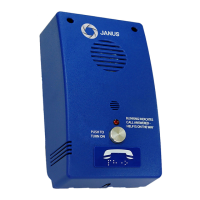
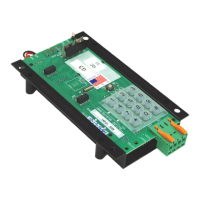
The JANUS Line Powered ADA Telephone is a hands-free communication device designed for elevator systems, ensuring compliance with ADA (Americans with Disabilities Act) requirements. It functions as an emergency phone, allowing occupants to communicate with an answering service or designated contact in case of an emergency. The phone is line-powered, meaning it draws its operational power directly from the telephone line, though optional battery and external power supply configurations are available for enhanced functionality or specific line conditions.
Function Description:
The primary function of the JANUS ADA Telephone is to provide reliable, hands-free communication from an elevator car. When activated, typically by pressing an emergency button, the phone automatically dials pre-programmed numbers to establish a connection with an answering service or emergency contact. It features a speaker and microphone for two-way voice communication. The device also includes LED indicators to provide visual feedback on its status, such as "Call in Progress" (Red LED) and "Alarm Received" (Green LED).
The phone supports various programming methods, including calling the elevator phone to program it (Method A) or using the on-board keypad (Method B). Programming allows for setting up phone numbers, an identification code, a new password, and recording a location message. The location message is crucial for informing the answering service of the elevator's specific location.
Optional features include auxiliary outputs (AUX1 and AUX2). AUX1 can be programmed to activate based on the status of the Red or Green LEDs, or when the phone turns ON/OFF, providing flexibility for integration with other elevator systems. AUX2 is designed for phone line monitoring, closing if the telephone line drops below 2 volts, is disconnected, or shorted for more than 15 minutes. This feature requires an optional 12VAC power supply and a jumper on the LM connector.
The device is available in multiple styles:
- Box-Less Style (PNB): Designed for mounting directly on the car station, with a separate red lens cap and bezel for the LED.
- Box Style (PBX): A complete unit mounted in a phone cabinet on the car station.
- Flush Mount Style (PSS/PSL): Designed to be flush-mounted into a cutout on the car station.
- Surface Mount Style (PSM): Designed for surface mounting on a wall.
Important Technical Specifications:
- Input Connections: One shielded twisted pair communication cable (shield grounded at the controller end only).
- Phone Line Requirements: Standard (analog) loop start voice grade touch tone telephone line, PBX, or key system station analog telephone line. It will only work on an Analog phone line or an Analog port from a digital phone system.
- Power Required (on-hook): 0 mA
- Power Required (off-hook): 20 to 30 mA
- Phone Line Voltage (on-hook): 24 to 70VDC (nominally 48VDC)
- Phone Line Voltage (off-hook): 8 to 20VDC (nominally 14VDC)
- Ring Sensitivity: 40 - 120VAC RMS
- Dialing: DTMF (Dual Tone Multi Frequency)
- Frequency Response: 550Hz - 3400Hz, +/- 3db.
- Operational Loop Impedance: 600 ohms
- FCC Registration: US: NLFTE05B25668
- Ringer Equivalency Number: 0.5B
- Optional AC Adapter: 9 - 24VDC / 12VAC @ min. 200mA
- Max Power for Light: 110V, 1 Amp (for light behind pushbutton or COP)
- Battery Compatibility: 8.4V NiMH or Standard 9V-Alkaline battery (for specific conditions).
Usage Features:
- Hands-Free Operation: Allows for communication without needing to hold a handset.
- Programmable Phone Numbers: Up to four emergency phone numbers can be programmed, ensuring multiple contact options.
- Location Message Recording: Users can record a specific message identifying the elevator's location, which is played to the answering service. This can be listened to without changing it.
- Voice Prompt Messages: The phone can be configured to play voice prompts like "Elevator call at the tone press one to talk, press two for location." These prompts can be enabled, disabled, or delayed.
- Adjustable Speaker Volume: The speaker volume can be adjusted by calling into the unit and pressing "9" twice during a call.
- Programming Access Code: A password can be set for programming mode, enhancing security.
- Call Timer: A call timer can be set (060-990 seconds) or disabled (000 seconds).
- Push Button Control: The emergency button's behavior can be configured, including options for turning the phone on/off, playing messages, or requiring a sustained press for a call.
- Ring Time for Outgoing Calls: The duration of ringing for outgoing calls can be adjusted (18-60 seconds, default 50).
- Redial Feature: Can be set to redial the number one or two more times, or disabled.
- Multi-Language Support: The phone can be programmed to play messages in English, Spanish, or both, in a specified order.
- LED Indicators: Red LED for "Call in Progress" and Green LED for "Alarm Received" provide clear visual status.
Maintenance Features:
- Troubleshooting Guide: The manual provides a comprehensive troubleshooting guide for common issues such as the phone not turning ON, dialing incorrect numbers, low/no sound, noise on the line, broken communication, phone ringing busy, phone not ringing, or phone turning ON by itself.
- Visual Inspection: Always visually check for loose or shorted wires, physical damage, or missing components.
- Battery and Power Supply Information: Guidance on when a 9V battery or a 9-24VDC/12VAC power supply with an 8.4V NiMH battery is needed.
- NiMH Battery Maintenance: If using an 8.4V NiMH battery with a power supply, it needs to be checked every 12 months.
- Power Supply Polarity: The P9 connector for the power supply is polarity sensitive, requiring caution during connection.
- Wiring Recommendations: Highly recommends 20-22 AWG twisted shielded pair wiring for the incoming phone line in the traveling cable, with the shield grounded at the elevator controller end only, to reduce interference.
- Technical Support: Janus technical support is available via phone for assistance.
- Automated Programming System (APS): A QR code is provided to connect to an Automated Programming System for convenient programming.

 Need help?

 To Next Page
 General