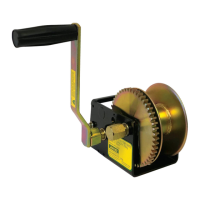
2 Speed Boat Trailer Winch Owner’s Manual
6
Winches are not intended (1) for the movement of people and (2) as a load securing device for boats on trailers
(T) +61 (0)8 8243 9100 (F) +61 (0)8 8243 9185 Toll Free Sales: 1 300 135 935
Email: sales@advansa.com.au Web: www.advansa.com.au
Moving the Boat
Important !
• Obey a stop signal from anyone.
• Maintain tension on the wire cable to keep it tightly and evenly wound on the drum.
• If the winch and boat are not visible during the entire operation, get help from another person.
• Appoint a supervisor if more than one person is involved in the operation. This will reduce confusion and increase safety.
• Where possible, remove the handle when the winch is not in use, to help avoid unauthorised use.
Move the boat slowly and smoothly, only a small distance at first. Make sure the boat is balanced and securely attached before continuing.
Engage the pawl (ratchet) when winding the boat towards the winch, disengage the pawl (ratchet) when releasing the boat. Do not engage the pawl
(ratchet) while the winch gears are turning. Stop the winch before engaging the Pawl. Ensure the handle is securely positioned on the shaft.
Grip the handle tightly at all times during operation. When required, disengage the Pawl by moving the load slightly to remove pressure from the
Pawl, then pull out and turn the Pawl lever 90 degrees. Do not try to stop a spinning handle, step clear until the spinning stops.
Observe the wire cable as it winds onto the drum. If it becomes loose, uneven, or overlapped, stop the operation and rewind before continuing.
Continued operation with overlapped or uneven wire cable can damage and shorten its life.
Cleaning the Winch
Important !
Increase the frequency of maintenance procedures if the winch is:
• Operated for long periods.
• Used to pull heavy loads.
• Operated in wet, dirty, hot or cold surroundings.
Clean the winch to remove dirt and help prevent rust and corrosion.
Clean the winch every three months or whenever it is dirty.
Wipe all components to remove dirt and grease.
Leave a light film of oil on all surfaces to protect them against rust and corrosion.
Wipe off excess amounts of oil to avoid accumulation of dirt.
Remove all unnecessary objects from the area surrounding the winch.
Lubricating the Winch
Important !
Make sure the lubricant has a temperature rating appropriate for the ambient temperatures of the operation.
Lubricate the winch properly to help protect it from wear and rust.
Lubricate the winch at least every three months, by applying a light grade oil to the drum shaft and bushes. Rotate the drum several times to allow oil to
penetrate, and wipe off excess oil to avoid dirt accumulation.
Inspecting the Winch and other associated equipment
Important !
Keep written records of inspection. This allows comparison with comments from previous inspections so
you can see changes in condition or performance
Warning
Do not use damaged or malfunctioning equipment. Seek immediate repair.
Inspect the winch to detect signs of damage or poor operation before they become hazardous.
Instructions – Frequent Inspection
Perform frequent inspections:
• Before each operation.
• Whenever you notice signs of damage or poor operation


 To Next Page
 Loading...