The JBL 5233 and 5234
Electronic Frequency Dividing Networks
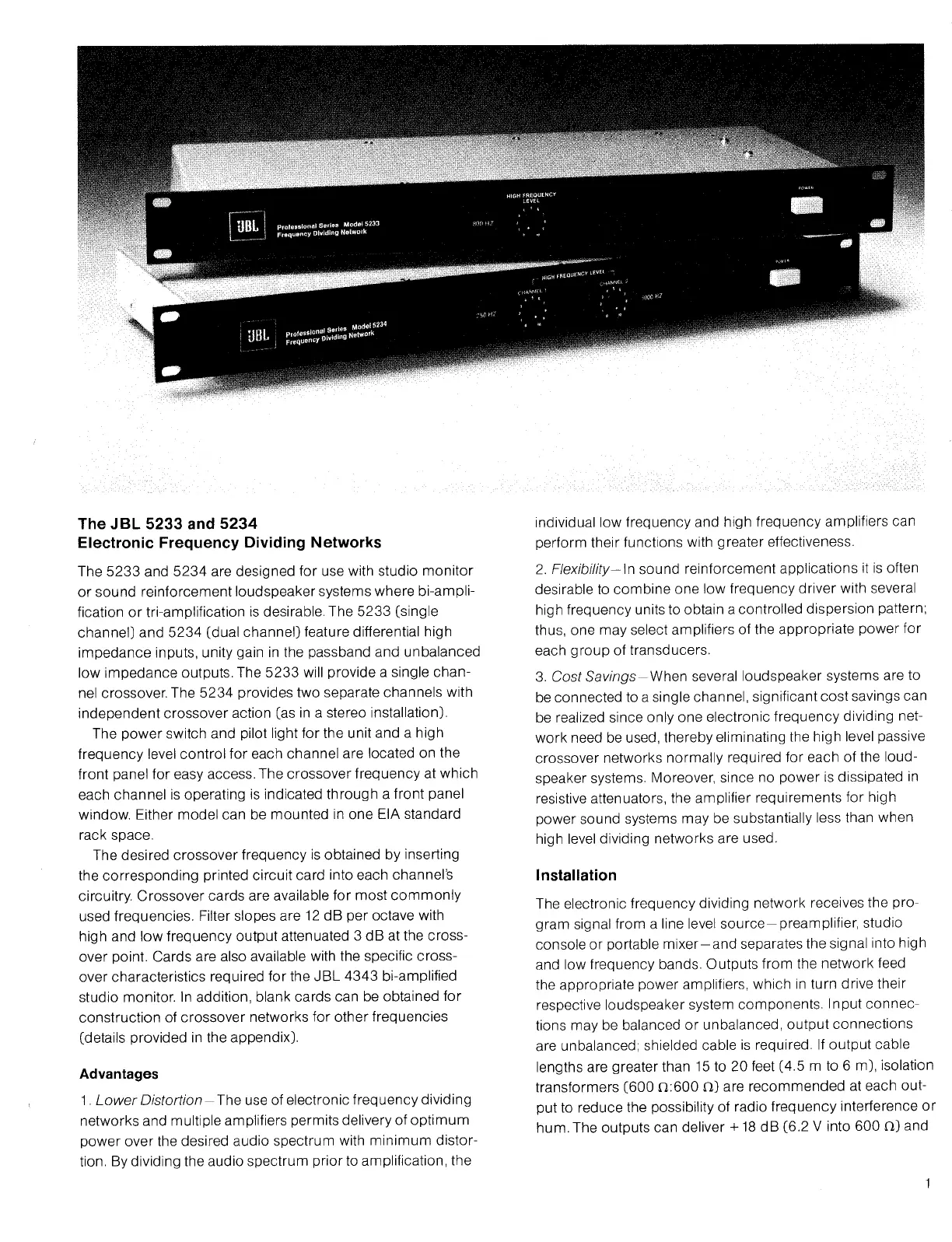
The 5233 and 5234 are designed for use with studio monitor
or sound reinforcement loudspeaker systems where bi-ampli-
fication or tri-amplification is desirable. The 5233 (single
channel) and 5234 (dual channel) feature differential high
impedance inputs, unity gain in the passband and unbalanced
low impedance outputs. The 5233 will provide a single chan-
nel crossover. The 5234 provides two separate channels with
independent crossover action (as in a stereo installation).
The power switch and pilot light for the unit and a high
frequency level control for each channel are located on the
front panel for easy access. The crossover frequency at which
each channel is operating is indicated through a front panel
window. Either model can be mounted in one EIA standard
rack space.
The desired crossover frequency is obtained by inserting
the corresponding printed circuit card into each channel's
circuitry. Crossover cards are available for most commonly
used frequencies. Filter slopes are 12 dB per octave with
high and low frequency output attenuated 3 dB at the cross-
over point. Cards are also available with the specific cross-
over characteristics required for the JBL 4343 bi-amplified
studio monitor. In addition, blank cards can be obtained for
construction of crossover networks for other frequencies
(details provided in the appendix).
Advantages
1.
Lower
Distortion-The use of electronic frequency dividing
networks and multiple amplifiers permits delivery of optimum
power over the desired audio spectrum with minimum distor-
tion.
By dividing the audio spectrum prior to amplification, the
individual low frequency and high frequency amplifiers can
perform their functions with greater effectiveness.
2.
Flexibility— In sound reinforcement applications it is often
desirable to combine one low frequency driver with several
high frequency units to obtain a controlled dispersion pattern;
thus,
one may select amplifiers of the appropriate power for
each group of transducers.
3.
Cost
Savings
-When several loudspeaker systems are to
be connected to a single channel, significant cost savings can
be realized since only one electronic frequency dividing net-
work need be used, thereby eliminating the high level passive
crossover networks normally required for each of the
loud-
speaker systems. Moreover, since no power is dissipated in
resistive attenuators, the amplifier requirements for high
power sound systems may be substantially less than when
high level dividing networks are used.
Installation
The electronic frequency dividing network receives the pro-
gram signal from a line level source —preamplifier, studio
console or portable mixer-and separates the signal into high
and low frequency bands. Outputs from the network feed
the appropriate power amplifiers, which in turn drive their
respective loudspeaker system components. Input connec-
tions may be balanced or unbalanced, output connections
are unbalanced; shielded cable is required. If output cable
lengths are greater than 15 to 20 feet (4.5 m to 6 m), isolation
transformers (600
n:600
n) are recommended at each out-
put to reduce the possibility of radio frequency interference or
hum.
The outputs can deliver +18 dB (6.2 V into 600 n) and
1


 To Next Page
 Loading...