Conventional Passive Networks
LOUDSPEAKER
SYSTEM
r
1
PROGRAM
SOURCE
LOUDSPEAKER
SYSTEM
PROGRAM
SOURCE
ONE
AMPLIFIER
PASSIVE
FREQUENCY
DIVIDING
NETWORK
Two-Way System
ONE
AMPLIFIER
PASSIVE
FREQUENCY
DIVIDING
NETWORKS
Three-Way System
Electronic Networks
LOUDSPEAKER
SYSTEM
Two-Way System with Single Channel Active Crossover
PROGRAM
SOURCE
THREE
AMPLIFIERS
Three-Way System with Dual Channel Active Crossover
will drive the line inputs of conventional amplifiers. Two or
more power amplifiers can be driven from each output.
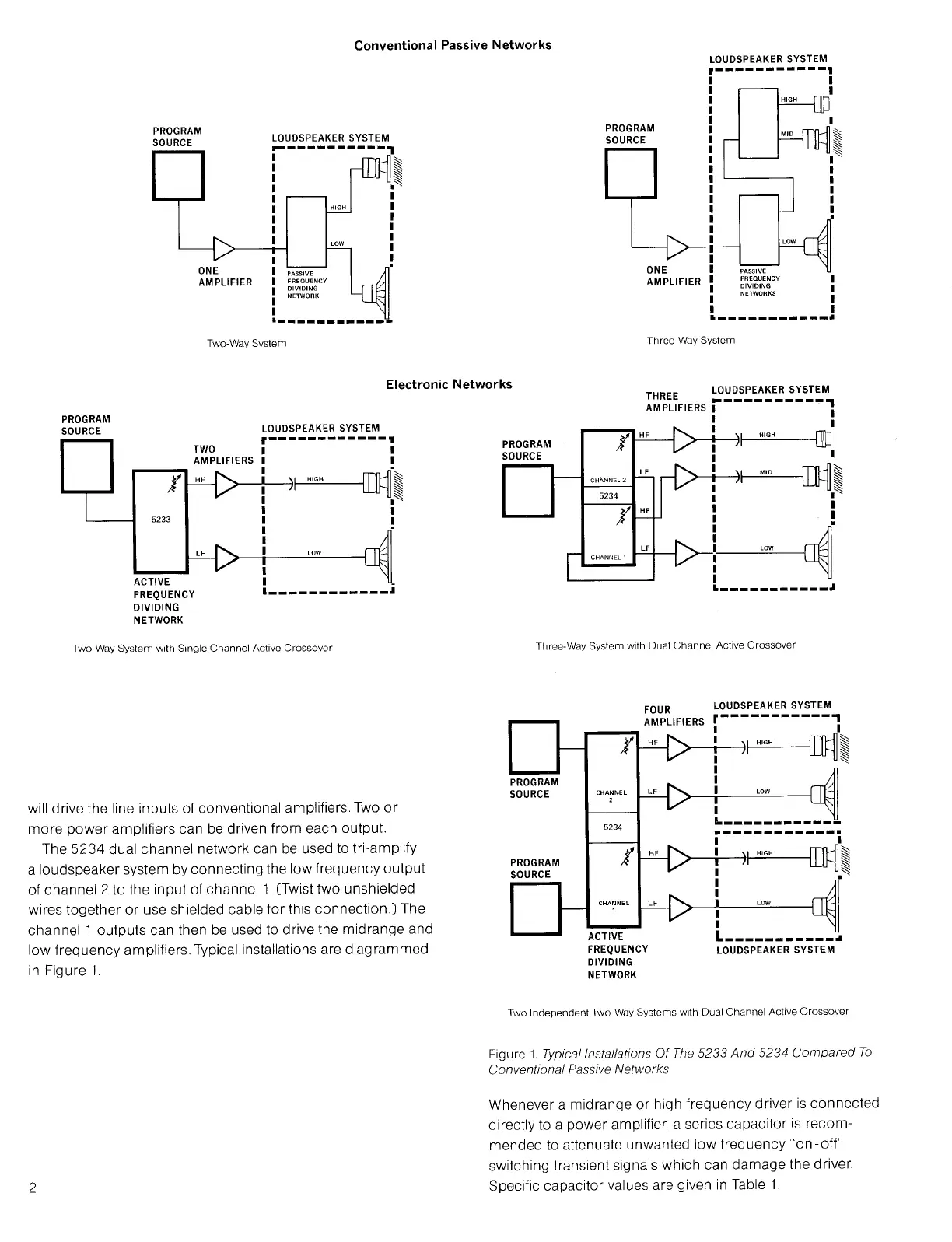
The 5234 dual channel network can be used to tri-amplify
a loudspeaker system by connecting the low frequency output
of channel 2 to the input of channel 1. (Twist two unshielded
wires together or use shielded cable for this connection.) The
channel 1 outputs can then be used to drive the midrange and
low frequency amplifiers. Typical installations are diagrammed
in Figure 1.
PROGRAM
SOURCE
PROGRAM
SOURCE
LOUDSPEAKER
SYSTEM
FOUR
AMPLIFIERS
ACTIVE
FREQUENCY
DIVIDING
NETWORK
LOUDSPEAKER
SYSTEM
Figure 1. Typical Installations Of The 5233 And 5234 Compared To
Conventional Passive Networks
Whenever a midrange or high frequency driver is connected
directly to a power amplifier, a series capacitor is recom-
mended to attenuate unwanted low frequency "on-off"
switching transient signals which can damage the driver.
Specific capacitor values are given in Table 1.
HIGH
LOW
HIGH
MID
LOW
PROGRAM
SOURCE
TWO
AMPLIFIERS
ACTIVE
FREQUENCY
DIVIDING
NETWORK
HIGH
LOW
CHANNEL 2
5234
CHANNEL 1
HIGH
MID
LOW
LOUDSPEAKER
SYSTEM
CHANNEL
2
5234
CHANNEL
1
HIGH
LOW
HIGH
LOW
Two Independent Two-Way Systems with Dual Channel Active Crossover


 To Next Page
 Loading...