performance characteristics in
a
reverberation-free
environment.
Since most listening rooms
possess
varying
degrees
of reverberation, some adjustment
of
the controls
is
usually preferred.
The loudspeaker system should
be
adjusted while
reproducing normal program material
with
the
amplifier
tone controls set
at
the middle (generally
referred to
as
"flat") position. Begin by placing both
of
the loudspeaker system controls
at
the reference level
and listening to
a
variety of program material long
enough to
become
accustomed to the system's
performance.
After
the ear has
become
attuned to the "0" setting,
evaluate the
presence
and brilliance qualities of the
loudspeaker's performance. The most valid evaluation
will
be
obtained using various types of material played
monaurally.
(This can
be
accomplished in stereo
or
quadraphonic installations by setting the amplifier mode
control
for monaural reproduction and using the balance
control
to
select
the individual loudspeaker system to
be
adjusted.) The evaluation should
be
made while seated
in
the normal listening position.
To
arrive
at
the specific setting for
each
of the
loudspeaker system controls, proceed
as
follows:
1.
Set the
Presence
control
at "0"
and rotate the
Brilliance
control to the extreme left of its travel. This
will
attenuate high frequency performance
so
that the
ear
will
perceive only the balance between the low
frequency loudspeaker and the midrange transducer.
2. If midrange material —such
as
violin,
piano,
or
guitar
—seems
too
close
or overemphasized, reduce the
setting
of the
Presence
control by rotating it to the left.
Conversely, if midrange material
seems
too distant,
increase the output of the midrange transducer by
rotating
the control clockwise.
7
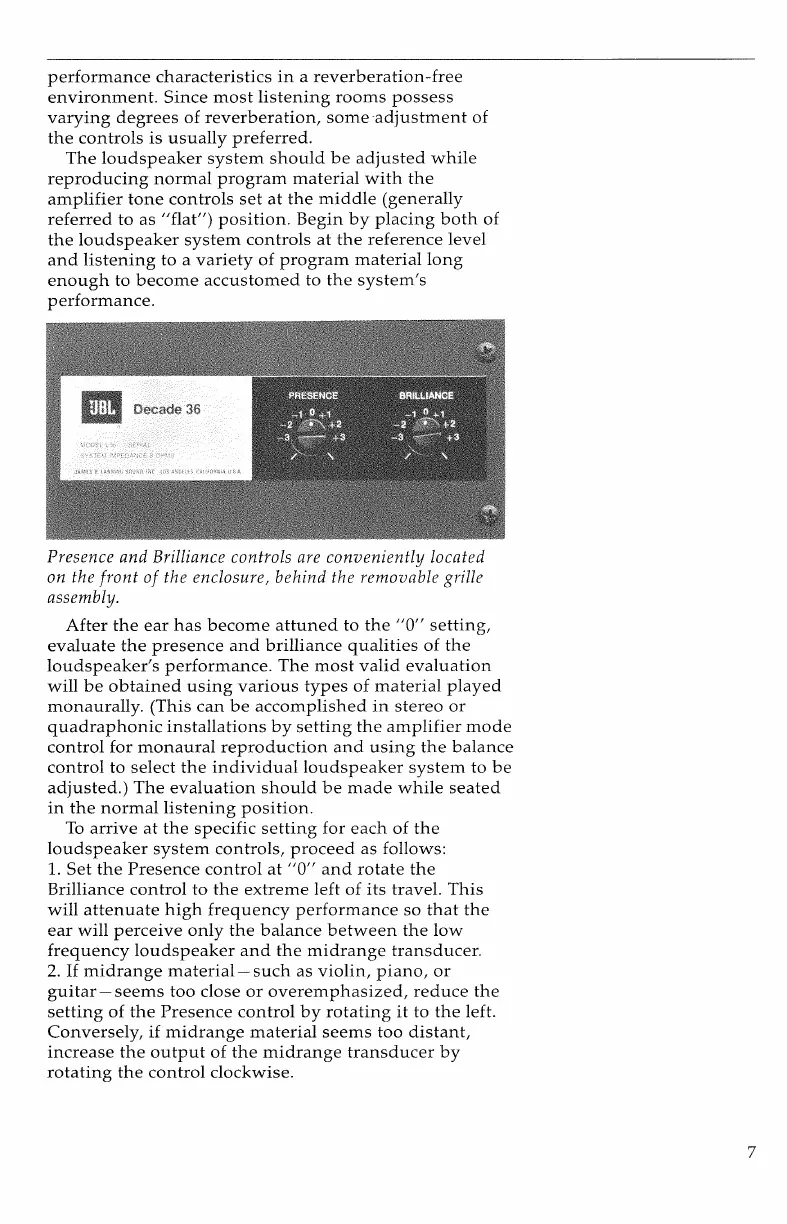
Presence and Brilliance controls are conveniently
located
on the front of the enclosure,
behind
the
removable
grille
assembly.



 To Next Page