49
GB
CO
2
Direct Test Set
Special features:
The JBL CO
2
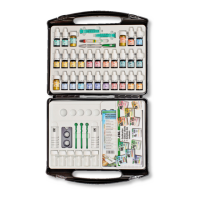
Direct Test Set is designed for quick and accurate determination of the carbon dioxide content in
aquarium water.
Why test?
Carbon dioxide (CO
2
) is the most important plant nutrient. Aquarium water usually has values between 2 and 4
mg/l if no carbon dioxide is added. However, a CO
2
concentration between 20 and 35 mg/l is recommended, with
20 - 25 mg/l having proven to be optimum levels. This level is not harmful to sh whilst at the same time promoting
luxuriant plant growth. Therefore, gradually adjust your CO
2
fertilisation unit until this level is attained.
The amount of CO
2
which needs to be added to your CO
2
fertilisation unit to achieve this value depends on
various factors. These factors include water agitation and the intensity of illumination (more light causes plants
to grow faster, thereby increasing the required CO
2
) in addition to direct consumption by plants. Thus the
correct dose must be determined individually for each aquarium. You can nd out more on this by reading the
instructions for use of your CO
2
fertilisation unit.
Tanks with few or no plants such as those preferably used to keep sh from Lake Malawi or Lake Tanganyika do
not need to be supplied with additional CO
2
.
Remedial measures for fresh water:
Carbon dioxide concentration too low: < 20 mg/l. Add carbon dioxide with JBL ProFlora bio (CO
2
from natural
production by microorganisms). Use a JBL ProFlora CO
2
fertilisation system to add the CO
2
.
Carbon dioxide concentration too high: > 35 mg/l. There is a need for remedial action if the sh breathe
noticeably faster and hang around the water surface. In this case, aerate the tank by using a JBL ProSilent
diaphragm pump.
Reduce the supply of CO
2
. In the event of acute carbon dioxide poisoning, perform a 50 % a water change.
Instructions for use of the CO
2
Test Set direct in fresh water:
1. Rinse both measuring tubes with the tank water several times.
2. Rinse the syringe with the water which is to be tested.
3. Use the enclosed syringe to ll the measuring tubes with 20 ml of tank water. Make sure that no bubbles
form when the sample water is added.
4. Place the measuring tubes on the two circles of the enclosed colour chart.
5a. Add 5 drops of Reagent 1 to the measuring tube which is on the white circle and shake gently.
5b. Then add Reagent 2 drop by drop to the measuring tube, shaking the tube gently after every drop. Count
the drops until the water turns a pink colour which corresponds to the measuring tube on the other coloured
circle. Look into the measuring tubes from above when comparing the colours.
5c. Add the drops of Reagent 2 drop by drop until the colour remains stable for at least 60 seconds.
6. Every drop corresponds to 2 mg/l of carbon dioxide in the water. The number of drops x 2 equals the carbon
dioxide concentration in mg/l.
As other acids in the tank water also interfere with the measurement, the blank value must be subtracted from
the measured value to obtain an accurate value. The blank value can be determined by taking a water sample
of 100 ml of tank water and aerating it with a JBL ProSilent diaphragm pump with an air stone for 15 minutes.
Then measure the blank value in accordance with the above-mentioned instructions.
Result 1 – blank value = actual carbon dioxide concentration in mg/l.
Please observe the safety instructions!
You will also nd easy-to-follow pictographic instructions on the reverse side of the colour chart.
Our tip for ecologically minded users:
All reagents for the JBL Test Sets are commercially available as reasonably priced rells!


 To Next Page
 Loading...