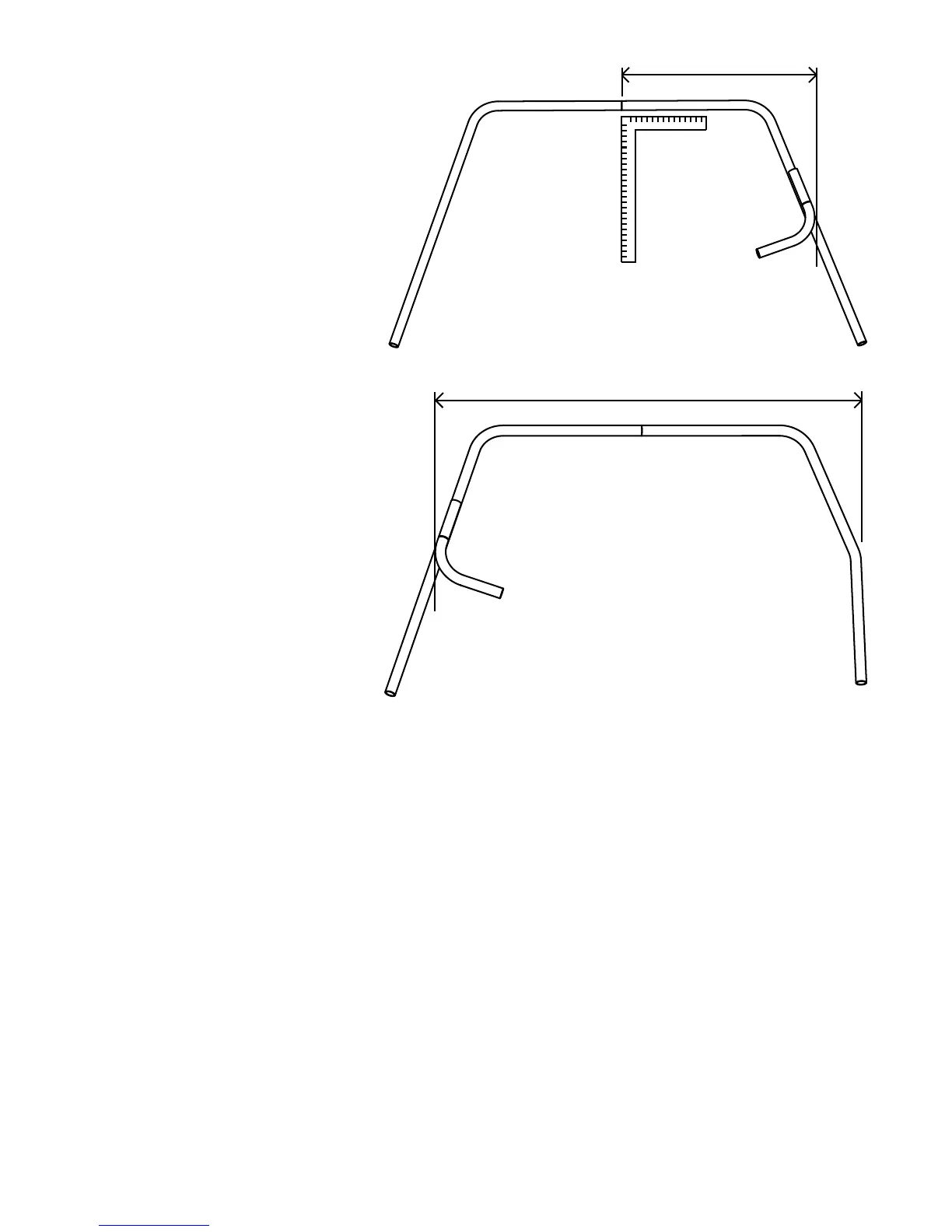
Figure 23 - 3rd bend position
Figure 24 - 4th bend position
BEND 3:
At this step you may want to use
alarge90
o
square to help position the
template. Position the template above
the rollbar tube with the template line
facing up towards the top of the rollbar
asshowningure23.Slidethetemplate
up or down the rollbar tube until its
outside is 31” from the rollbar’s center.
Mark your tube and make the bend.
BEND 4:
Position the template with the
template line facing up towards the
top of therollbar asshown ingure
24. Slide the template up or down the
rollbartubeuntilitsoutsideis62”from
theoutsideofthe3rdbend.Also,verify
the bend is the same distance down
the tube from the top of the rollbar. If
all is correct mark the tube and make
the bend.
Lastly, cut the ends of the tube
tomaketherollbar40”talland your
done.
Finished!
PROCEDURE FOR SETTING UP A PRODUCTION BENDER USING THE TEMPLATE METHOD
AsIstatedearlier,thismethodcanbeusedforproductionbending.Theideaofmakingthebends
from the center out doesn’t usually work well in production. Most production bending is done by feeding
thetubethroughthebenderandmakingeachbendasneeded,therebyeliminatingtheneedtoremove
thetubefromthebenderandipitaround.Forthisyouwouldwantasetupsheetwiththelocationsof
where to place the marks on the tubing for each bend location. The problem with template bending is that
the template has the tube stretch and springback already in it. Since the tubing will grow in length as you
makebendsinit,howcanyoumeasureitaccuratelyonceit’sbent?Unfortunately,youcan’t.Whatyou
mustdoisplacemarksdownthetube,forexample10”apart,startingattheoneendbeforeyoustart
bending.Nowwheneveryoutransferthemarkfromthetemplatetothetubebeingbentyoucaneasily
measurethedistancefromoneofthe10”markstodeterminewherethemarkwouldofbeenplacedon
an unbent piece of tube.
- 11 -


 To Next Page
 Loading...