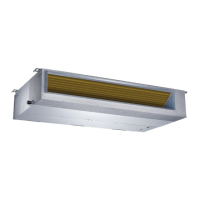
This document describes the Johnson JDMV3 series duct-type air conditioning unit, providing comprehensive information on its function, technical specifications, usage, and maintenance.
Function Description:
The Johnson JDMV3 is a duct-type air conditioning system designed for cooling and heating various indoor environments. It operates by circulating refrigerant through indoor and outdoor units, delivering conditioned air through a duct system. The unit is available in different capacities, indicated by BTU/h (fg/h) ratings, and supports both single-phase and three-phase power supplies, depending on the model. It can be configured for either low or middle pressure applications, offering flexibility in installation. The system is designed to provide efficient temperature control and can be integrated with wired or wireless remote controllers for user convenience.
Important Technical Specifications:
The manual provides detailed tables for various technical specifications, including:
- Refrigerant Type and Charge: The unit uses flammable refrigerants, specifically R410A and R32, with specific charge amounts depending on the pipe length and model. The maximum charge in a room and the minimum required floor area (Amin) are calculated based on formulas involving the lower flammable limit (LFL), release height (h0), and room area (A). For R32 models, minimum room sizes are specified based on refrigerant quantity (m) and Amin.
- Pipe Dimensions: The document specifies the required diameters for liquid and gas connecting pipes, including Φ6.35 (1/4"), Φ9.52 (3/8"), Φ12.7 (1/2"), Φ16 (5/8"), Φ19 (3/4"), and Φ22 (7/8").
- Pipe Length and Drop Height: Maximum pipe lengths and drop heights are provided based on BTU/h capacity, ranging from 15m (49ft) to 75m (246ft) for length and 8m (26ft) to 30m (98.4ft) for drop height, depending on the model and refrigerant type. Oil traps are recommended for vertical suction line risers to prevent liquid compression or oil return deterioration.
- Electrical Specifications: Minimum cross-sectional areas for power and signal cables are given, ranging from 0.75 mm² for currents up to 6A to 6 mm² for currents up to 40A. Power supply specifications (phase, voltage, and circuit breaker/fuse amperage) are detailed for various indoor and outdoor unit models, covering both independent and inverter-type A/C systems. Voltages typically range from 208-240V for single-phase and 380-420V for three-phase.
- Static Pressure: The maximum functional total external static pressure should not exceed 0.80 in WC or 200 Pa.
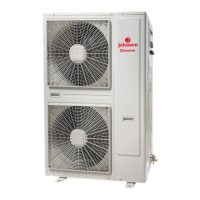
- Dimensions: Detailed diagrams and tables provide outline dimensions for indoor units (low and middle pressure models) and outdoor units, as well as dimensions for air outlet, air inlet, and mounted lugs. These dimensions are crucial for proper installation and maintenance access.
Usage Features:
- Operating Modes: The unit supports various operating modes, including AUTO, FORCED COOL, OFF, COOL, HEAT, and DRY. The manual button allows cycling through AUTO, FORCED COOL, and OFF.
- Temperature Ranges: Operating temperature ranges for both indoor and outdoor units are specified for COOL, HEAT, and DRY modes. For example, indoor temperature ranges from 17°C - 32°C (62°F - 90°F) in COOL mode, and outdoor temperature from 0°C - 50°C (32°F - 122°F). Special considerations are given for tropical models and low-temperature cooling systems.
- Remote Control: The system can be controlled via wired or wireless remote controllers.
- Safety Protections: The unit incorporates safety features that may activate and disable the unit if operating conditions fall outside specified temperature ranges. A 3-minute protection feature prevents compressor overload.
- Error Codes: The indoor unit display can show error codes (e.g., E(x), P(x), F(x), EH(xx), EL(xx), EC(xx), PH(xx), PL(xx), PC(xx)) to indicate malfunctions.
Maintenance Features:
- Cleaning: Regular cleaning of the indoor unit is recommended using a soft, dry cloth or a cloth soaked in warm water. Combustible cleaning agents, benzene, paint thinner, or polishing powder should not be used. Filters should be cleaned, and metal parts should be handled with care to avoid injury.
- Pre-Season Inspection: Before periods of frequent use, it's advised to check for damaged wires, leaks, and ensure air inlets and outlets are unobstructed.
- Long Periods of Non-Use: If the unit will not be used for an extended time, it should be turned off, disconnected from power, and the FAN function should be run until the unit is completely dry.
- Motor and Drain Pump Maintenance: The manual provides instructions for disassembling and maintaining the motor and drain pump, including removing panels, blower housing, and disconnecting electrical cables.
- Troubleshooting: A detailed troubleshooting section helps identify common issues (e.g., unit not turning on, unusual noises, poor cooling/heating performance, remote control issues) and provides possible causes and solutions. It emphasizes contacting an authorized service provider for persistent problems.
- Refrigerant Handling: Strict precautions are outlined for handling flammable refrigerants, including using appropriate tools, preventing contamination, ensuring proper earthing, and avoiding overfilling cylinders. Recovery and evacuation procedures are detailed, emphasizing the use of inert gas and calibrated equipment.
- Electrical Safety: All electrical work must comply with local and national codes, be performed by a licensed electrician, and ensure proper grounding and secure connections to prevent overheating, fire, or electrical shock. The main power to the system must be turned off before any electrical work.
- Drainage System: Proper installation and maintenance of the drainpipe are crucial to prevent water leakage and damage. The drainpipe should be insulated, sloped downwards, and supported to prevent sagging.
- Storage: The unit should be stored in a well-ventilated area, protected from mechanical damage, and in compliance with transport regulations.

 Need help?
 General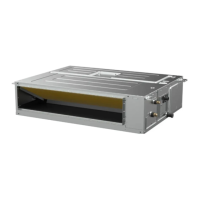

 To Next Page