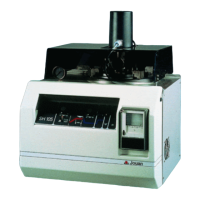
This document is a service manual for the Jouan C3i and CR3i centrifuges.
Function Description
The C3i and CR3i centrifuges are designed for laboratory use, specifically for relative centrifugal force (RCF) applications where elements of different density need to be separated. The CR3i model is a refrigerated version, utilizing R134a refrigerant without CFC, making it environmentally friendly. The core operation of these centrifuges is controlled by a microprocessor system, which manages various aspects including operating modes, generation of alternating current amplitude and frequency, adjustable components for motor speed servo, temperature regulation (for CR3i), and safety devices such as lid lock, zero speed detection, imbalance detection, and motor overtemperature detection. It also handles fault diagnosis.
The microprocessor system, along with a power PCB, forms the electronic core, with three distinct zones identified on the PCB. Zone 1 contains the microprocessor, EPROM, and RAM, managing program parameters. Zone 2 handles signal conformity and controls the lid lock and refrigeration group commands. Zone 3 is isolated and manages the power system, including the 15 VDC power supply for control electronics, the IGBT module, PWR commands, the brake IGBT, and the diode bridge.
The motor control principle for both C3i and CR3i centrifuges involves an asynchronous 3-phase motor, generating sinusoidal 3-phase voltages in amplitude and frequencies. During braking, energy from the rotating parts is commuted across a resistance. The motor is a 3-phase stator and a short-circuited rotor, creating a magnetic field rotating at the synchronized speed Ns = F/p (where F is supply frequency and p is the number of poles). The induced currents in the rotor create forces that drive the rotor, and the relative speed between the rotor and stator determines the speed at which the field is created at the stator. The difference (s) between the synchronized speed Ns and the actual speed N of the rotor is called the slippage.
Important Technical Specifications
Dimensions and Weight:
- C3i: 372 x 400 x 495 mm, 40 kg / 52 kg (uncrated / crated)
- CR3i: 375 x 575 x 605 mm, 72 kg / 85 kg (uncrated / crated)
Electrical Specifications:
- Mains supply: 220/240 VAC 50 Hz or 120 VAC 60 Hz
- Max power: C3i: 500 W, CR3i: 800 W
- Average power: C3i: 350 W, CR3i: 550 W
- Refrigeration (CR3i only): 235 W
Performance:
- Max speed: Swing-out: 4 000 rpm (C3i), 4 100 rpm (CR3i); Angle: 14 000 rpm
- Max RCF: Swing-out: 3 082 x g (C3i), 3 082 x g (CR3i); Angle: 18 407 x g
- Max capacity: Swing-out: 4 x 280 ml; Angle: 6 x 100 ml
- Microprocessor controlled: Yes
- Display: High visibility digital display
- Memory size: 5 programs, direct access
- Program protection: Recall key lock
- Speed range: 500 to 14 000 rpm (10-100 rpm accuracy, ± 20 rpm)
- Timer range: 30 sec to 99 min + hold position (30 sec to 1 min accuracy)
- Acceleration rates: 5
- Braking rates: 5
- Temperature (CR3i): -9°C to +40°C (± 1.5°C accuracy)
- Typical performance: 4°C at 4 000 rpm (4 x 280 ml swing-out), 1°C at 14 000 rpm (20 x 1.5 ml angle)
- Maximum density: 1.2 g/cm³
- Maximum energy: 14 400 J
Usage Features
The centrifuges feature an intuitive user interface with a membrane keyboard and three digital displays. Operational parameters are easily set and monitored. Safety is a key aspect, with features like lid lock, zero speed detection, and imbalance detection to prevent unsafe operation. The CR3i model offers precise temperature control for sensitive samples.
Installation requires a stable, rigid bench capable of supporting the centrifuge's weight. Adequate clearance (at least 30 cm) around the rear panel is necessary for proper air circulation and heat dissipation from the condenser.
The centrifuges include a diagnostic menu accessible via the keyboard and display, which helps in identifying possible breakdowns and error codes. Error codes (ERR 1 to ERR 10) indicate specific issues such as speed errors, lid problems, imbalance, motor overtemperature, and operating anomalies.
Maintenance Features
The service manual provides detailed procedures for replacement of various components and calibration. Maintenance should only be performed by qualified personnel.
Replacement Procedures:
- Motor Replacement: Involves dismounting the front panel, disconnecting cables, removing the bowl, and detaching the motor. Refitting is the reverse process.
- Imbalance Detector Replacement: Similar to motor replacement, involving removal of the front panel, bowl, and disconnecting the detector.
- Lid Lock Assembly Element Replacement: Covers replacement of the lid lock microswitch and solenoid.
- Power Supply Rack Replacement: Involves removing the front panel, unscrewing the transformer, and disconnecting all electrical connections.
- Refrigeration Board Replacement (CR3i): Requires disconnecting the board from the supply rack and removing screws.
- Electronic Board Replacement (Microprocessor + Power PCB): Involves removing the front panel, disconnecting cables, and unscrewing the board.
- Display Board and Keyboard Replacement: Involves unscrewing the display board and detaching the keyboard.
- Gas Spring Replacement: Requires opening the lid, removing the supply rack panel, and detaching the gas spring.
- Tacho Replacement: Involves unscrewing the shock absorber and the optical sensor.
- EPROM Replacement: Requires careful extraction and insertion of the EPROM chip using a proper extractor tool to avoid damage.
- Lid Replacement: Involves opening the lid, extracting the pin binding the gas spring and lid, and unscrewing the hinge.
- Refrigeration Group Repairs (CR3i): Comprehensive procedure including disconnecting cables, removing the lid, motor, front panel, supply rack, compressor, and separating the centrifuge walls.
- Condenser Components Replacement: Involves accessing the refrigeration group and dismounting specific components like the fan block.
- Motor Checking: Includes checking electrical circuit integrity, continuity between phases, and resistance values.
- Checking and Maintenance of the Centering Group: Focuses on the correct positioning of washers, free movement along the centering core shaft, and proper greasing of the washer.
Calibration Procedures:
- Imbalance Adjustment: Involves an adjustment procedure where the EPROM's imbalance threshold value is set to 350. This requires running a test cycle and observing the vibration peak.
- Temperature Sensor Calibration (CR3i): Involves removing the front panel, taking the J5 connector of the temperature sensor, and performing a test to calibrate the temperature display to 37°C.
Diagnostic and Test Modes:
- Functional Test: Allows for various tests using the keyboard and display, protected by an access code.
- EPROM Version Check: Displays the EPROM index letter on the temperature display.
- Test Mode: Accessible by a combination of keys, allowing for acceleration and braking programming.
- Temperature Probe Calibration and Other Tests: Includes calibrating the temperature probe, tachometer test, lid solenoid test, resetting programs, and complete program resetting in RAM.
- Calibration of Imbalance Detection Threshold: Sets the imbalance threshold to 350 and allows for checking actual rotating speed and maximum imbalance reading.
- Run Linking: Allows for running a sequence of preset runs.
- Statistical Analysis: Displays total running hours, number of runs, and number of runs above 5000 rpm.
The manual also includes a list of recommended tools for standard maintenance and electrical diagrams for various versions of the centrifuges.

 Need help?
 General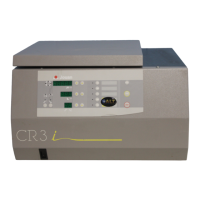

 To Next Page