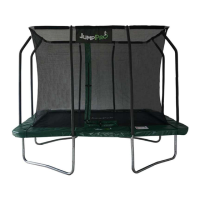
This document is an assembly and maintenance manual for a JumpPRO Xtra Rectangular Trampoline with Enclosure and Ladder.
Function Description
The JumpPRO Xtra Rectangular Trampoline is designed for recreational use, providing a safe and enjoyable jumping experience. It includes an enclosure net for added safety and a ladder for easy access. The trampoline is intended for outdoor use only.
Important Technical Specifications
The trampoline is available in three sizes:
- 23ft x 10ft: 701x305x285CM
- 17ft x 10ft: 518x305x285CM
- 15ft x 8ft: 457x244x285CM
Key specifications include:
- Max user weight: 180kg
- Recommended age: 6+ years
- Frame: Constructed from steel, featuring various top rails, middle sections, and leg sections.
- Jumping Mat: Made of a durable material, attached to the frame with springs.
- Springs: Number of springs varies by model: 156 (23ft x 10ft), 124 (17ft x 10ft), 112 (15ft x 8ft).
- Enclosure: Includes a safety net, bottom pole tubes, upper pole tubes (curved at the top), pole caps, fiberglass rods (long and short), and corner fiber rod connectors.
- Ladder: Provided for safe access to the jumping mat.
- Assembly Tools (not supplied): Gloves, safety glasses, and a mallet are recommended for assembly. A special spring loading tool (item M) and an offset screwdriver (item Y) are provided.
Usage Features
The trampoline is designed for various jumping activities, with specific instructions for fundamental bounce, knee drop, seat drop, and front drop. Users should always jump in the middle of the jump mat and avoid exiting by a jump. Somersaults, risky landing, or head/neck injury are serious risks, and users should limit the time of continuous usage to avoid regular stops.
Safety Guidelines:
- Always ensure the trampoline is assembled in accordance with the instructions and checked before first use.
- Adult supervision and guidance are required at all times during use.
- Only one user should be on the trampoline at a time.
- Always close the net opening before jumping.
- Jump without shoes.
- To prevent accidents due to slipping, do not use the trampoline when the mat is wet.
- Empty pockets and hands before jumping.
- Do not eat while jumping.
- Do not use in strong wind conditions.
- The trampoline should not be buried into the ground.
- It is recommended to place the trampoline on a flat and level surface at least 2 m from any structure or obstruction such as a fence, garage, house overhanging branches, laundry lines, or electrical wires.
- Trampolines shall neither be installed over concrete, asphalt, or any other hard surface nor at proximity of other conflicting installations (e.g., padding pools, swings, slides, climbing frames).
- Modifications made by the consumer to the original trampoline (e.g., the adding of an accessory) shall be carried out according to the instructions of the manufacturer.
- A certified trampoline instructor should be contacted to further develop your trampoline skills.
Maintenance Features
Regular checks and maintenance are crucial for the safe operation and longevity of the trampoline.
Pre-use Checks:
- Attention to the need to carry out checks and maintenance of the main parts (frame, suspension system, mat, padding, and enclosure) at the beginning of each season and also at regular intervals. If these checks are not carried out, the trampoline could become dangerous.
- Check all nuts and bolts for tightness and tighten when required.
- Check that all spring-loaded (pit pin) joints are still intact and cannot become dislodged during play.
- Check all coverings and sharp edges and replace when required.
- Retain the maintenance instruction manual.
- Outdoor trampolines should be equipped with a device that in strong wind conditions avoids displacement due to wind (e.g., steel bars in the ground or loads like sandbag or water bags) and/or items catching wind like net and mat should be removed.
- In certain countries during winter periods, the snow load and the very low temperature can damage the trampoline. It is recommended to remove the snow and store the mat and the enclosure indoor.
- Check that mat, padding, and enclosure are without defects.
Ongoing Maintenance:
- Sunlight, rain, snow, and extreme temperatures: Reduce the strength of these parts over time.
- Inspect the trampoline and the netting for defects: Reduce use every time. Tighten up fittings and check regularly that all ties have been tied correctly. Replace the net after 1 year of use.
- Hook-and-loop fasteners: Make sure that the hook-and-loop fasteners are closed correctly during use of trampoline.
- Trampoline and net: Should be packed away in winter. Make sure all parts are dry and packed securely. Store dry. Always be aware of wear and tear due to weather and wind.
- Securing the trampoline in strong winds: Tie the trampoline down with ropes attached to the trampoline top rail. Tie the trampoline down in a minimum of three places distributed evenly across the trampoline frame.
- Disassemble and dismantle: Do not secure the legs as these may become misaligned and damage the trampoline. Dismantle or remove the trampoline completely, if required. It may result in great danger if the trampoline is not secured in strong winds.
Moving the Trampoline:
- If the trampoline and enclosure needs to be moved, it should be moved by a minimum of two people, kept horizontal and lift slightly.
- If necessary, the trampoline and enclosure can be taken apart for moving. To take the trampoline apart, follow the assembly steps in reverse order.
Spare Parts:
To order replacement parts, contact customer service. Information required includes product description, item ID, and item description (refer to pages 6-8 of the manual). Contact details for customer service are provided: Phone: 01342 776 488, Email: sales@trampolines.co.uk, Working Days/Hours: Monday - Friday: 9am - 5pm.

 Need help?
 General

 To Next Page