3534
Following successful automatic synchronisation, the transmitter from
which the signal was picked up is permanently displayed. Thus if no signal
was picked up, no transmitter is displayed.
The date is always advanced automatically by the time signal. This process
also takes the 29th of February into account in leap years.
If all of the attempts at picking up a signal lead to no clear synchronisation,
the reception display is switched off (see also description of the ‘Reception
Display’ in section 6.3). On any such days without synchronisation, your
watch continues to run with the accuracy of a quartz timepiece, using the
internal time memory. As soon as the signal is picked up again successfully,
your watch is synchronised and the reception display is switched back on.
Recommendation: To ensure the best possible conditions for overnight
reception of the synchronisation signal, the watch should not be worn and,
if possible, not left near to any electrical appliances, mobile or cordless pho-
nes.
Important note:
When travelling into a different reception area (e.g. going from Germany to
Japan) no automatic time or thus transmitter synchronisation occurs until
the watch’s next attempt to pick up a signal. If the watch fails to pick up any
transmitter signal, please perform a manual transmitter call (see section 6.4
on manual synchronisation).
4. Functions
Please note: Depending on the model, your Junghans radio-controlled watch
is equipped with buttons or recessed correctors. Please use a suitable poin-
ted object to operate the recessed correctors.
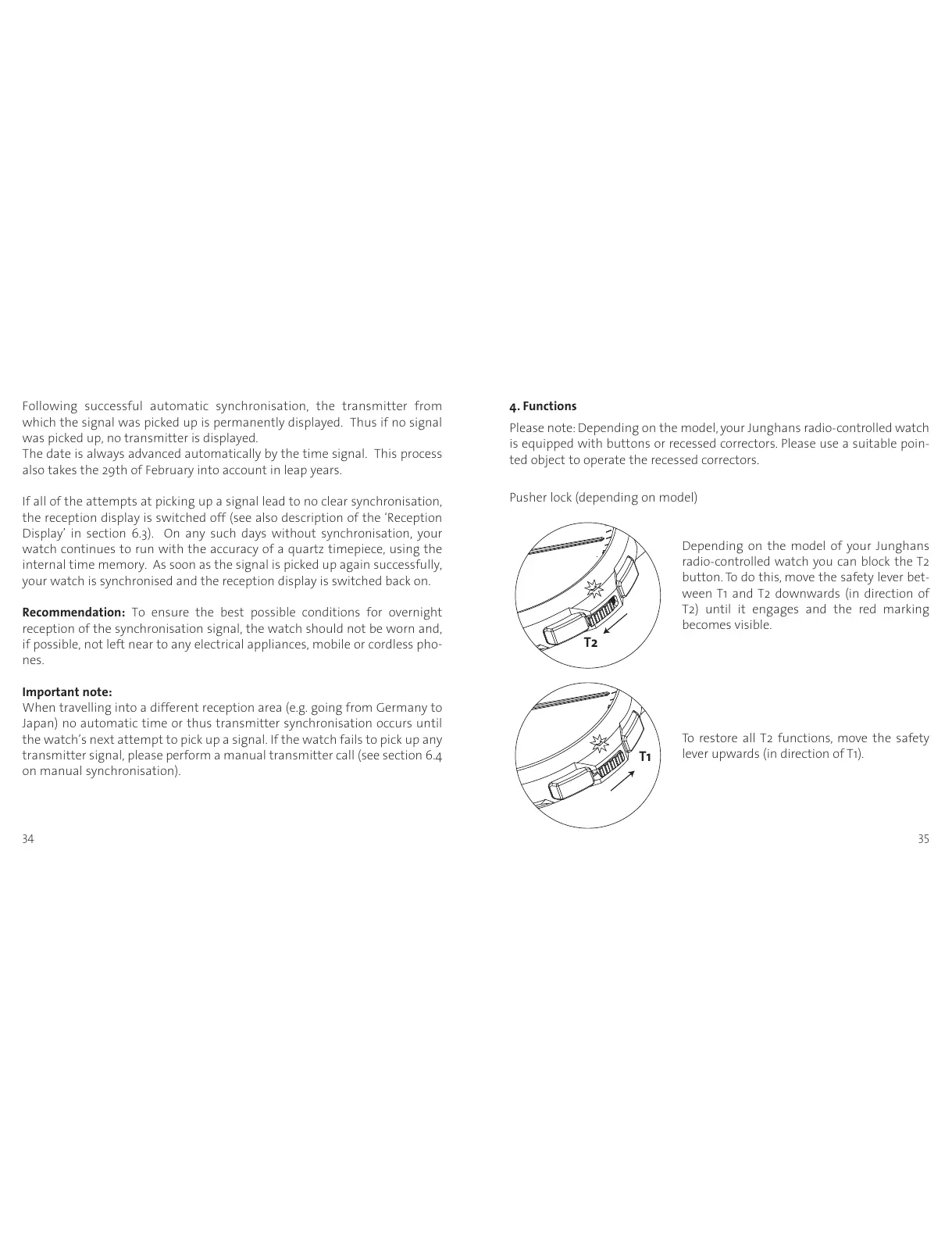
Pusher lock (depending on model)
Depending on the model of your Junghans
radio-controlled watch you can block the T2
button. To do this, move the safety lever bet-
ween T1 and T2 downwards (in direction of
T2) until it engages and the red marking
becomes visible.
To restore all T2 functions, move the safety
lever upwards (in direction of T1).



 To Next Page