3938
Pressing the T1 button resets the counter to [C0:00]. Please note: The reset
function can only be operated if the stopwatch function has first been paused.
6.2 2
nd
time
The 2
nd
time function gives you the option, independent of the analogue
time, to have another time shown on the LCD display (e.g. if you are on holi-
day in another time zone and want to see the time at home).
Press the T1 button repeatedly until the 2
nd
time is digitally displayed on the
LCD. The 2
nd
time can be set in 30-minute steps using the T2 button.
To do this, with the 2
nd
time displayed on the LCD, press the T2 button. The
2
nd
time starts to flash. Each press of the T2 button then lets you advance
the 2
nd
time by 30 minutes. If you hold down the T2 button, you can set the
2
nd
time in fast forward mode.
6.3 Reception display
The reception display shows you whether the watch has synchronised itself
with the signal from any of the four transmitters. This is shown by the posi-
tion of the bar in the LCD display. There are four possible displays:
DCF 77 (Europe)
WWVB (USA)
JJY 40 (Japan)
JJY 60 (Japan)
If the reception display is shown on the LCD, the watch has picked up the sig-
nal properly during the overnight automatic synchronisation. If all of the
reception times on the LCD display are switched off, this means that due to
poor reception conditions the watch was not able to synchronise automati-
cally. The next time that a signal is successfully picked up from one of the 4
transmitters, the reception display will be shown again.
6.4 Manual time synchronisation (transmitter calls)
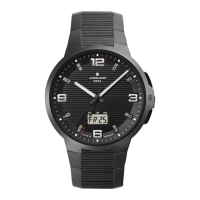
Your Junghans multi-frequency radio-controlled watch can also be synchro-
nised manually, by performing what is called a ‘transmitter call’.
You do this by pressing the T1 button for over 3 seconds. The second hand
starts to move and positions itself at 12 o’clock. In parallel with this, the hour
and minute hands continue to show the current time. The reception phase
then starts. The reception display flashes on the LCD for the transmitter
with which synchronisation last took place and, instead of the date, the
seconds [00] are now digitally displayed. Please hold the watch still or put it
down while the signal is being received.
If synchronisation with the transmitter is not possible, all of the other trans-
mitters are then checked for possible reception of any of their signals. As
soon as a signal has been picked up, the digital seconds on the LCD display
start to advance. When the watch has picked up the signal, the hands auto-
matically set themselves to the transmitter’s local time and the second hand
advances to the current second. On the LCD the date is shown and the
transmitter that was successfully received is represented by the correspon-
ding reception display.
Should you be in a time zone different from that of the transmitter that the
watch picked up, then after one-off synchronisation you will need to set the
applicable local time for that location using the time zone setting function.


 To Next Page
 Loading...