52
Exposure Control
Manual exposure control is recommended in the
following situations:
l
When shooting using reverse lighting or when the
background is too bright.
l
When shooting on a reflective natural background
such as at the beach or when skiing.
l
When the background is overly dark or the
subject is bright.
I
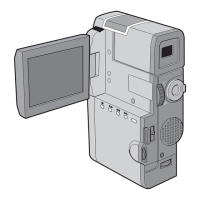
Set the Power Switch to “0” while pressing down
the Lock Button located on the switch. Open the
LCD monitor fully or pull out the viewfinder fully.
Press
EXPOSURE.
The exposure control
indicator appear.
Rotate the
MENU
Wheel towards “+” to
brighten the image, or towards O-” to darken
the image. (maximum *6)
1
Press the
MENU
Wheel in. Exposure
adjustment is complete.
To Return To Automatic Exposure Control . . .
. . .
press
EXPOSURE
twice or set the Power Switch to
‘D “.
(If
EXPOSURE
is pressed once, the camcorder
will enter the exposure control mode again.)
To Brighten The Subject Quickly. . .
. . .
press
BACKLIGHT.
q
is displayed and the
subject is brightened. If pressed again,
q
disappears and the brightness returns to the
previous level.
l
+3 exposure has the same effect as the
BACKLIGHT
Button.
l
Using
BACKLIGHT
Button may cause the light
around the subject to become too bright and the
subject to become white.
l
Backlight compensations is also available when
the Power Switch is set to u D “.
NOTL:
Backlight, spotlight (w pg. 47) compensation and
“SNOW (w pg. 47)” have no effect when the
manual exposure control mode is engaged.
Daxsar-r Switch
BACKLIGHT
BUttUll
EXP’OSURE Button
- MENU Wheel
Iris Lock
Use this function in the following situations:
l
When shooting a moving subject.
l
When the distance to the subject changes (so its
size in the LCD monitor or the viewfinder
changes), such as when the subject is backing
away.
l
When shooting on a reflective natural background
such as at the beach or when skiing.
l
When shooting objects under a spotlight.
l
When zooming.
When the subject is close, keep the iris locked.
Even when the subject moves away from you, the
image will not darken or brighten.
Before the following steps, perform steps 1 and 2
of “Exposure Control”.
Adjust zoom so that the subject fills the LCD
monitor or the viewfinder, then press and hold
the
MENU
Wheel for over 2 seconds. The
exposure control indicator and “0” appear.
Press the
MENU
Wheel in. “0” changes to
I
q
’ and the iris is locked.
Iris lock.indicator
To Return To Automatic Iris Control . . .
. ..press
EXPOSURE
twice so that the exposure
control indicator and “0” disappear. Or, set the
Power Switch to ti 0”.
To lock The Exposure Control And The iris . . .
. . . after step 2 of “Exposure Control”, adjust the
exposure rotating the
MENU
Wheel. Then lock
the iris in step 3 of “Iris Lock”. For automatic
locking, press
EXPOSURE
twice in step 2. The
iris becomes automatic after about 2 seconds.
Iris
Like the pupil of the human eye, it contracts in well-
lit environments to keep too much light from
entering, and dilates in dim environments to allow in
more light.


 To Next Page
 Loading...