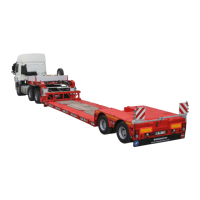
This document is a user manual for the Kässbohrer Tipper Series, providing comprehensive information on the vehicle's running gear, upper structure components, transportation process, and maintenance.
The manual emphasizes safe and efficient vehicle operation, adherence to local laws, and proper use. It prohibits carrying people, live animals, unsecured goods, dangerous materials, and exceeding permissible weights or dimensions. Various symbols are used throughout the manual to highlight important information, critical accidents, additional information, environmental precautions, and mandatory personal protective equipment. Personal protective equipment, including gloves, protective clothing, helmets, earplugs, goggles, and masks, is mandatory during operations and maintenance. The manual stresses the importance of keeping the user manual available, observing safety signs, securing loads, and not modifying the vehicle without manufacturer approval. Only original spare parts should be used.
Main Information
The vehicle's identification plate (1) is located on the right side and contains information such as type approval number, VIN, technical capacities (total, king pin, axle), nationally approved capacities, and vehicle type. The brake data plate (2), for vehicles with an EBS system, provides details on empty and loaded vehicle weights, axle lifting, brake chamber data, references, driving height, pin positions, and IN/OUT connections. The VIN (chassis) number (3) is also located on the right side, marked with a different color. The manufacturer's warranty is based on compliance with usage and maintenance conditions outlined in the manual and warranty book.
Trailer Running Gear and Usage Instructions
Brake System
The brake system includes air couplings (yellow for brake line, red for supply line), compressed air tanks, an EBS socket, Roll Stability Support (RSS), PREV (Park Release Emergency Valve), and brake chambers.
- Air Couplings: Standard (Palm), Duomatic, and C (UK) couplings are used. Only one type should be used at a time. The parking brake of both truck and trailer must be engaged during mounting/demounting. Sealing surfaces must be clean and durable. Test points allow checking air pressure.
- Compressed Air Tanks: Store pressurized air. Capacities vary by vehicle. Condensed water must be drained via the drain valve, especially in cold weather. Low air tank pressure (below 4.5 bars) triggers an EBS warning. If service line pressure drops below 2.5 bars, brakes lock automatically.
- EBS Socket: For electronically controlled brake systems (ALB, ABS/ABV). Requires an EBS-equipped truck and cable connection. Driving without a connected EBS is illegal.
- Roll Stability Support (RSS): Integrated into the trailer modulator, it detects roll-over risk and automatically applies brakes. It cannot override physics.
- PREV (Park Release Emergency Valve): Located on the driver's side. The black button (1) controls the service brake, and the red button (2) controls the spring-loaded park brake. For driving, the red button must be pushed, and the black button pulled. Frequent use of the service brake without air connections can reduce air pressure and braking power.
- Spring Loaded Park Brake: Activated by pulling the red button. Deactivated by pushing it. Must be deactivated before driving.
- Brake Chambers: Can be disc or drum type. Maintenance and repair must be performed by authorized services. Manual deactivation of the parking brake spring involves removing the release rod (2) from its slot (4), inserting it into boreholes (1), and screwing in the nut (3). This disables the spring brake. Activation involves reversing these steps. The vehicle must be secured with wheel chocks before these operations.
Suspension System
Vehicles are equipped with an air suspension system.
- Manual Control: A control button on the driver's side allows selecting fifth wheel height (lower or higher).
- Auto Reset: The auto reset lever automatically sets the driving height when the EBS socket is mounted and the vehicle is driving at a defined speed.
- Electronic Controlled Air Suspension (ECAS): An optional system that electronically sets or adjusts driving height. The lever automatically sets the driving height when the EBS socket is mounted and the vehicle is driving at a defined speed.
- Manometer (Axle Load Indicator): Displays estimated axle load. Connected to fixed-type axle airbags. Not a legal measurement.
- Smartboard (Info Center): Allows operators to view failure codes, axle load, and control the axle lifting system. Some functions may work even if the truck is not connected, if the Smartboard has a battery.
Electrical System
Vehicles can have 15-pin (1), 2x7-pin (2), or 15-pin+2x7-pin (1+2) electrical sockets.
- 15-Pin Socket: Provides electricity for stop lamps, signal lamps, etc. Pin functions are detailed in the manual.
- 2x7-Pin Socket: Provides electricity for stop lamps, signal lamps, etc. Pin connections are suitable for 24S ISO 3731 and 24N ISO 1185 norms. Pin functions are detailed in the manual.
- Light System: Equipped with lights suitable for regulations. Lamps must be checked regularly. Repairs must be done by authorized services using original parts. Adding or removing lamps may make the vehicle non-compliant. LED systems may cause failure lamps in older tractors.
King Pin
The king pin connects the truck and trailer. Vehicles may have 2" or 3.5" diameter pins. The king pin diameter must be checked before connection. If wear exceeds 2 mm, it must be replaced. Vehicles may have a double king pin slot, allowing the king pin to be moved.
Landing Gear
Front landing gears are located behind the gooseneck area to support the vehicle when parked without a truck.
- Working Principle: The crank handle (1) is removed from its holder (2) and positioned perpendicularly. Low speed (A) is used for fine adjustments, high speed (B) for quick lifting/lowering.
- Safety: The semi-trailer must be secured with wheel wedges to prevent tipping. Loading/unloading without the tractor connected is dangerous. If the tractor leaves a loaded trailer, ensure the load is homogeneously distributed. Disconnect the semi-trailer only when the landing gear is in the middle (neutral) position. Lower air suspensions and adjust landing gears for long-term parking without a tractor.
- Aluminum Landing Gear: Optional. Lift by pulling the lever and insert the pin into the hole. Ensure the landing gear is in the highest position before driving.
Side Protection Equipment (Side Underrun Protection)
Must be in the off position during travel. Some can be opened upwards for service access. To remove, turn the locking pin 180° clockwise or counterclockwise, then lift. To lower, lift slightly, unlock pins, and carefully lower. Improperly fixed underrun protection can cause injury.
Semi-Trailer Axle System
Axles are disc or drum type. They must only be loaded with the maximum legally permissible axle load. Brake adjustment by an authorized service of the tractor company is obligatory.
- Self-Steering Axles: Optional, usually at the rear, to increase maneuverability. Have a locking mechanism. The turning radius differs from standard vehicles.
- Locking: For EBS vehicles, automatically locks when reverse gear is engaged. Can be locked manually by closing valve (1) or turning the button off. Reversing with unlocked steering axles is dangerous.
- Unlocking: Automatically unlocks when the vehicle moves forward. Manually unlocked by turning the valve handle 90° clockwise (2) or moving the button to the open position.
- Axle Lifting: Optional feature to minimize tire wear and balance load distribution. Requires active EBS connection. Automatically controlled based on legal regulations and speed limits. Can be manually controlled for maneuvering or traction help (vehicle speed below 30 km/h, axle capacity not exceeding 30%). Can be activated by pushing the brake pedal 3 times when parked. Changing axle lifting configuration may void regulation compliance.
- Hubodometer: Shows distance traveled in kilometers or miles. Unit is adjusted to tire diameter.
- Tires: Choose based on load capacity index, road conditions (highway, off-road, mixed-use), low decibel, fuel efficiency (Class A), and wet surface braking. EU tire labels are available on the website. Dual/twin wheeled vehicles require properly matched tires (tread depth difference no more than 5 mm). Using mismatched tires can disrupt driving safety and accelerate wear.
- Spare Wheel Holder: Different types are offered.
- Crane Type: Remove screws (2), turn lever (3) counterclockwise to lower, remove fixation parts (4). To place, mount fixation parts, lift by turning handwheel (3) clockwise, and fix screws.
- Swedish Type: Remove pin (1), remove pawl hook (2), pull back lowering arm (3), lift holder slightly to release retaining ring (4). Lower slowly. Release arm by removing pin (5) and loosen nuts. To place, put tire on holder, position stoppers, and tighten nuts.
3.10. Mudguards: Equipped with mudguards/mudflaps to minimize splashing. Foldable mudflaps (1) must be folded during huckepack operations. Must be opened when driving.
3.11. Wheel Chock: Two units in the vehicle.
- Pin Type Holder: To remove, pull cotter pin (1). To place, put chocks on holders and mount cotter pin. Must be used on fixed axles, not idle/steer axles. Must be placed properly and stored properly after driving.
Boxes and Storage Units:
- Plastic Toolbox: To unlock, remove lock cover, turn key, pull lever, and open door.
- Stainless Toolbox: To unlock, remove lock cover (1), turn key, pull lever (2), and open door.
- Fire Extinguisher Cabinet: Protects fire extinguishers. Must be maintained regularly, and expiration dates observed. To open, open latches (1), lift cover, remove fasteners. To close, insert extinguisher, fix with fasteners, close cover, and secure latches.
- Water Tank: For general cleaning. Fill via the neck. May have a soap dispenser. Empty in cold weather to prevent cracking. Wastewater must be disposed of according to regulations. Water is not for drinking.
- Document Box: For non-valuable documentation. Round type opens by turning counterclockwise. Square type opens by lifting and removing the pin.
Bumper:
- Liftable Bumper: Complies with EU 70/221. To lift, unlock mechanism, lift counterclockwise, and lock. To lower, unlock, lower clockwise, and lock. Driving with the bumper open is dangerous.
Ladders:
- Access Ladder: Fixed ladder on the front for climbing to the superstructure (tub).
- External Ladder: Stored on mudguards for accessing the tub. Pull pins to remove.
Upperstructure Components and Use
Overview of the Trailers Upper Structure Components
Self-supporting upper structure made of modular aluminum or steel parts.
Body
- Body Impermeability: Welded floor and side panels ensure impermeability.
Front Panel
Includes hydraulic cylinder (1), electric socket connections (2), and walking platform (3).
Rear Panel
Tipper vehicles have three types: Mechanical, Hydromechanical, and Combi (Double Leaf).
- Tightening Locks: For safety.
- Mechanical Rear Door: Opens automatically when the tub is lifted. Opening angle increases with double-hinged option.
- Hydromechanical Rear Door: Opens first when tub lift begins. Controlled by a control unit or remote control.
- Control Unit: Loosen tightening locks. Select "Control Selection" (1). Turn hydraulic valves to point the tub for opening. Press "rear door" button (2) to open. Turn hydraulic valves to point right for closing. Press "rear door" button (3) to close. Ensure no one is in front or behind the vehicle.
- Remote Control Device: Loosen tightening locks. Switch "control selection" (1). Turn hydraulic valves to point the tub for opening. Press "rear door" button (2) to open. Turn hydraulic valves to point right for closing. Press "rear door" button (3) to close. Ensure no one is in front or behind the vehicle.
- Combi (Combined) Rear Door: Combines top-hung and leaf door functions.
- Top-Hung Guide: Tightening locks (1) must be open. Loosen by turning counterclockwise. Door opens when body lifts.
- Double Leaf Guide: To use, open door handle lock, remove pin (1), pull lock holder (2) to not block handle (3). Right leaf opens first, then left. Leaf doors are fixed to side panels with a door fixing handle.
- Grain Door: Small discharging door on rear panels. Ensure tightening locks and locking pipes are secured before operation.
- Opening: Loosen handle by turning counterclockwise (1). Pull lever (2).
- Closing: Loosen handle by turning counterclockwise (1). Pull lever (2). Tighten handle by turning clockwise (3).
- Grain Bag: Optional, depending on configuration.
Walking platform with aluminum side pipe tarpaulin (aluminum or steel optional). Access ladder optional for automatic and mechanical tarpaulins.
Lifting and Lowering the Tub
Controlled by equipment in the truck.
- With Joystick:
- Lifting: With vehicle running, press clutch pedal. Move PTO switch (1) up. Release clutch. Move lifting/lowering lever (2) down (A), then forward (B). Move to idle (C). Hydraulic piston activates.
- Lowering: Move lifting/lowering lever (1) down (A), then backward (B). PTO switch (2) moves to closed, tub lowers. Move lifting/lowering lever (1) down (A), then forward (B), then to middle (C).
- With Switch:
- Lifting: With vehicle running, press clutch pedal. Move PTO switch (1) up. Release clutch. Press lifting button until load is unloaded.
- Lowering: Press clutch pedal. Move PTO switch to off. Press lowering button.
- With Remote Control Device:
- Lifting: Select remote control by turning "Control Selection" (1). Turn hydraulic valves to lifting mode. Push "front cylinder" (2) button.
- Lowering: Turn hydraulic valves to lowering mode. Push "front cylinder" (1) button.
Tarpaulin
- Rolling Aluminum Pipe: Basis for tipper vehicles.
- Mechanism: Remove cotter pin (Figure 1). Attach tensioning chain (Figure 2). Pipe rolls clockwise (Figure 3) and fixes to hooks (Figure 4).
- Automatic Tarpaulin: Control unit on chassis.
- Opening: Check for obstructions. Turn key to I position (1) or press [B] button on remote control. Ensure full opening. Control unit has automatic stop. Check clamping hooks and safety cables.
- Closing: Check for obstructions. Turn key to I position (4) or press [A] button on remote control. Ensure full closing. Check clamping hooks and safety cables.
- Mechanical Tarpaulin:
- Opening: Check for obstructions. Remove elastic cords and safety cables. Free rotation rod (A) by removing snap pin (B) from support (C). Hold rod and turn hand crank (D) to uncover container.
- Closing: Check for obstructions. Free rotation rod (A) by removing snap pin (B) from support (C). Hold rod and turn hand crank (D) to cover container. Block rod. Check clamping hooks and safety cables.
Hydraulic Piston
- Hydraulic System Connection Points:
- Way Hydraulic Gear Pump Use: Gear pump converts mechanical energy to hydrostatic energy. Use suitable hydraulic oils only.
- Connection Method: Determining return direction and suction pressure lines.
- Pump – PTO Connection: Pump should turn RIGHT (clockwise) if main transmission turns RIGHT and auxiliary transmission is connected.
- Hydraulic Oil: Mineral-based, replaced every 6 months. Viscosity 12-100 cSt (ideal 20-40 cSt). Operating temperature 35-55°C (min -23°C, max 82°C). Low viscosity for cold, high for hot weather.
- Filtering: System must have oil and air filters (not on pump suction line). Most efficient filtering is 10 µm (up to 25 µm allowed). Filters checked periodically.
- Oil Warning Hole: On pump cover (1) to warn of oil seal problems. If oil comes out, take to service center.
- Operating Instructions:
- Before Starting: Check pump flow rate and pressure. Check ISO/UNI connection. Fill tank with fresh oil. Oil filter not on pump suction line.
- Operating the Pump: Initial operation without pressure at low speed (idle) with empty tipper. Check for noise/leakage. Stop if extraordinary. Check/top up tank level. Do not operate above specified pressure/speed. Do not change pressure control valve settings. Perform periodic maintenance. Contact service for problems. Ignoring instructions voids warranty.
- Use of Telescopic Cylinder:
- Operating Temperature: 35-55°C.
- Hydraulic Oil: Mineral-based, replaced every 6 months. Viscosity 12-100 cSt (ideal 20-40 cSt). Low viscosity for cold, high for hot weather.
- Filtering: System must have oil and air filters (not on pump suction line). Most efficient filtering is 10 µm (up to 25 µm allowed). Filters checked periodically.
- Issues to be Considered for Installation: Cylinder and bracket connection planes must be perpendicular. Mount to allow movable joints to adjust. Closed length of cylinder must be 20-50 mm more than before mounting. Leave safe distance when stages open.
- Points to Note When Operating: Vehicle on smooth, strong ground. Do not move with tipper open. Driver should not leave vehicle during operation. Operate in sufficient light. Check rear doors are open before unloading. Check load flowability. No persons near tipper during operation. Do not excessively increase engine speed. Do not change pressure control valve settings. Grease connection points regularly. Ignoring warnings voids warranty.
Transportation Process
Pre-Driving Checks
Ensure all documentation is available, adjustments and loading conditions are correct, vehicle is coupled and secured, pneumatic and electrical connections are made, EBS is operational, structural hardware is in place and locked, load is evenly distributed, load weight is within limits, regulations are complied with, lighting and signal system is operational, tire air pressures are correct, and parking brake is released.
Semi-Trailer and Tractor Coupling
- Coupling: Check kingpin and couplings for grease. Lower tractor rear suspension airbags. Set 5th wheel locking to "On". Adjust semi-trailer height. Prevent movement with parking brake and wheel chocks. Move tractor until 5th wheel touches top-connection plate and locks kingpin. Raise landing legs. Connect air, electrical, and EBS cables. Release parking brake. Driving at wrong 5th wheel height can cause malfunctions.
- Uncoupling: Apply parking brake (after checking drum temperature). Use wheel chock if hand-brake type. Disconnect brake air lines (brakes apply automatically). Disconnect electrical connections. Lower mechanical landing gear (high speed, then low speed). Unlock 5th wheel lock. Move tractor forward 500 mm. Lower tractor rear suspension airbags.
Loading – Unloading Operations
- Safety Reminder: Parking brake activated, vehicle fixed with wheel chocks. Park on flat, firm surface. Ensure proper load distribution. Suspension may raise during loading/unloading; set to driving position after. Check height limits. Weight/dimensions must not exceed technical/legal limits. Load distribution affects stability, braking distance, and turning radius. Comply with laws and regulations.
Cautions During the Parking and Stopping
Use parking brake and wheel chocks. Use marking plate in public traffic areas.
Loading
Load must be secured. Distribute load as low as possible, with center of gravity above centerline. If roof lift/sliding roof used, ensure it's suitable for driving. Secure canvas connections. Secure load with brackets and holders.
Important Technical Considerations
- Fire Extinguisher: Check annually, refill if used. Wear protective gloves when handling liquid accumulations.
- Wheel Chocks: Keep in place during parking, remove before setting off.
- Modifications: Only authorized services. Otherwise, warranty void.
- Air Leakage: If air pressure drops instantly, contact authorized service. Affects braking and airbag capacity.
- Environment: Dispose of waste materials (batteries, oil, cleaning cloths) according to regulations. Do not discharge into channels, sewers, landfills.
- Health and Safety (Battery): Keep sparks/fire away. Wear eye protection and rubber gloves. Do not let children handle. Pay attention to sulfuric acid. Read manual before working. Do not use with low electrolyte level.
- Expired Tires: Dispose of according to regulations.
- Dangerous Chemicals: Act according to ADR Legislation in emergencies.
- Recycling: Trailer components are largely recyclable. Contact approved company for end-of-life recycling.
Loading and Load Security
Loading – Unloading Operations
- Safety Reminder: Parking brake activated, vehicle fixed with wheel chocks. Park on flat, firm surface. Ensure proper load distribution. Suspension may raise during loading/unloading; set to driving position after. Check height limits. Weight/dimensions must not exceed technical/legal limits. Load distribution affects stability, braking distance, and turning radius. Comply with laws and regulations.
Loading
Load must be secured. Distribute load as low as possible, with center of gravity above centerline. If roof lift/sliding roof used, ensure it's suitable for driving. Secure canvas connections. Secure load with brackets and holders.
Safety Instructions
Ensure cargo is properly distributed, within loading limits, total weight, and axle load capacities. Place cargo as close to the floor as possible, with center of gravity on the vehicle's centerline. Load is assumed to be evenly distributed. For point loads, use a rigid distribution platform. Do not stand under/around load during crane/forklift loading. Do not exceed permissible height. Do not fix load with non-permissible equipment.
Load Distribution and Load Limits of Tractor Semi-trailer Combination
Ensure proper load distribution according to laws and regulations. Consider loading limits, total weight, and axle load capacities. Comply with laws of all countries where driven. Axle loads vary; comply with operation manual. Have loads checked at a weighing station if in doubt. Axle load: load conveyed by an axle or axle group.
Tilt Alert
Warns user with audible alarm during lifting/lowering on slopes of 3 degrees or more.
Inspection and Maintenance
Safety Instructions
Read safety instructions carefully. Obey traffic laws and environmental regulations. Maintenance by authorized services. If EBS warning lamp comes on, park immediately and contact service. Wash vehicle after ferry operation, muddy/salty roads, or corrosive substances.
Main Principles
Maintain operating status, prevent breakdowns, extend life, prevent damage, maintain value, reduce repair time, and keep vehicle clean.
Check electrical system, lighting, brake, and signal lamps. Check documents. Grease wheel plate and king pin. Check wheel nut tightness. Check landing gear speed ranges.
Cataphoresis Coating
Chassis/components may be cataphoresis coated. Damage must be repaired by an Authorized Service.
Periodic Maintenance and Controls
See warranty and maintenance manual.
Important Warning!
Periodically check lining thickness (replace if below half). Periodically check brake discs for deformation/cracks (apply to authorized service). Visually check caliper piston and bellows. Follow axle manufacturer's maintenance instructions. Healthy brake system depends on compatible tractor/system. Buyer responsible for brake adjustment at authorized tractor service.
Trouble Shooting
- Safety Regulations: Risk of accidents from unprofessional troubleshooting. Comply with laws, environmental rules. Troubleshooting by trained personnel. Park on firm, level surface, secured against sliding/tipping. Ensure protective devices are placed/secured after repair. Use original spare parts.
- Spare Tire Replacement:
- Removing: Park safely, secure with chocks. Apply spring-loaded parking brake. Loosen wheel nuts one turn. Place jack under axle. Raise axle, remove nuts. Take damaged wheel off by grabbing cheeks.
- Fitting: Position spare tire near hub. Lightly oil nut threads. Insert bar under tire, push bolts into rim holes. Hand tighten nuts. Tighten nuts with wrench in sequence. Lower jack, tighten nuts in sequence (repeat after 80 km and daily for first week). Check torque weekly. Check bolt holes for ovalization. Improper tightening causes deformation.
- Yay Yüklü Park Freni Acil Durum Çözme Butonunun Aktive Edilmesi (Spring Loaded Park Brake Emergency Release Button Activation): Risk of rollover. Ensure vehicle is parked on firm, flat, even ground and secured against rollover.
- Brake System: Risk of rollover. Ensure vehicle is parked on firm, flat, even ground and secured against rollover. Brake system work must be performed by specially trained personnel in authorized services.

 Need help?
 General

 To Next Page