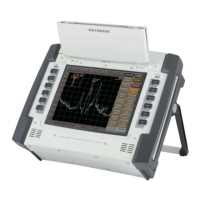
The Kathrein MSK 30/L is a versatile measuring instrument designed for receiving and measuring SAT, TV, and CATV signals, with the added capability of displaying digital signals. This user guide provides comprehensive instructions for its operation, configuration, and maintenance.
Function Description:
The MSK 30/L serves as a portable test meter for signal analysis in satellite, terrestrial, and cable television systems. It allows users to:
- Measure SAT, TV, and CATV signals: This includes evaluating signal strength, quality, and other parameters crucial for installation and troubleshooting.
- Display digital signals: The device can process and show information from digital broadcasts.
- Spectrum analysis: A dedicated spectrum analyser mode helps visualize signal distribution and identify potential interference.
- Channel list management: Users can select, view, and manage channel lists for different signal types (SAT, TV, CATV).
- Service functions: This includes selecting channels from a list and activating/deactivating full-screen mode for video display.
- Help function: Determines reception characteristics of unknown digital TV, CATV, or SAT signals.
- Memory functions: Allows saving and retrieving measurement results (Datalogger) and channel lists (Automemory TV).
- Configuration settings: Adjusts various meter parameters, including volume, brightness, battery saving mode, switch-off time, measurement ranges (TV/CATV Discovery), and SCR user frequency.
Important Technical Specifications:
- Type: MSK 30/L
- Order no.: 2170000003
- RF Section:
- Frequency range DVB-C/-T/-T2: 47 - 880 MHz
- Frequency range DVB-S/-S2: 950 - 2150 MHz
- Frequency resolution: Cable/TV/FM: 50 kHz, Sat: 100 kHz
- Transmission standards: B/G, I, D/K, M, N
- Digital Satellite Receiver DVB-S/-S2:
- Modulation type: QPSK, 8PSK
- Code rate (FEC) DVB-S: 1/2, 2/3, 3/4, 5/6, 7/8
- Code rate (FEC) DVB-S2: 1/2, 2/3, 3/4, 5/6, 8/9, 9/10, 2/5, 3/5
- Input symbol rate: 2 - 45 MS/s (DVB-S), 2 - 45 MS/s (DVB-S2)
- BER: 1E-6 ... 2E-2 (pre Viterbi)
- MER: 25 dB
- Digital Terrestrial TV Receiver DVB-T/-T2:
- DVB-T modulation: QPSK, 16/64 QAM
- DVB-T2 modulation: QPSK, 16/64/256 QAM
- FFT mode DVB-T: 2k, 8k
- FFT mode DVB-T2: 1k, 2k, 4k, 8k, 16k, 32k
- Guard interval DVB-T: 1/4, 1/8, 1/16, 1/32
- Guard interval DVB-T2: 1/4, 1/8, 1/16, 1/32, 1/128, 19/128, 19/256
- Code rate (FEC) DVB-T: 1/2, 2/3, 3/4, 5/6, 7/8
- Code rate (FEC) DVB-T2: 1/2, 2/3, 3/4, 5/6, 7/8, 3/5, 4/5
- Channel bandwidth: 6, 7, 8 MHz
- BER: 1E-6 ... 1E-2 (pre Viterbi)
- MER: 36 dB
- Digital CATV Receiver DVB-C (J83 A):
- DVB-C modulation: 16/32/64/128/256 QAM
- Input symbol rate: 2 - 6.999 MS/s
- BER: 1E-9 ... 1E-2 (pre RS)
- MER: 40 dB
- TV System Standards:
- Audio: FM, NICAM and AM audio
- Digital video decoding: MPEG-2; MPEG-4/AVC
- Level Measurement Section:
- Level measurement range: 30 ... 95 dBμV
- Measurement accuracy: Typ. ±1.5 dB
- Detector analogue: TV: peak value; Sat/FM: mean value
- Detector digital: Mean value
- Display:
- Monitor: 4.3" Touch TFT colour display (480 x 272 pixels)
- Sat finder (acoustical): Level-dependent whistling sound
- Power Supply:
- Li-Ion battery: 2.4 Ah, 18 Wh, 7.4 V
- Mains (plug-in power supply unit): 100 - 240 V (50/60 Hz)
- DC external: 12 V
- Remote Feeding:
- Remote feed voltage supply: 5/13/18 V
- Remote feed current: Max. 500 mA
- Control signals: 22 kHz, DiSEqCTM1.2, SCR-/SCD2 single-cable system
- Connections:
- RF input (impedance): 75 Ohm (F-type coaxial socket)
- USB port: 1 x port, USB 1.1
- DC voltage supply 12 V: DC plug adapter 2.5/5.5 mm
- General:
- Safety standards: Protection class II (AC/DC power supply unit), VDE EN 61010
- Dimensions (W x H x D): 185 x 125 x 44 mm
- Weight: approx. 0.7 kg
Usage Features:
The MSK 30/L is designed for intuitive operation with a combination of physical buttons, a navigation wheel, and a touch screen.
- Touch Screen Display Area: Displays signals, measurement parameters, image previews, and provides access to context-sensitive menus and transport stream information.
- Navigation Wheel: Used for navigating menu items, confirming selections, and changing setting values. It can also be pressed and held to open drop-down menus or numeric input fields.
- Numeric Field Input: Allows precise entry of frequency values and other numerical settings.
- Volume Menu: Adjusts volume, brightness, image format, and activates/deactivates battery saving mode.
- Configuration Menu: Provides access to advanced settings for SAT, TV, and CATV configurations, SAT Finder, SAT SCR, meter information, and diagnostics.
- Discovery Function: Enables changing TV or CATV measurement ranges (TERR ONLY, TERR&CABLE, CABLE ONLY) when no custom or automatic memory maps are active.
- SCR User Frequency: Allows configuration of SCR (Single Cable Routing) user frequencies, including LNB type and SCR user selection.
- Main Menu Access: Quick access to SAT, TV, CATV measurement ranges, spectrum analyser, channel lists, service functions, help, and memory.
- DC-RF In Switch: Controls remote feed voltage for LNBs. An LED indicates DC offset in SAT signals, prompting users to switch off the remote feed to prevent damage.
- Battery Status Indicators: Icons on the touch screen provide visual information about the battery charge level (FULL, <80%, <50%, <30%, <10%).
- Battery Saving Mode: Reduces display brightness after 30 seconds and automatically turns off the meter after 5 or 10 minutes of inactivity to conserve battery life.
- Dolby AC3 Audio Decoding: The device supports decoding of Dolby AC3 Audio code with an optional paid upgrade.
Maintenance Features:
- Cleaning: The meter should be cleaned with a soft cloth dampened with a solution of water or alcohol. Aggressive chemical products, diluting agents, abrasives, or rough cloths should be avoided.
- Battery Charging:
- Charge the battery at ambient temperature (approx. 20 °C) in well-ventilated areas.
- Do not cover the meter during charging or charge it in a hard-top case.
- Always turn off the meter to charge the battery.
- Charge for at least 7 hours overnight after each use, even if not fully discharged.
- Avoid leaving the battery discharged for extended periods to prevent premature failure.
- LED indicators (MAINS and CHARGE) provide feedback on the charging process (on/on for charging, on/off for completed, on/flashes for abnormal temperature).
- Battery Test:
- A battery test can restore the capacity of an old battery by performing 3 to 5 tests.
- Each test lasts approximately 20 hours, during which the meter cannot be used.
- The meter turns off automatically after the test.
- All functions except RESET are disabled during the test to ensure accuracy.
- The RESET function remains active for emergency shutdown.
- Interrupting the test with RESET may lead to incorrect battery charge display, requiring a retest.
- The battery is fully charged at the end of the test.
- Test results are displayed as a combination of letters and numbers (e.g., 130ACLY), where the number indicates battery life in minutes, and the last letter (Y/N) indicates working order or fault/interruption.
- Waste Disposal: Electronic equipment must be disposed of properly at an official collection point in accordance with directive 2002/96/EC.

 Need help?
 General

 To Next Page