6
of the down turned rudder. (Actually, the reason why your model descends in
the bank is much more complex - the wing gives less lift in the bank as the verti-
cal projection of the wing is the area that counts and you also have to beat the
inertia that tries to keep your model in the straight ight...) The elevator applied
when your model is in a banked turn also works like a rudder - fortunately it
helps to maintain the turn!
In practise, the ailerons are used to put your model to the desired angle
of bank, the rudder is used to maintain it, and the elevator input helps
to control height whilst also increasing the rate of turn.
Alternatively, you can use only the ailerons to bank your model, then turn
your model using just the elevator and nally resume the straight and level
ight with the opposite deection of ailerons.
We have got through about 3/4 of the turn and it is the time to think about
returning to straight and level ight in the desired direction. Return the con-
trols to the middle position (you may need to correct the turn with a little
right ailerons and/or rudder). If necessary give slight elevator input to settle
your model into a straight and level ight.
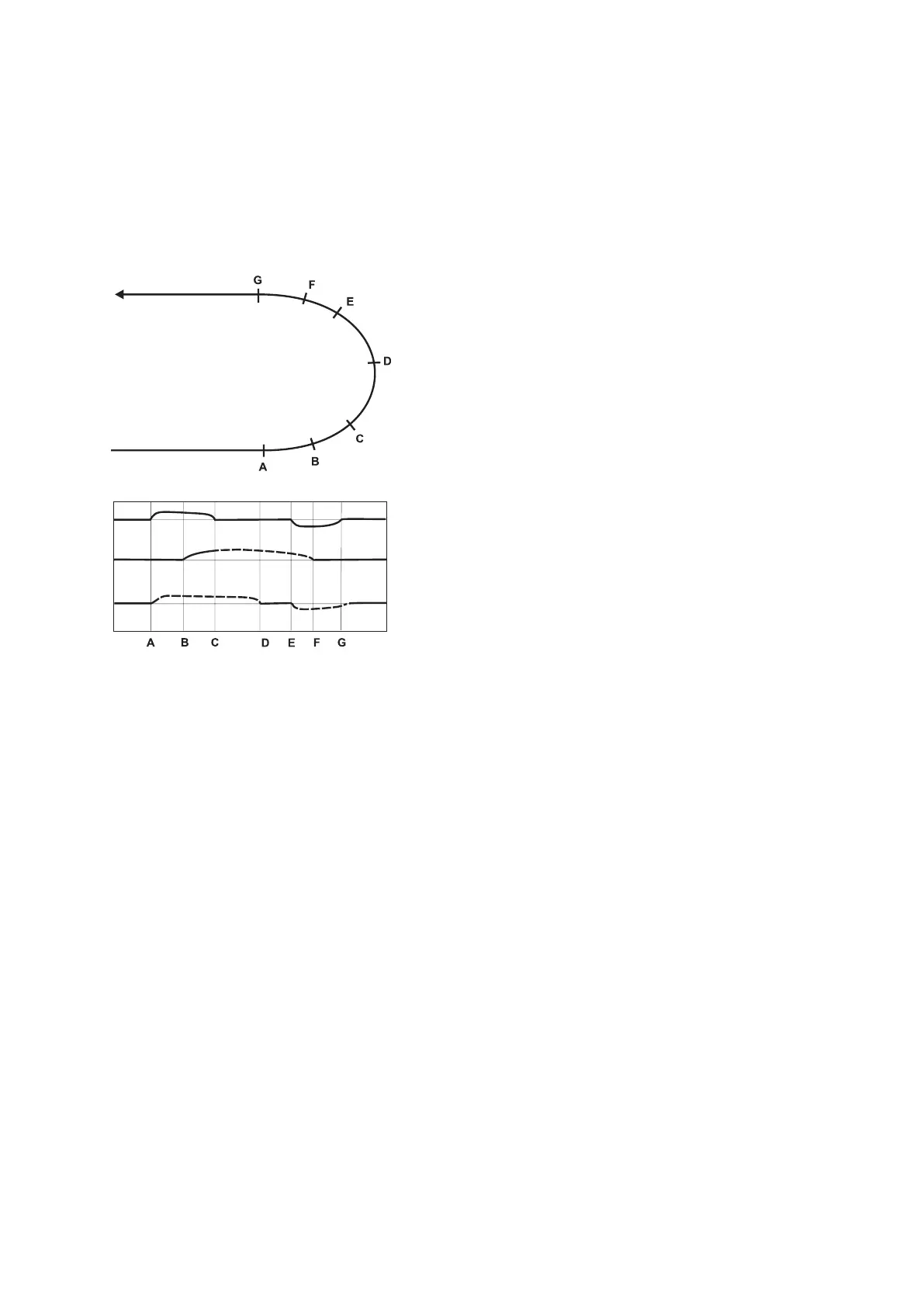
If you take a look at our drawing on the right you will notice that it takes some
time until the model actually starts to turn. And, when leaving the turn, you
have to start to apply the opposite ailerons and rudder sooner than the nose
of your model is pointing to the desired nal direction. The elevator and rud-
der deections are marked with dotted lines – this is because you cannot
tell exactly the track that the model will take during a gentle banked turn, or
entry to straight and level ight.
Congratulations! You have learnt how to achieve a coordinated turn using
rudder and elevator. Remember that model aircraft control is about guid-
ing your model in the desired direction rather than precise steering. Another
complication is the rudder control. It is easy and natural while the model is
ying away from you, but when your model is ying toward you the direc-
tion of control commands has to be reversed. A simple trick when the model
is ying towards you is to move the control stick towards the wing that you
want to lift, imagine supporting the wing by moving the stick under that
wing – it works!
Final setup
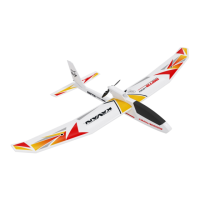
Now is the time for the nal setup. Fly your ALPHA 1500 V2 straight into wind,
leave the controls in the neutral position. If the model turns in one direc-
tion apply the rudder trim in the opposite direction until ALPHA 1500 V2 ies
straight. Without power your model must settle into a gentle glide, not too
fast so that it plummets to the ground, and not so slow that the controls feel
“soggy” and the model is on the edge of the stall. Apply the elevator trim in
the way described in the initial trimming section.
If your model banks to a side, apply a little of the aileron trim in the opposite
direction.
Powered and unpowered ight
The model has been already ne tuned for the unpowered phase of ight.
When you turn on the motor your model might tend to pitch nose up when
full throttle is applied. You cannot completely trim out this tendency with
any motor powered glider – just be aware of this characteristic when ying
your model. In practise you might have to make slight elevator corrections to
maintain a gentle, but positive climb. In some cases there might be a strong
trim change, and the only cure for this is to modify the thrust line of the mo-
tor. In order to reduce the nose up pitching you have to increase the down
thrust of the motor (by using card or scrap ply packing pieces). The opposite
problem is quite rare, but it is possible that a model correctly set up for the
glide requires a lot of up elevator to maintain a climb when power is applied.
The cure: decrease the down thrust of the motor.
Landing
When the power available starts to reduce check that you landing eld is
clear of people and other obstructions. Position your model about 10 to 20m
o the ground at the down wind end of your eld. Make the nal approach
into wind, keeping the wings level all the time as your model descends slow-
ly, and nally settles gently onto the ground. With more practice you will be
able to use a little up elevator to “round out” (slow down the model) at less
than 1m o the ground.
Congratulations!
Coordinated left turn (180°)
Left bank
Resuming straight ight
Straight and level ight
Control Surface Movement
Maintaining
constant
bank,
speed
and altitude
Elevator
Rudder
Left
Right
Up
Down
Straight and level ight
Ailerons
Left
Right


 To Next Page
 Loading...