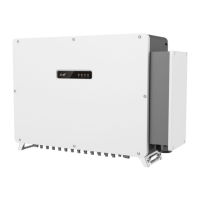
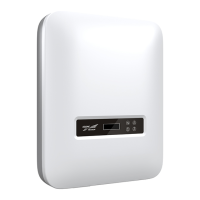
This document serves as the User Manual for the KEHUA TECH PV Grid-tied Inverter, specifically the SPI-B-H Series (320K-350K) models. It provides comprehensive information on the inverter's features, installation, operation, maintenance, transportation, and storage.
Function Description
The PV grid-tied inverter converts DC energy from a PV string into AC energy, which is then fed back to the power grid. It is designed for large power station grid-tied systems. A typical PV grid-tied generation system comprises a PV string, the PV grid-tied inverter, a transformer, and a power distribution system. The inverter tracks the maximum power point (MPPT) of the PV string to maximize power output and then converts the DC power to three-phase AC power.
Important Technical Specifications
The SPI-B-H Series (320K-350K) inverters come in several models, including SPI320K-B-H, SPI320K-B-H1, SPI350K-B-H, and SPI350K-B-H1. The model meaning breaks down as follows: "SPI" for SPI series PV grid-tied inverter, "320" or "350" for rated output power in kVA, "B" for non-isolated power, "H" for high-voltage, and "1" indicating 32 PV branches (without "1" means 24 PV branches).
For the SPI320K-B-H model:
- MPPT Input Voltage (Vdc): Min 500, Max 1500.
- MPPT Working Voltage with Full Load (Vdc): 860 to 1300.
- PV Connected Branches: 24.
- Branch Input Current (A): 0 to 25 (Typical 20).
- PV Input Power (kW): 0 to 500 (Typical 330).
- Startup Voltage (V): 550.
- Output Power (kVA): Typical 320, Max 352.
- Rated Grid Voltage (Vac): 800 (3P3W).
- Grid Voltage Range (Vac): 720 to 880 (Settable).
- Frequency Range (Hz): 48 to 50.5 (Typical 50, Settable).
- Grid-tied Inverting Efficiency: 99.0%.
- Grid-tied China Efficiency: 98.5%.
- Grid-tied Current Harmonic: 3% (Under full-load).
- Power Factor Range: 0.8 (ahead) to 0.8 (lag) (Typical 1).
- Current DC Component (mA): <1154.
- Output Current (A): Typical 254.0.
- Protection Grade (IP): IP66.
- Isolation Type: No isolation (input cannot be connected with ground, or grounding output must be with isolation transformer).
- Heat Dissipation Way: Smart wind-cooling.
- Noise: <75±2dBA@1m (Do not install in a noise-sensitive environment).
- Display Way: LED indicator.
- Communication Port: RS485/ Ethernet (optional)/ WIFI (optional)/ GPRS (optional)/PLC (optional).
- Operation Temperature (°C): -35 to 60 (Typical 25).
- Storage Temperature (°C): -40 to 70 (Typical 25).
- Relative Humidity: 0% to 100%.
- Atmosphere (kPa): 70 to 106.
- Altitude (m): 0 to 5000 (Above 4000m, rated power decreases).
- Over-voltage Category: II (DC)/ III (AC).
- Pollution Degree: III.
For the SPI320K-B-H1 model, the main difference is 32 PV connected branches and a branch input current of 0 to 15A (Typical 13A).
For the SPI350K-B-H model, the output power is Typical 350kVA, Max 385kVA, with a PV input power of 0 to 500kW (Typical 360kW) and a current DC component of <1262mA. Output current is Typical 277.8A.
For the SPI350K-B-H1 model, it has 32 PV connected branches, output power of Typical 350kVA, Max 385kVA, PV input power of 0 to 500kW (Typical 360kW), branch input current of 0 to 15A (Typical 13A), and a current DC component of <902mA. Output current is Typical 277.8A.
Usage Features
- High Efficiency: Innovated three-level design ensures high transition efficiency.
- Grid Scheduling Support: Supports PLC communication and night SVG function to meet grid scheduling requirements.
- Adjustable Reactive Power: The reactive power is adjustable, with a power factor range of -0.8 (lag) to +0.8 (ahead).
- Smart Monitoring: Features smart I-V scanning, fault wave capture, and remote online update functions.
- Comprehensive Protection: Includes island protection, high/low voltage ride-through, reverse DC connection protection, AC short circuit protection, leakage current protection, and surge protection.
- Communication Methods: Offers multiple communication options: Ethernet, RS485, WIFI/GPRS (optional), and PLC (optional) for local and remote monitoring via APP or energy cloud on PC.
- PID Function (Optional): If configured and enabled, the PID function adds reverse voltage to PV strings at night to repair PID effects, ensuring all PV string voltages to ground are positive.
Maintenance Features
- Regular Maintenance: Recommended every half or one year, depending on the environment's dust level.
- System Cleanliness: Check for dust or sundries on air outlet holes and heat sink. Clean if necessary.
- Electrical Connection Check: Inspect wiring for looseness, dropping, or damage, especially where wires touch metal.
- Wire Inlet Hole Sealing: Ensure wire inlet holes are completely sealed; use fireproof mud if not.
- Fan Maintenance: Check for abnormal noise or cracks in fan blades. Replace if necessary. Clean the fan with a soft brush or cleaner. Before maintenance, shut down the inverter, disconnect all power, and wait 30 minutes for capacitors to discharge.
- LED Indicator Cleaning: Clean the LED indicator surface with a damp cloth if too dirty to read.
- Troubleshooting Guide: The manual provides a detailed troubleshooting list for common faults like grid voltage/frequency abnormal, output over-current, leakage current abnormal, relay fault, radiator over-temperature, MPPT/branch over-voltage/over-current, and branch reverse connected. For persistent issues, contact the service center with inverter S/N, distributor/dealer info, grid-tied power generation date, problem description, and contact information.
- Safety Precautions: Emphasizes safety announcements, ESD protection, grounding requirements, and moisture-proof protection. All electrical connections and operations must be performed by qualified professionals following local standards and safety guidelines.
- Storage: When storing, follow placing direction on carton, maintain 20cm gap from ground, 50cm from walls/heat sources, and ensure temperature is -40°C~70°C. Avoid poisonous gas, flammable/explosive objects, corrosive chemicals, strong shaking, impact, and magnetic fields. Recheck if stored over six months.

 Need help?
 General

 To Next Page