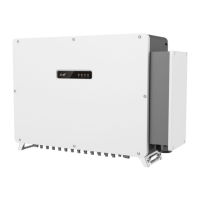
The Kehua Tech SPI-B2 Series (1500-6000) PV Grid-Connected Inverter is a device designed to convert DC energy from solar PV arrays into AC energy and feed it into the power grid. It is suitable for both home and commercial rooftop PV generation systems. The inverter is available in various models, including SPI1500-B2, SPI2000-B2, SPI3000-B2, SPI3600-B2, SPI4000-B2, SPI4600-B2, SPI5000-B2, and SPI6000-B2, catering to different power requirements.
Function Description
The inverter's primary function is to convert direct current (DC) generated by photovoltaic (PV) panels into alternating current (AC) for use in homes, businesses, or to be fed back into the electrical grid. It incorporates a Boost circuit and an Inverter circuit, along with LC and output filters, to ensure efficient and stable power conversion. The device is designed for single-phase grid connection.
Key functional features include:
- Efficient Power Generation: The inverter adopts HERIC inverter topology and advanced completely digitized control technology to optimize power generation from PV arrays.
- Reliable and Safe Operation: It uses an aluminum alloy die-cast outer case, ensuring durability and a wide temperature range for operation.
- Smart Management: The inverter supports RS485, GPRS, and WiFi communication for smart cloud platform monitoring and APP monitoring, allowing users to track performance and manage the system remotely.
- Environmental Adaptability: Designed for small size, easy installation and use, and air cooling, it is suitable for various installation environments.
- Display and Indicators: The inverter features an LCD display to show inverter status and information, service and operation information, and alarm information and faults. It also has a power indicator (green for grid-connected status, flicker for PV power normal) and an alarm indicator (on for inverter fault).
- Operation Panel: The operation panel includes buttons for navigation (ESC, ENT) to move the cursor, increase/decrease values, enter sub-menus, and confirm commands.
- Communication Ports: It includes ports for WiFi/GPRS, COM (for DRM and meter connection), and GRID (AC output terminal).
- Anti-islanding Protection: The inverter incorporates active anti-islanding methods to ensure safety during grid outages.
- Power Factor Control: It supports power factor control settings.
- MPPT Disturbance Step Setting: Allows for configuration of Maximum Power Point Tracking (MPPT) parameters.
- Anti-countercurrent Power Setting: Enables settings to prevent reverse current flow.
- Grid Active Power Setting: Configures active power output to the grid.
- Date & Time Setting: For accurate record keeping and system synchronization.
Important Technical Specifications
The SPI-B2 series offers a range of power outputs and input capabilities:
- DC Input Power (W):
- SPI1500-B2: 2025
- SPI2000-B2: 2700
- SPI3000-B2: 4050
- SPI3600-B2: 4860
- SPI4000-B2: 5400
- SPI4600-B2: 6210
- SPI5000-B2: 6750
- SPI6000-B2: 8100
- Vmax PV (d.c.V): 600
- MPPT Voltage Range (d.c.V): 100–550
- Isc PV (d.c.A): 16.5 (for SPI1500-B2 to SPI2000-B2), 2*16.5 (for SPI3000-B2 to SPI6000-B2)
- Full-load MPPT Voltage Range (d.c.V): 125–450 (SPI1500-B2), 165–450 (SPI2000-B2), 150–450 (SPI3000-B2), 180–450 (SPI3600-B2), 200–450 (SPI4000-B2), 230–450 (SPI4600-B2), 250–450 (SPI5000-B2), 300–450 (SPI6000-B2)
- Startup Voltage (d.c.V): 120
- No. of MPPTs: 1 (for SPI1500-B2 to SPI2000-B2), 2 (for SPI3000-B2 to SPI6000-B2)
- Strings per MPPT: 1 (for SPI1500-B2 to SPI2000-B2), 1/1 (for SPI3000-B2 to SPI6000-B2)
- Max. Input Current (d.c.A): 13.2 (for SPI1500-B2 to SPI2000-B2), 13.2/13.2 (for SPI3000-B2 to SPI6000-B2)
- Rated Output Power (W): 1500 to 6000, depending on model.
- Rated Apparent Power (VA): 1500 to 6000, depending on model.
- Rated Grid Voltage (a.c.V): 230
- Grid Voltage Range (a.c.V): 180–280
- Grid Type: Single-phase
- Max. Continuous Output Current (a.c.A): 6.5 to 26.0, depending on model.
- Efficiency: Max. efficiency of 98.1% (SPI1500-B2 to SPI3000-B2), 98.3% (SPI3600-B2 to SPI6000-B2). Europe efficiency of 97.7% (SPI1500-B2 to SPI3000-B2), 97.9% (SPI3600-B2 to SPI6000-B2).
- DC Reverse Connection Protection: Yes
- AC Short-Circuit Protection: Yes
- Leakage Current Protection (RCD): Yes
- DC Isolation: Optional
- PV Fault Detect: Yes
- Input DC Impedance Monitor: Yes
- Surge Protection: Yes (Class D, Piezoresistor)
- Standard & Certification: IEC62109-1/-2, EN62109-1/-2, AS4777.2-2015, (G83/2 G59/3) VDE4105 EN50438 (upon request) AS 62040 CGC/CQC CE
- Size (W×H×D) (mm): 360 × 420 × 125
- Weight (kg): 11.8 (Max.) for SPI1500-B2 to SPI2000-B2, 12.6 (Max.) for SPI3000-B2 to SPI6000-B2.
- Installation: Wall-mounting
- Insulation: Non-isolated
- Overvoltage Category: PV: II, AC: III
- Degree of Protection: IP65
- Self-Consumption at Night: <1W
- Operating Temperature Range: -30–60 °C (If the temperature is higher than 45 °C or lower than -25 °C, the inverter needs to decrease rated power to use)
- Operating Humidity Range: 0–100%
- Cooling: Natural
- Maximum Operating Altitude: 3000m (>2000m derating)
- Noise Emission (typical): <25dB (A) @ 1m
- Display: LCD display + LED indicator
- Communication: RS485 / WiFi (optional) / GPRS (optional) / DRM (Australia)
- AC Terminal: Plug and play (max. 6mm²)
- DC Terminal: D4B
- Other Function: Update online
Usage Features
- Installation: The inverter is designed for wall mounting. Vertical installation is preferred, with a tilt angle not exceeding ±15°. Adequate spacing (at least 500mm from top/bottom, 600mm from sides) is required for heat dissipation. The installation site should be cool, dry, and well-ventilated, away from direct sunlight, rain, snow, vibration, corrosive materials, salty or flammable gases, and without good ventilation or closure.
- Electrical Connection:
- Grounding: An external grounding terminal is provided. The PE wire of the AC output terminal must be connected to ground.
- DC Input (PV) Connection: Independent breakers for each PV input are recommended. The DC input voltage should not exceed the max. input voltage of the inverter. The grounding wire with positive pole or negative pole of PV array should not be connected to the inverter.
- AC Output (GRID) Connection: It is forbidden for several inverters to share an AC switch or to connect with load between the inverter and AC switch. Recommended AC breaker specifications vary by model (e.g., 20A for SPI1500-B2/SPI2000-B2, 25A for SPI3000-B2/SPI3600-B2, 32A for SPI4000-B2/SPI4600-B2/SPI5000-B2, 40A for SPI6000-B2).
- Communication:
- WiFi/GPRS: The inverter can be equipped with WiFi/GPRS modules for internet monitoring.
- COM Port: Supports DRM and RS485 communication for smart meter connection.
- LCD Operation: The LCD provides access to various menus for monitoring and configuration.
- First Startup: Requires entering a power-on password.
- Main Page: Displays date, time, inverter status, daily power, and total power.
- Main Menu Page: Allows navigation to Running Info, Power Query, Record Query, System Set, and System Info.
- Running Information: Displays real-time data such as input power, output power, frequency, voltage, current, and temperature.
- Power Query: Shows daily and total power generation.
- Record Query: Accesses user logs, grid-connected, and off-grid records.
- System Setting: Allows user/admin login to configure various parameters like date/time, language, ON/OFF grid standards, power calibration, engineer settings (active power, reactive power, power factor, ISO protect, PV parallel mode, soft start, anti-countercurrent power, overvoltage protection, overcurrent protection, overvoltage recover point, under-voltage protection point, under-voltage recover point, over-frequency protection point, under-frequency recover point, PV mode setting, etc.), and I/O set (anti-island enable, anti-countercurrent enable, DRM mode).
- System Information: Displays model, serial number, control software version, and display software version.
- Startup and Shutdown:
- Startup: Involves switching on DC isolator and AC switch, waiting for the inverter to prepare, and checking inner parameters, AC grid parameters, and insulation impedance.
- Shutdown: Simply switch off all switches and wait for indicators to turn off.
- Australian Standard Special Instructions: For Australia, the default grid voltage is 230V. The inverter needs to be set to QV to 258V, and the value should be set as 112.3%. The inverter is expected to provide a volt-watt response as per specific curves and default settings for different regions (Australia A, B, C, New Zealand).
- RCD Instructions: An external residual current device (RCD) is mandatory. The switch must be triggered at a residual current of 30 mA (recommended). For Australia, the inverter can use an additional 30 mA (type A) RCD in installations according to IEC 60755.
Maintenance Features
- General Maintenance: The inverter needs to be maintained regularly. The sundries and dust on the inverter surface should be cleaned with a soft brush. If the surface of the LCD and LED indicator is dirty, use a wet cloth to clean them. Do not clean the inverter with any solvent, abrasive material, or corrosive material.
- Troubleshooting: The manual provides a comprehensive troubleshooting guide with fault codes and corresponding solutions.
- E016 (Grid voltage abnormal): Check the safety provision of the inverter meets the local grid-connected requirement, check the local grid voltage, and ensure all normal, please contact local distributor.
- E017 (Grid frequency abnormal): Same as E016.
- E025 (PV1 over-voltage): Check the configuration of the PV system, and if all normal, please contact local distributor.
- E026 (PV2 over-voltage): Same as E025.
- E027 (Fan fault): Check the radiator, and see if it is blocked.
- E029 (Inverter over-temperature): Check the environment temperature and see if the temperature exceeds the normal range. If all normal, please contact local distributor.
- E032 (Inverter over-current): If the fault always exists, please contact the local distributor.
- E035 (Grid current DC component abnormal): If the fault always exists, please contact the local distributor.
- E038 (Relay fault): If the fault always exists, please contact the local distributor.
- E042 (Leakage current protection): Check the insulation resistance of the PV system, check the environment and see if the environment is too moist, check the grounding connection. If all normal, please contact local distributor.
- E043 (PV1 over-current): Check the PV system. If the fault always exists, please contact the local distributor.
- E044 (PV2 over-current): Same as E043.
- E046 (Radiator over-temperature): Check the environment temperature and see if the temperature exceeds the normal range. If all normal, please contact local distributor.
- E047 (Insulation fault): Check the insulation resistance of the PV system, check the environment and see if the environment is too moist, check the inner grounding and see if the connection is loose. If all normal, please contact local distributor.
- Alarm Information: If any alarm is present, shut down the inverter, wait 5 minutes, restart, and if the alarm persists, contact the local dealer or service center.
- Information for Contacting Support: When contacting support, provide the inverter S/N, distributor/dealer of the inverter, date of grid-connected power generation, problem description (including alarm information displayed on the display screen and indicators, and other information obtained from the menu), and your detailed contact information.

 Need help?
 General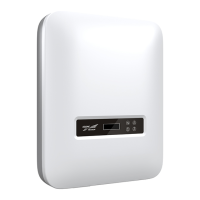

 To Next Page