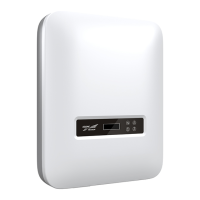
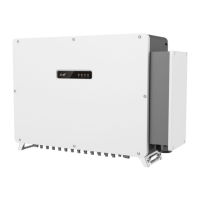
The document describes the KEHUA TECH SPI500K-B (V4.1-V4.3) User Manual, which details a PV grid-connected inverter.
Function Description
The SPI500K-B series inverter is designed for PV grid-connected power generation systems. Its primary function is to convert the DC power generated by PV modules into AC power and transmit it to the grid. The system continuously tracks the maximum power point (MPPT) of the solar battery array to ensure maximum power output regardless of sunlight and temperature conditions. The inverter can operate automatically without constant monitoring, determining whether to connect to the grid and generate power based on the PV array's output. The operational process includes startup, grid connection and generation, standby, normal halt, and fault handling.
The system comprises PV modules, a PV junction box, the PV grid-connected inverter, a metering device, and a power distribution system. Electricity from the PV modules passes through an SPD (Surge Protection Device) and a DC filter. The SPD absorbs DC side surge voltage, while the DC filter restrains high-frequency signal conduction interference and stabilizes the DC voltage with a storage capacitor. A three-phase full-bridge inverter unit converts the DC to AC, matching the grid's frequency and phase. This AC power then undergoes filtering to suppress high-frequency signal interference before being delivered to the grid via a transformer.
The inverter also includes an Emergency Power Off (EPO) button to disconnect the inverter from the power grid in emergencies, ensuring safety. After using the EPO button, the user must pop it up and reboot the control power to recover grid-connected operation.
Important Technical Specifications
The SPI500K-B series comes in three versions: V4.1, V4.2, and V4.3, with slight differences in DC input configuration.
DC Side Specifications:
- DC input route amount:
- V4.1: 1 route
- V4.2 & V4.3: 8 routes
- DC distribution breaker:
- V4.1: None
- V4.2 & V4.3: Yes
- Anti-reverse diode:
- V4.1 & V4.2: None
- V4.3: Yes
- Max. PV array power: 550kWp
- Max. PV array open-circuit voltage: 1000Vdc
- Max. DC current: 1200A
- MPPT voltage tracking range: 460~850Vdc
- Startup voltage: 480Vdc
- MPPT efficiency: 99.9%
- Max. reverse feedback current: 0A
Grid Side Specifications:
- Rated output power: 500kW
- Adjusting range of output active power: 0~500kW
- Max. output current: 1008A
- Total current wave distortion: <3% (rated power)
- Power factor: >0.99 (adjustable from -0.9 to +0.9)
- Max. efficiency: >98.5%
- Europe efficiency: >98.2%
- Rated grid-connected voltage: 315Vac, 3-phase
- Rated grid-connected frequency: 50/60Hz
General Specifications:
- Standby consumption: <150W
- Consumption at night: <80W
- Isolation type: No transformer
- Communication ports: RS232/RS485 (standard equipped), Ethernet (optional), GPRS (optional)
- Human-machine interface: LCD touch screen
- Dimension (W×H×D): 1100mm × 2000mm × 800mm
- Weight: 1000kg
- IP grade: IP20 (indoor)
- Cooling: Wind cooling
- Environment temperature: -25°C ~ 55°C (if >45°C, rated power needs to be decreased)
- Relative humidity: 0~95%, with no condensation
- Altitude: <3000m (if >3000m, rated power needs to be decreased)
- Noise: <75dB
Usage Features
The inverter boasts several user-friendly features:
- Wide input voltage range.
- Output adopts LC filtering.
- Advanced IGBT power module.
- Safe and reliable DSP+CPLD control architecture with fiber transmission.
- Busbar uses film capacitance for extended equipment life.
- Sine wave output, automatic grid synchronization, low current harmonic, and minimal grid impact.
- Disturbance detection technology for anti-islanding operation protection.
- Comprehensive protection functions and high reliability.
- Excellent thermal design for lower temperature rise and longer service life.
- Advanced MPPT algorithms with 99.9% efficiency.
- LCD touch screen with multi-language interface for display and settings.
- Monitoring via RS232/RS485 communication port.
- Protection and operation parameter settings.
- Modular design for easy installation, operation, and maintenance.
- Optional auxiliary heating function.
- Optional low voltage ride-through and reactive power compensation functions.
- Compatibility with Kehua's anti-countercurrent system for self-used grid-connected projects.
The touch screen allows users to:
- Look up current operation parameters (output power, daily energy, gross energy, CO2 emission reduction, grid voltage, frequency, internal temperature, input/output currents, etc.).
- View and change operation modes.
- Inquire about current and historical faults.
- View and change the current time.
- Access a main page with graphs (power curve, daily/monthly generation capacity/time) and functions (running information, engineering setting, screen setting, history information, factory setting, login/logout).
- Perform ON/OFF operations to start and stop the equipment.
- Login with different authority levels for setting and alteration.
- Set site parameters, power station mode, anti-countercurrent function, CVT/MPPT mode, active islanding permission, date, time, backlight brightness, screensaver, and language.
- Inquire and eliminate history logs, data, and faults.
- Recover to factory settings.
Maintenance Features
The manual emphasizes the importance of correct maintenance for optimal inverter operation and extended service life, categorizing it into preventive and remediation maintenance.
Safety Precautions:
- Only professionals with corresponding qualifications should perform operations and wiring.
- Do not open the inverter's casing; it may cause electric shock and void the warranty.
- Wait 20 minutes after powering down DC and AC sides before checking or maintenance to ensure complete discharge (DC busbar voltage should be under 10V).
- Cover PV arrays with light-proof material during daytime installation to prevent high voltage generation.
- Avoid using the inverter in environments exceeding technical specifications (temperature: -25°C~55°C), direct sunlight/rain, vibration/impact, dust, corrosive materials, salt, burnable gas, or poor ventilation.
- No liquids or objects should enter the cabinet.
- The inverter must be grounded before electrical connection.
- The product is a grade A device; users should take action to avoid wireless interference in residential areas.
- The product may cause DC current in external protective earthing conductors; only type B RCD or RCM can be used at the input.
- Do not insert fingers or tools into rotating fans.
- Use dry powder fire extinguishers in case of fire; liquid extinguishers may cause electric shock.
- Wear anti-static rings connected to ground before contacting sensitive components.
Routine Maintenance (Checking Items):
- Daily: Temperature and humidity, cleanliness of control room and other rooms.
- Weekly: Cleanliness of cabinet and platform surface, performance of temperature and humidity alarm.
- Monthly: Air condition filter clean and replacement, resistance measuring of anti-static staging, ground, seat, and wrist strap.
- Seasonally: SPD (before thunderstorm season).
- Yearly: Fixed gas extinguishing device, inflammable gas alarm, smoke detector, heat detector, and auto alarm device, grounding and ground connection resistance test, dust grain density measuring.
Preventive Maintenance (Quarterly Tasks):
- Keep the environment clean.
- Check wiring terminals on input/output cables for good connection.
- Check fan operation and ensure air vents are not blocked; replace damaged fans promptly.
- Periodically check equipment status.
Maintenance Operation Procedure:
- Shut down the inverter via the ON/OFF operation on the panel.
- Switch off all input and output disconnectors.
- Wait at least 20 minutes for residual charge to dissipate.
- Dismantle DC input, AC output, and grounding cables; insulate wire joints.
- Dismantle panel screws to perform maintenance or replacement.
- Reinstall the panel, reconnect wires, switch on AC output breaker, then DC input breaker, and reset startup operation.
The manual also provides a troubleshooting guide for common faults like IGBT over-temperature, PV over-voltage, communication faults, drive faults, soft start faults, grid connection abnormal, grid frequency/amplitude abnormal, hardware faults, internal over-temperature, insulation faults, fan faults, main contactor faults, input breaker disconnected, leak current faults, and emergency power off. Each fault lists potential solutions, including checking components, waiting for recovery, or contacting the company.

 Need help?
 General

 To Next Page