Normal Operating sounds&Sights
UNDERSTANDING THE SOUNDS YOU MAY
HEAR
Your new high-efficiency refrigerator may make unfamiliar
sounds, These are aii normal sounds and soon wiii
become familiar to you, They also indicate your refrigerator
is operating as designed, Hard surfaces, such as vinyl or
wood floors, walls, and kitchen cabinets may make
sounds more noticeable, Listed below are descriptions of
some of the most common sounds you may hear, and
what is causing them,
NOTE:R!g!d foam insulation iSvery energy efficbnt,
but is not a sound insuiator,
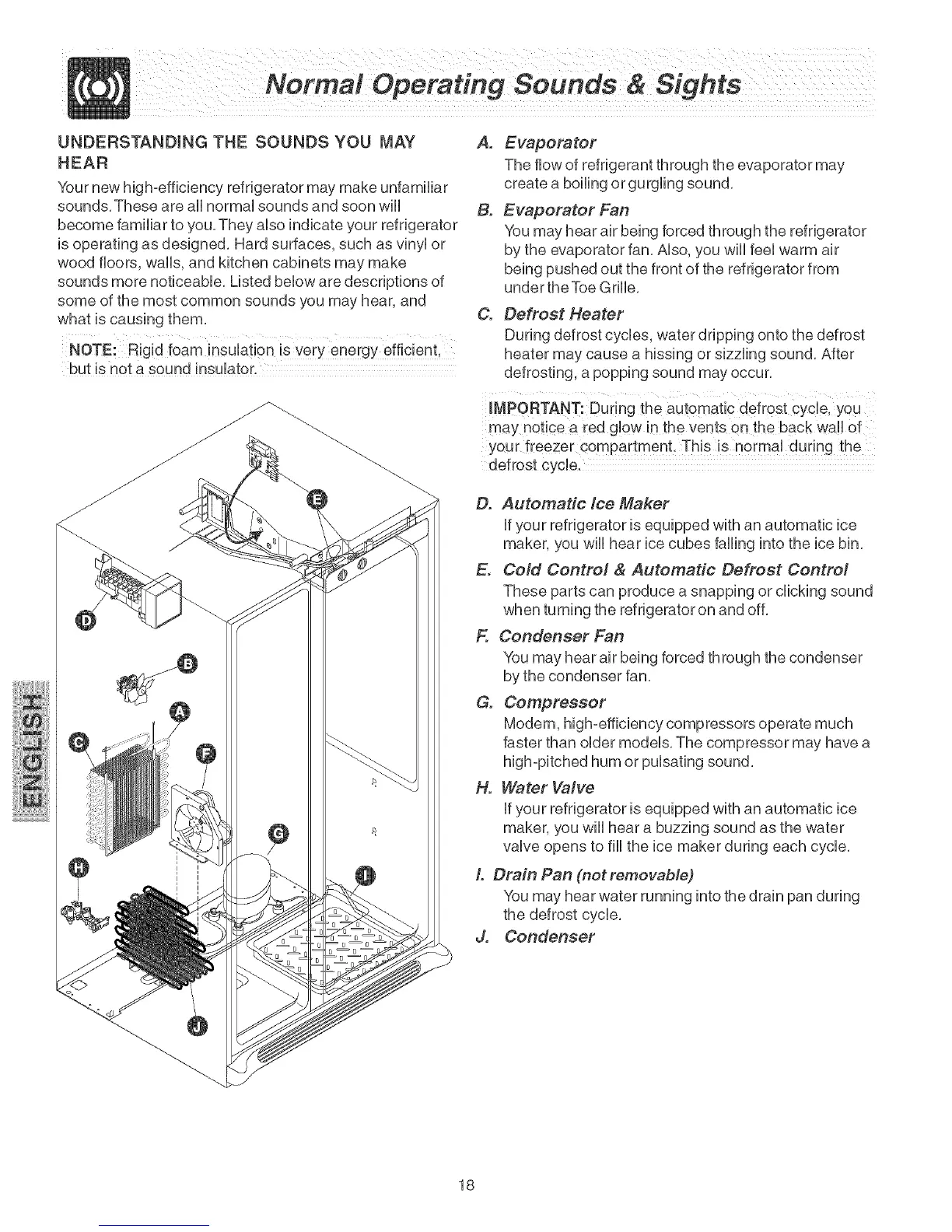
A. Evaporator
The flow of refrigerant through the evaporator may
create a boiling or gurgling sound.
B. Evaporator Fan
You may hear air being forced through the refrigerator
by the evaporator fan, Also, you wiii feel warm air
being pushed out the front of the refrigerator from
under theToe Grille,
C. Defrost Heater
During defrost cycles, water dripping onto the defrost
heater may cause a hissing or sizzling sound. After
defrosting, a popping sound may occur.
mMpORTANT: Dur!ng the automatic defrost cycle, you
may not!ce a red glow in the vents on the back wail of
your freezer compartmenL This is normai during the
defrost cyde.
D. Automatic ice Maker
if your refrigerator is equipped with an automatic ice
maker, you will hear ice cubes falling into the ice bin,
E. Cold Control & Automatic Defrost Control
These parts can produce a snapping or clicking sound
when turning the refrigerator on and off,
F. Condenser Fan
You may hear air being forced through the condenser
by the condenser fan.
G. Compressor
Modern, high-efficiency compressors operate much
faster than older models. The compressor may have a
high-pitched hum or pulsating sound.
H. Water Valve
if your refrigerator is equipped with an automatic ice
maker, you will hear a buzzing sound as the water
valve opens to fill the ice maker during each cycle,
to Drain Pan (not removable)
You may hear water running into the drain pan during
the defrost cycle,
Jo Condenser
18



 To Next Page