Need help?
Do you have a question about the Kenwood KFCD60B15 and is the answer not in the manual?
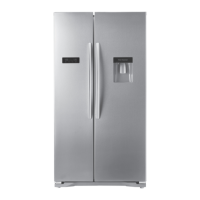
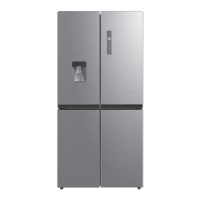
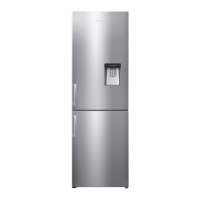
This document is an installation and instruction manual for the Kenwood 60cm Frost Free Fridge Freezer with Water Dispenser, models KFCD60B15, KFCD60W15, and KFCD60X15.
The Kenwood 60cm Frost Free Fridge Freezer is a household appliance designed for storing fresh and frozen food items. It features a frost-free system, eliminating the need for manual defrosting, and includes a water dispenser for convenient access to chilled water. The unit is categorized as a Refrigerator – Freezer, suitable for use in ambient temperatures between 10°C and 43°C.
Installation and Setup: The manual provides detailed instructions for unpacking, locating, and levelling the unit. It specifies free space requirements (25mm on sides, 50mm at rear, 25mm at top) for proper ventilation and door opening. The door swing is reversible, with comprehensive steps provided for changing the door's orientation, though contacting a qualified technician is recommended for this procedure. The unit should not be turned on for two hours after moving to allow coolant fluid to settle.
Door Handles: The door handles are installed by screwing them into place and covering the screw holes with caps.
Water Tank and Dispenser: The unit includes a water tank that needs to be inserted into the water dispenser's hole. The valve of the tank must be securely pushed down. To remove, hold the handle and bottom of the tank, then pull and push up simultaneously. Users are cautioned not to press on the valve and to ensure the rubber seal is in proper position. Only drinking water should be used, and the tank should not be filled above the maximum level. Hot water should not be filled into the tank. The water dispenser is operated by pressing a lever with a container, ensuring the lock is in the "Unlock" position.
Operation: The fridge freezer is controlled by an electronic control panel.
Defrosting Frozen Food: Frozen food should be defrosted at room temperature, and any liquid lost during defrosting should be drained. Ensure no ice crystals remain before cooking. Cook food as soon as possible after defrosting. Never refreeze defrosted food unless cooked again, except for shellfish which should never be refrozen.
Cleaning:
Internal LED Light: The internal LED light is a panel that cannot be changed by the user. A qualified service agent must be contacted for any issues with the light.
Handling and Moving: When moving the unit, hold it around its sides or base. Do not lift by the edges of the top surface.
Servicing: Servicing should only be performed by an authorised engineer using genuine spare parts. Users are advised not to attempt repairs themselves to avoid injury or malfunction.
Switching Off for Long Periods: If the unit will not be used for an extended period, disconnect it from the mains, empty all food, clean the appliance, and leave the door ajar to prevent unpleasant smells.
Condensation: Condensation on the exterior may occur due to room temperature changes. Wipe off moisture. If the problem persists, contact a qualified technician.
Disposal: Old units should be disposed of in an environmentally friendly manner to recover valuable raw materials. Special procedures are required for the refrigerant and insulation materials. Ensure no pipes on the back are damaged. Contact local council for information on disposal options. When disposing of an old unit, remove any locks or latches and the door as a safety measure.
 General
| Brand | Kenwood |
|---|---|
| Model | KFCD60B15 |
| Category | Refrigerator |
| Language | English |

 To Next Page