EasyManua.ls Logo

KGN pillinger AV Series - User Manual

KGN pillinger AV Series
15 pages
Print Icon
To Next Page IconTo Next Page
Loading...
AV & EV PRESSURE BOOSTER SETS
Operating & Maintenance
Original Instructions
Dated: 10.09.2020 Revision: 1
Ref: OM0001
Question and Answer IconNeed help?

Do you have a question about the KGN pillinger AV Series and is the answer not in the manual?

Summary

Introduction and Scope

Manual Purpose

Manual intended for installer/user for safe installation and operation of KGN Pillinger products.

Safety Warnings and Precautions

Danger and Equipment Damage

Failure to observe DANGER caution may result in injury and/or damage to equipment.

Electric Shock Hazard

Failure to observe ELECTRIC SHOCK warning may result in electric shock.

General Hazard Warning

Failure to observe WARNING may cause damage/injury to property, environment or person(s).

Product Overview

Component Identification

EV Booster Range Components

Storage and Handling Guidelines

Operating Limits and Noise

Product Identification Codes

Installation Procedures

Protection Against Dry Running

Option to protect against running the booster set dry using a low voltage relay.

Pipe Work Connection

Guidance on connecting pipework to the booster set manifolds, ensuring support and sealing.

Electrical Connection Requirements

Instructions for making electrical connections by qualified personnel according to standards.

Commissioning Process

Pre-start Up Checks

Procedures before starting, including accumulator pressure vessel and pump checks.

Booster Set Operation

Variable Speed Drive (VSD) Adjustment

Refers to a designated manual for modifying Variable Speed Drive settings.

Slow Fill Anti-Surge System

Accessing Product Manuals

Maintenance Schedule and Tasks

Monthly Maintenance Checks

Recommended maintenance tasks to be performed on a monthly basis.

Six-Monthly Maintenance Checks

Additional maintenance tasks recommended every six months.

General Fault Finding and Disposal

Troubleshooting Common Faults

Table listing common faults, their possible causes, and recommended actions.

Product Disposal Instructions

Guidelines for disposing of the product and packaging according to local regulations.

EC Declaration of Conformity

Overview

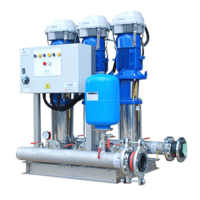
The KGN Pillinger AV & EV Pressure Booster Sets are designed to transfer and boost clean (potable) water in domestic, commercial, and industrial applications. These booster sets are built with identical pumps and controllers in parallel, mounted on a common stand with suction and discharge manifolds, on-off valves, check valves, pressure gauges, pressure transmitters, and a single or three-phase control panel. The system requires installation with preinstalled, sized membrane pressure vessels.

Function Description:

The pumps are controlled by Variable Speed Drives (VSDs) according to system requirements. Initially, the pressure vessel(s) supply the demand. When the pressure drops to a set control value, the VSD starts the first pump. If water demand increases, the first pump speeds up, and subsequent pumps are engaged as needed. As demand reduces, pump speed decreases until they stop. If demand reduces further, the last pump fills the pressure vessel and then shuts down. The unit operates as a pressure transducer-controlled single or multi-pump booster set, capable of duty/assist or duty/assist/standby operation. Internal software programming within the VSD adjusts pump speed to match system demand. If the demand exceeds the 'Duty' pump's capacity, an 'Assist' pump automatically activates via an RS 485 data link or control logic. This process repeats for additional assist/standby pumps if available and if the duty and assist pumps fail to meet demand. Pumps run under transducer control, which sends signals to inverters to increase, decrease speed, or stop at zero demand. Overload, overcurrent, undercurrent, overvoltage, and undervoltage protection are integrated into the VSD. On multi-pump sets, the 'Duty' pump is typically determined by the internal electronic programming of the drive, with automatic rotation of pump duty every 24 hours (or a pre-programmed period). All units include one or more pressure vessels to provide positive system pressure, aiding pump control. Standard units feature a low water cut-off circuit, using a low voltage relay, which should be wired to a float switch or electrodes in the suction break tank. For sets with twin suction break tanks, KGN Pillinger offers an optional additional set of electrodes and a 'Twin Tank Selector Switch' (fitted on the control panel fascia, adjacent to the control panel, or local to the tanks) to allow the operator to select the 'Live' tank for low water protection while the other tank is isolated for cleaning or maintenance. Depending on the specification, volt-free contacts for remote indication of pumps running, pumps tripped, and low water cut-off may be fitted for connection to client BMS systems. Pressure switches may also be fitted for high- and low-pressure monitoring or control.

Important Technical Specifications:

  • Fluid Temperature: 5°C to 80°C
  • Ambient Temperature: 5°C to 40°C
  • Operating Pressure: 8 Bar, 10 Bar, 16 Bar (dependent on model)
  • Protection Class (Motor, Panel, VSD): IP55
  • Starts per Hour (Kw dependent):
    • 0.25-3 Kw: 60 starts/hour
    • 4-7.5 Kw: 40 starts/hour
    • 11-15 Kw: 30 starts/hour
    • 18.5-22 Kw: 24 starts/hour
    • 30-37 Kw: 16 starts/hour
    • 45 Kw: 8 starts/hour
    • 55 Kw: 4 starts/hour

Usage Features:

  • Product Identification Code: Each set is identified by a specific coding system indicating optional extras, number of vessels, variable speed drive type (motor-mounted or panel-mounted), booster type (A Series, Eco Range, Transfer Set, Pillinger Compact Booster), break tank type (above or common base), size of vessel, number of pumps, horizontal/vertical orientation, alternative pump/VSD supplier, pump model, and tank model (if included).
  • Installation Requirements: The booster set must be installed by a competent person familiar with relevant regulations. It requires a ventilated, dry, frost-free position with 0.5m clearance on all sides and front for maintenance. It must be installed on a level, structurally sound surface with free-moving anti-vibration mounts.
  • Dry Running Protection: KGN offers an optional low voltage relay to protect against dry running, wired to a float switch or electrodes in the suction break tank.
  • Pipework Connection: Connection pipework must be adequately sized, well-supported, and match or exceed the manifold diameter. Pipework should be flushed before connection. All joints must be sealed and watertight.
  • Electrical Connections: All electrical connections must be made by a qualified electrician in accordance with local regulations and standards. The incoming supply must be sized for the motor full load current of all pumps. Connections must follow product wiring diagrams and comply with safety standards. Cable and fuse/MCB protection must be suitably rated, and the equipment must be earth bonded.
  • Slow Fill - Anti Surge (AV units only): In case of power failure or starting on an empty system, the Slow Fill system manages water filling at a reduced pressure, preventing pressure shock waves. The VSD operates pumps to achieve a set pressure before running at full capacity. This feature is currently available on boosters with Hydrovar VSDs but can be designed for new or existing systems.
  • VSD Adjustment: Modifications to VSD settings require referring to the designated manual.

Maintenance Features:

  • General: The unit is constructed with low-maintenance components.
  • Recommended Service: KGN Pillinger recommends commissioning and biannual servicing by a fully trained KGN Pillinger engineer.
  • Safety Precautions: Do not touch live parts for at least 8 minutes after switching off power. The electrical system must be isolated before any work.
  • Accumulator Pressure Vessel: The pressure vessel(s) are pre-charged with dry clean air or oxygen-free nitrogen gas during commissioning. This charge must be checked and adjusted regularly to maintain correct system operation.
  • Pumps: Ensure pumps are filled with liquid, primed, and bled before operation, and are running in the correct direction/rotation.
  • Monthly Checks:
    1. Pumps for leakage and quiet running.
    2. Operation of the set and test auto duty rotation.
    3. Pipework and installation for condition and leakage.
  • Six-Monthly Checks (in addition to monthly schedule):
    1. Pre-charge pressure in the vessel and top up if necessary.
    2. Operating points of pressure switches and adjust if necessary.
    3. Exercise valves to prevent seizure.
    4. Control panel: test trips, check contactors, lamps, etc.
  • Fault-Finding Guidance: The manual provides a table for common faults, possible causes, and recommended actions (e.g., "No power, the set is off" -> "Power supply disconnected" -> "Connect power supply").
  • Disposal: The product and its associated parts must be disposed of in accordance with local regulations, including packaging.

KGN pillinger AV Series Specifications

General IconGeneral
BrandKGN pillinger
ModelAV Series
CategoryWater Pump
LanguageEnglish

Related product manuals