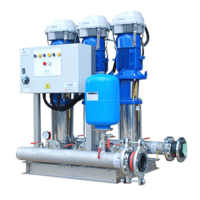
The KGN Pillinger Dry Well Submersible Pump Set is a robust and automated system designed for collecting and transferring various products, particularly in applications involving foul water or surface water. This manual, dated 10.02.2022 (Revision: 1), provides comprehensive operating and maintenance instructions for installers and users.
Function Description:
The pump set consists of a skid-mounted stainless steel holding tank equipped with all necessary ports for inlet, outlet, and air vents. It integrates horizontally mounted electric submersible pumps, valves, pipework, and controls. The primary function is to automatically collect fluid and transfer it via the pumps, controlled by float switches or level electrodes within the stainless steel holding tank. In a typical operation, when the fluid level in the tank reaches "start level 1," one pump activates. If the level continues to rise to "level 2," the second pump will engage, and both pumps will operate until the fluid level drops. The system is designed for duty/standby operation, ensuring continuous functionality. The starters are interlocked, allowing only one pump to run at a time under manual or auto control. In auto control, pumps operate based on fluid levels, with duty alternation to ensure even wear. A high-level float/electrode triggers an alarm (light and buzzer) if the level continues to rise, which can be muted and reset once the level drops. If the duty pump fails to clear the sump, the assist pump will automatically start.
Important Technical Specifications:
While specific technical data for individual pump models is not detailed in this general manual, the system is designed to handle raw sewage and surface water. Electrical connections must be sized, installed, and protected according to the latest safety standards and local regulations. The incoming electrical supply must be capable of carrying the full load current of all pumps operating simultaneously. It is critical that the equipment is earth bonded to the building's earth system. The system is constructed with low-maintenance components. The UKCA Declaration of Conformity indicates compliance with the MACHINERY Directive (2006/42/EC), LOW VOLTAGE Directive (2014/30/EU), and EMC Directive (2014/65/EU), as well as technical standards such as EN ISO 12100:2010, EN 809+A1:2009, EN 61000-6-1:2007, EN 61000-6-2:2005, EN 61000-6-3:2007+A1:2011, and EN 60204-1:2006+A1:2009.
Usage Features:
- Automated Operation: The system automatically manages fluid collection and transfer based on predefined level triggers.
- Duty/Standby Control: Ensures continuous operation and extends pump life through automatic alternation.
- Manual Override: Pumps can be operated individually in manual control via switches on the control panel door.
- Level Control Options: Can be configured with either float switches ('Stop', 'Start', 'High Level') or electrodes ('Stop', 'Start', 'High Level', 'Common').
- High-Level Alarm: Provides visual and audible alerts for critical fluid levels, with a 'cancel alarm' function.
- Robust Construction: Skid-mounted stainless steel tank and durable components for longevity.
- Product Identification: Units are identified by a 'P' Number, Serial Number, or Site/job Reference found on the nameplate.
- QR Code Support: Scannable QR codes provide access to specific product details.
Maintenance Features:
- Recommended Bi-annual Servicing: KGN Pillinger recommends routine maintenance visits twice a year by a trained engineer.
- Comprehensive Service Checks: During service, a KGN engineer will perform:
- Visual inspection of pumps.
- Topping up oil levels where necessary.
- Testing pump motors.
- Cleaning and checking electrodes, non-return valves (NRVs), gate valves, and electrical connections.
- Testing all electrical controls.
- Providing a detailed report of findings and an invoice.
- Low Maintenance Design: The unit is constructed with low-maintenance components, minimizing daily upkeep requirements.
- Monthly User Checks: Users are advised to perform monthly checks, including:
- Thorough visual inspection of the equipment during a complete cycle.
- Cleaning dirt or debris from high-level float switches and other float switches using a water hose.
- Verifying that float switches have not moved from their pre-set positions and that pumps are operating correctly.
- Fault-Finding Guidance: The manual provides a table for general fault-finding, outlining possible causes and recommended actions for common issues like pumps not running, frequent starting, prolonged running, or a flooded pumping set.
- Blockage Prevention Guidelines: Emphasizes the importance of not disposing of items like disposable nappies, sanitary towels, cloth/plastic items, toilet cleaning wipes, or cooking fat through the drainage system to prevent pump failure and costly repairs.
- Disposal Information: The product and its associated parts must be disposed of in accordance with local regulations.
Safety Considerations:
The manual highlights critical safety warnings:
- DANGER: Failure to observe cautions may result in injury and/or equipment damage.
- ELECTRIC SHOCK: Risk of electric shock if warnings are not observed.
- WARNING: Failure to observe warnings may cause damage/injury to property, environment, or persons.
- Heavy Units: Assembled units are heavy; proper lifting devices and methods are essential to prevent injury and damage.
- Competent Personnel: Installation, operation, and maintenance must be performed by competent persons familiar with relevant regulations.
- PPE: All personnel working on the equipment must wear necessary Personal Protective Equipment (PPE).
- Raw Sewage Hazards: Foul water pumps handle raw sewage, posing risks of Leptospirosis (Weils Disease) and exposure to unknown substances, chemicals, and harmful gases. Only trained and qualified engineers should service these pumps, especially in confined spaces.
- Explosive/Toxic Gases: Sewage gases are explosive and toxic. Smoking, naked flames, or sparks are prohibited in the vicinity of the equipment.
- Dry Running Prevention: Pumps must never run dry to prevent rapid damage to internal components.
- Noise Emissions: Exposure to excessive noise can cause permanent hearing damage; end-users are responsible for identifying legal requirements and implementing noise control.

 Need help?
 General

 To Next Page