So you’re asking yourself...Where did 1728 come from anyway. Did we make it up? Nope! 1728 is one
cubic foot or 12 x 12 x 12. Is it magic? Nope, wrong again, Thank you for playing! Dividing by this figure
converts total cubic inches into total cubic feet. You’ll want to stay with me on this one, it could get tricky.
Divide the total cubic feet by the number of drivers to be installed in the enclosure, usually two, to get the
total cubic feet per driver. This is how the manufacturer usually lists specifications.
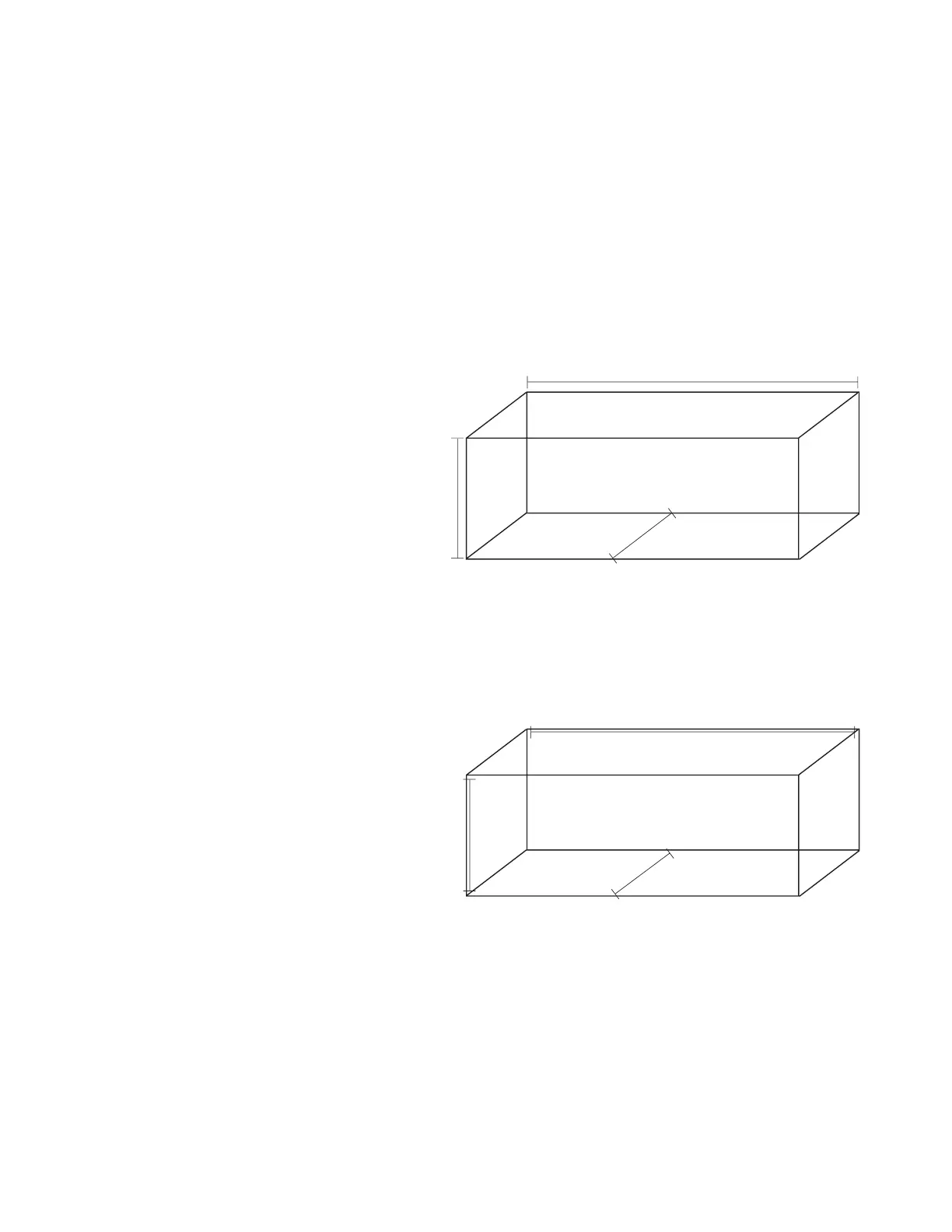
When calculating an enclosure’s volume you will work with EXTERNAL and INTERNAL dimension. External
dimensions are what you have to work with after measuring the space available in the vehicle. Internal
dimensions are what you’ll want to go by when selecting a speaker for the enclosure. So you say, What’s
the Dif. Huh? External, internal, it doesn’t matter! It could mean the difference of having a 12” woofer in
too small of a box or a 10” woofer in the right box.
We all know, a 10” woofer in the right box will sound
better than a 12” woofer in the wrong box!
Let’s look at the numbers: if you’re using 3/4” MDF, you would
subtract double the thickness of the MDF from each dimension to get internal dimension.
I know you hear me, but let me show you!
Since we are using 3/4” or .75” MDF
.75” + .75” = 1.5”
14” - 1.5” = 12.5”
41” - 1.5” = 39.5”
14” - 1.5” = 12.5”
12.5” x 39.5” x 12.5” = 69171.88
INTERNAL cubic inches
6171.88 / 1728 = 3.57
INTERNAL cubic feet
3.57 / 2 drivers = 1.79 cu. ft. per driver
Step 2: Calculating Displacement
Displacement refers to the space used by
things inside an enclosure that influence total
volume and is mostly associated with drivers in
an enclosure. However, other factors will also
influence an enclosures total volume, like
ports, bracing and occasional screw driver that
gets left inside the box by accident. It is a
good idea to look in the box before sealing it
up, to make sure you have not left any tools inside. To calculate exact enclosure volume, we’ll need to con-
sider port, bracing and speaker displacement.
Port Displacement: Calculating the amount of space taken by a port will test your memory of high
school geometry. This is one of those things back in school you said to yourself, “I’ll never use this”( so you
slept through that class). Guess what? It is coming back to haunt you! It really is pretty simple. If only the
teacher could have related it to car audio, we might have paid more attention. Are you ready?
Area x Length = Volume.
Isn’t that simple?


 To Next Page
 Loading...