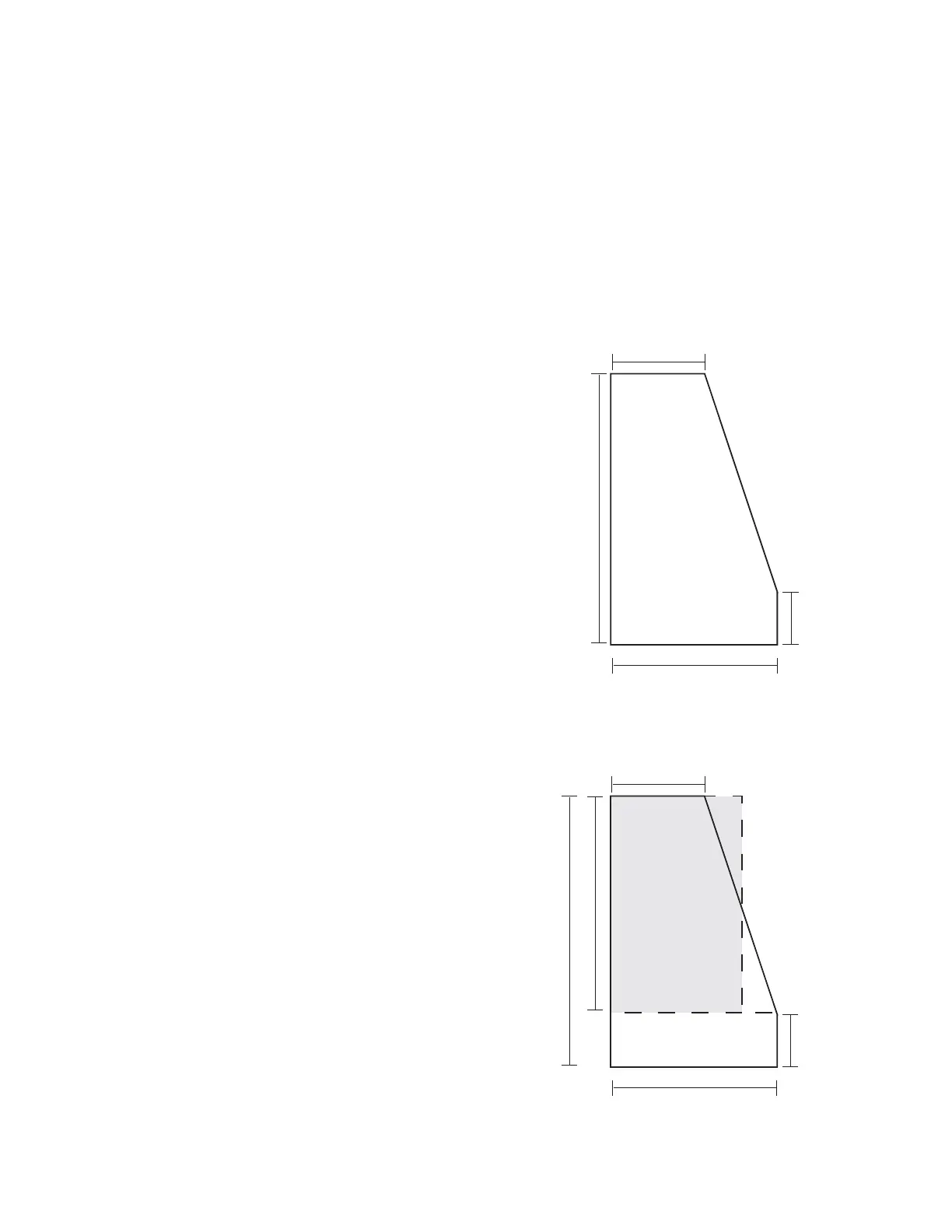
Since the formula to determine enclosure volume does not allow for two different depth dimensions (5”
Top and 13” Bottom), we must find an average of these two figures.
To find the average, add the figures together (5 +13) then divide by the number of figures added (2).
Once again, it would have been helpful to stay awake in geometry class! Are you with me? Let’s look at the
numbers.
5” + 13” = 18” 18”/2 = 9”
In essence, averaging the 5” depth and 13” depth gives us a rectangular box to work with instead of an
angled one ( note the “dotted line” enclosure). Now the formula for figuring volume works.
3.53 / 2 = 1/765 cu. ft. per driver
To calculate internal volume, you must subtract the thick-
ness of the wood. We’re using 3/4” MDF again, so deduct
1.5” from each dimension.
54” - 1.5” = 52.5”
9” - 1.5” = 7.5”
17” - 1.5” = 15.5”
52.5” x 7.5” x 15.5” = 6103.13 cu. in.
6103.13 / 1728 = 3.53 cu. ft.
Angled Enclosures with Risers
This type of enclosure is a little more difficult to work with
than just an angled enclosure, but we’ll help you through.
Follow the calculations below for volume on an angled
enclosure with a riser.
Dimensions: 17” Height x 44” Width x 5’ Depth(Top) and 13”
Depth (Bottom) with a 4” riser.
First, make the box into a rectangle like we did before by
averaging the top and bottom depth measurements:
5 + 13 = 18 18/2 = 9
Instead of using the entire height dimension, deduct the
height of the riser, 4” for this example.
17” - 4” = 14” High



 To Next Page