EasyManua.ls Logo

Kiddicare Gliding Crib - User Manual

Kiddicare Gliding Crib
8 pages
Print Icon
To Next Page IconTo Next Page
Loading...
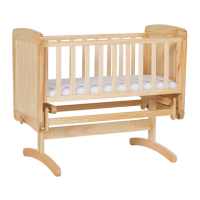
gliding crib
Instruction Manual
Important: Keep for future reference, read carefully
Kiddicare
Club Way,
Cygnet Park,
Hampton,
Peterborough,
Cambridgeshire PE7 8JA
Customer Care: hello@kiddicare.com
Care
Warning: The crib/cradle should be locked in the fixed position when a child is
unsupervised init.
Warning: Do not use the crib/cradle if any part is broken, or missing and use only spare
parts approved by Kiddicare
Warning: Be aware of the risk of open fires and other sources of strong heat, such as
electric bar fires, gas fires, etc in the near vicinity of the crib/cradle.
We recommend you use a mattress size 85 x 43cm for this crib/cradle. The thickness of
the mattress chosen shall be such that the internal vertical height (surface of the mattress
to the upper edge of crib sides) is at least 200mm in the highest position of the base.
A child’s safety is your responsibility.
Do not use the body of the cradle without its frame.
The crib/cradle should be placed on a horizontal floor.
When a child is able to sit, kneel or to pull itself up, the crib/cradle shall not be used
anymore for this child.
Young children should not be allowed to play unsupervised in the vicinity of the crib/cradle.
Maintenance
All assembly fitting should always be tightened properly and that care should be taken that
no screws are loose, because a child could trap parts of the body or clothing (e.g. strings,
necklaces, ribbons for babies dummies, etc.), which would pose a risk of strangulation.
From time to time, check your crib/cradle for loose screws, and worn parts. Replace or
adjust the parts as needed.
Cleaning
Your crib can be cleaned by wiping with a damp cloth and drying with a soft clean cloth.
Do not use abrasives, bleach, alcohol or ammonia based household polishes.
Safety
Complies with BS EN 1130 1997
All manuals and user guides at all-guides.com
all-guides.com

Other manuals for Kiddicare Gliding Crib

Question and Answer IconNeed help?

Do you have a question about the Kiddicare Gliding Crib and is the answer not in the manual?

Summary

Product Care and Safety

Safety Guidelines

Essential safety precautions, warnings, and usage restrictions for the crib, including fire risks.

Maintenance Recommendations

Instructions for regular checks of fittings and parts to ensure the crib's integrity and safety.

Cleaning Instructions

Guidance on cleaning the crib using a damp cloth and soft cloth, avoiding harsh chemicals.

Product Usage

Locking the Crib

Instructions on using the insert to secure the crib in a fixed, stable position.

Overview

This document outlines the assembly, care, and usage instructions for the Kiddicare Gliding Crib, a product designed to provide a safe and comfortable sleeping environment for infants. The crib is designed to comply with BS EN 1130 1997 safety standards, ensuring it meets specific requirements for stability, durability, and child safety. Its primary function is to serve as a secure sleeping space for a baby, featuring a gliding mechanism that allows for gentle rocking, which can be soothing for infants. This gliding motion can be locked into a fixed position when not desired or when the child is unsupervised, adding to its versatility and safety.

Function Description:

The Kiddicare Gliding Crib is a baby crib with a built-in gliding mechanism. This mechanism allows the crib to rock gently from side to side, mimicking the motion often used to comfort and lull a baby to sleep. The gliding feature is intended to be used when the child needs soothing or is being put to sleep. For periods when the child is unsupervised or when a stationary crib is preferred, the gliding function can be easily locked, converting it into a stable, fixed crib. This dual functionality makes the crib adaptable to different situations and preferences. The crib is designed to accommodate a mattress of specific dimensions, ensuring a snug and safe fit for the baby. The internal vertical height from the mattress surface to the upper edge of the crib sides is designed to be at least 200mm in the highest base position, a critical safety feature to prevent a child from climbing out. The crib's structure is robust, comprising various wooden and metal components that are assembled to form a secure enclosure for the baby. The design emphasizes both functionality and safety, providing a reliable sleeping solution for infants.

Usage Features:

The crib is designed with several usage features to ensure both convenience for parents and safety for the child.

  • Gliding Mechanism: The core feature is its gliding motion, which can be engaged to gently rock the baby. This motion is smooth and controlled, designed not to be overly vigorous, ensuring the baby's comfort and safety.
  • Lockable Fixed Position: A key safety and convenience feature is the ability to lock the gliding mechanism. This is crucial when the child is unsupervised, as it prevents accidental movement and provides a stable sleeping environment. The manual explicitly states that the crib should be locked in the fixed position when a child is unsupervised.
  • Mattress Compatibility: The crib is designed for a mattress size of 85 x 43cm. Adhering to this specific size is important for safety, as an ill-fitting mattress could create gaps where a child might become entrapped. The thickness of the mattress is also important, ensuring the internal vertical height from the mattress surface to the upper edge of the crib sides is at least 200mm in the highest base position.
  • Age and Developmental Stage Limitations: The crib is intended for use until a child is able to sit, kneel, or pull themselves up. Once a child reaches these developmental milestones, the crib should no longer be used for that child, as they may be able to climb out, posing a fall risk. This is a critical safety instruction that parents must follow.
  • Placement Guidelines: The crib should always be placed on a horizontal floor to ensure stability and proper functioning of the gliding mechanism. It should also be kept away from open fires and other strong heat sources like electric bar fires or gas fires, to prevent fire hazards.
  • Supervision: Young children should not be allowed to play unsupervised in the vicinity of the crib/cradle, emphasizing the need for adult supervision to prevent accidents.
  • Assembly: The crib requires assembly, and the manual provides detailed diagrams and instructions for this process. It includes a list of parts and tools required, with an Allen key provided and a cross-head screwdriver needed but not included. The assembly steps are clearly illustrated, guiding the user through connecting various components like side panels, base supports, and the gliding mechanism. Proper assembly is crucial for the crib's stability and safety.

Maintenance Features:

Proper maintenance is essential to ensure the continued safety and longevity of the Kiddicare Gliding Crib.

  • Regular Fastener Checks: All assembly fittings, such as screws and bolts, should always be tightened properly. It is crucial to regularly check that no screws are loose. Loose screws can not only compromise the structural integrity of the crib but also pose a strangulation risk if a child traps parts of their body or clothing (e.g., strings, necklaces, ribbons for dummies) on them. This emphasizes the importance of routine inspections.
  • Inspection for Worn Parts: From time to time, users should check the crib for any worn parts. If any parts show signs of wear or damage, they should be replaced or adjusted as needed. The manual specifies that only spare parts approved by Kiddicare should be used, ensuring compatibility and maintaining safety standards.
  • Cleaning Instructions: The crib can be cleaned by wiping it with a damp cloth and then drying it with a soft, clean cloth. This method helps to keep the crib hygienic without damaging its materials.
  • Prohibited Cleaning Agents: It is explicitly stated that abrasive cleaners, bleach, alcohol, or ammonia-based household polishes should not be used. These substances can be harsh on the crib's materials, potentially causing damage or leaving residues that could be harmful to a baby. Adhering to the recommended cleaning methods helps preserve the crib's finish and ensures a safe environment for the child.
  • Structural Integrity: The manual warns against using the crib if any part is broken or missing, reinforcing the importance of maintaining the crib's structural integrity for the child's safety.
  • Body of the Cradle: The manual also states not to use the body of the cradle without its frame, indicating that the frame is integral to the crib's stability and safety.

Overall, the Kiddicare Gliding Crib is designed as a practical and safe sleeping solution for infants, with clear instructions provided to guide parents through its assembly, usage, and maintenance, ensuring the well-being of the child.

Kiddicare Gliding Crib Specifications

General IconGeneral
BrandKiddicare
MaterialWood
Color OptionsWhite, Natural
Mattress IncludedNo
Assembly RequiredYes
Mattress RequiredYes

Related product manuals