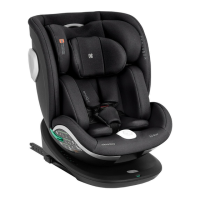
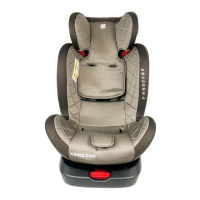
The Kikkaboo i-TRIP car seat is an i-Size Enhanced Child Restraint System designed to provide optimal safety for children from 40 to 150 cm in height and up to a maximum weight of 36 kg. It is approved according to European Regulation ECE R129, making it suitable for i-Size compatible car seats. The car seat offers versatile usage, functioning as a 5-point harness system for children between 40 and 105 cm (from birth to approximately 4 years) and as a booster seat with a 3-point vehicle belt for children between 100 and 150 cm (from 3 to 10 years). For specific cars, it can also be used as a booster seat for children between 135 and 150 cm.
Key Components:
The car seat is equipped with several key components for functionality and safety:
- Headrest (1): Adjustable to ensure proper positioning for the child's head and neck.
- Small headrest (2): Provides additional support for smaller children.
- Internal cushion (3): Enhances comfort and fit for younger children.
- Buckle (4): The central fastening mechanism for the 5-point harness.
- Crotch pad (5): Prevents the child from sliding down and adds comfort.
- Central adjuster (6): Used to tighten and loosen the 5-point harness straps.
- Adjuster strap (7): Connects to the central adjuster for harness adjustment.
- Adult seat belts guide gap (8): Guides the vehicle's 3-point seat belt when used as a booster.
- Shoulder belts (9): Part of the 5-point harness system.
- Backrest reclining handle (10): Allows adjustment of the backrest recline position.
- Rotation button (11): Enables the 360° rotation system for easy installation and child placement.
- ISOFIX button (12): Used to extend and retract the ISOFIX connectors.
- Headrest handle (13): For adjusting the height of the headrest.
- Top tether (14): An additional anchorage point for enhanced stability, especially in forward-facing installations.
- Child car seat (15): The main body of the car seat.
- ISOFIX connector (16): Connects the car seat to the vehicle's ISOFIX anchors.
Installation and Usage Features:
ISOFIX Preparation (2.1):
If the vehicle lacks ISOFIX guide sockets, these should be inserted into the ISOFIX anchors, typically located between the backrest and seat cushion. The ISOFIX button (12) should be pressed to extend the ISOFIX connectors (16) to their longest position.
Top Tether Preparation (2.2-2.3):
The Top Tether (14) strap is pulled out and extended by pressing its release button until it is long enough to connect to the vehicle's Top Tether anchorage point. Correct tightening is indicated by the button changing to green.
Harness and Headrest Adjustment (2.4-2.6):
- For 5-point harness (40-105 cm): The central adjuster (6) is pressed down, and shoulder belts (9) are pulled to release the harness. The headrest (1) is adjusted using its handle (13) to align the shoulder belts with the child's shoulders.
- For booster mode (100-150 cm): The 5-point harness and internal cushion (3) are removed. The headrest (1) is adjusted to ensure the vehicle's 3-point diagonal belt sits correctly on the child's shoulders, allowing two fingers to fit between the headrest's shoulder strap and the child's shoulder.
360° Rotation System (2.7):
The car seat features a 360° rotation system, activated by pulling the rotation button (11) outwards. This allows for easy rotation of the car seat for installation in rearward-facing (40-105 cm) or forward-facing (76-150 cm) positions, and for placing the child in the seat. The car seat locks automatically into place at 90° and 180° rotations.
Installation Modes:
- Rearward-Facing (40-105 cm, from birth to approx. 15 months) with 5-point harness + ISOFIX + Top Tether (3.1-3.2): The car seat is installed in the fullest recline position, with ISOFIX connectors engaged (indicator turns green), and the Top Tether connected. The car seat is pushed firmly against the vehicle's backrest. Children between 40 and 75 cm may require additional cushions.
- Forward-Facing (75-105 cm, from approx. 9 months to 4 years) with 5-point harness + ISOFIX + Top Tether (3.7): Similar to rearward-facing installation, but the car seat faces forward.
- Forward-Facing (100-150 cm, from 3 to 10 years) with 3-point vehicle belt or 3-point vehicle belt & ISOFIX (3.8-3.9): The 5-point harness and internal cushion are removed. The car seat is installed facing forward, with the vehicle's 3-point belt guided through the red belt guide gaps (8) and ensuring the diagonal belt sits over the child's collarbone, not their neck. ISOFIX can be used for added stability.
Child Securing (3.3-3.4, 3.9):
- With 5-point harness: The red button on the buckle (4) is pressed to release the harness. The child is placed in the seat, and the buckle latches are guided together and inserted into the buckle until an audible "click" is heard. The adjuster strap (7) is pulled to ensure the harness is snug against the child's body.
- With 3-point vehicle belt: The vehicle's 3-point belt is pulled out, guided around the child, and fastened. The diagonal and lap belt sections are routed through the red belt guide gaps (8) on the car seat.
Safety Checks (3.5):
Before every journey, ensure:
- ISOFIX connectors are securely engaged and indicators are green.
- The child restraint is against the vehicle seat's backrest.
- The 5-point harness (if used) is snug, allowing no more than one finger between harness and child's body.
- Straps are not twisted, shoulder straps are correctly positioned, and the lap strap is worn low.
- The buckle is properly secured.
Removal of the Car Seat (IV):
- ISOFIX: Press the ISOFIX release buttons (12) to disengage connectors, then push them back into the base.
- 3-point vehicle belt + ISOFIX: Release the vehicle belt buckle, unthread the belt, then follow ISOFIX removal steps.
Removal and Installation of the 5-point Harness (V):
- Removal (5.1-5.6): The central adjuster (6) is pressed, and shoulder straps (9) are pulled to release the harness. The headrest (1) is pushed down, and the car seat is rotated to face the rear. The rear cover board is opened, and webbing loops are placed over the joint plate. The shoulder belts and pads are removed from the headrest slots and buckle. The metal plate of the buckle is turned vertical and removed.
- Installation (5.7-5.12): The 5-point harness buckle (4) is placed into the crotch pad (5). The buckle's metal plate is inserted vertically into its housing. Buckle latches are guided together and inserted until an audible "click" is heard. The headrest (1) is pushed up to align holes. Shoulder belts and pads are threaded through the headrest slots, ensuring shoulder pad straps are beneath shoulder belt straps. The car seat is rotated to face the rear, and the rear cover board is opened to place webbing loops over the joint plate, then closed.
Care and Maintenance (VI):
- 5-point harness buckle: Buckle failure can cause injury. Do not use oil or lubricants on any part of the buckle. Malfunctions are often caused by debris buildup. Signs of malfunction include slow release, insecure locking, lack of audible click, difficulty inserting, or requiring extreme force to open.
- Cleaning the buckle: Remove the buckle from the car seat. Soak it in warm water with mild dish soap for at least an hour, then rinse and air dry thoroughly before reattaching.
Important Warnings:
- Always keep the instructions for use for the entire life of the car seat.
- Never install the car seat in the front passenger seat if there is an active airbag.
- Do not use forward-facing before the child is 15 months old.
- Do not use rearward-facing if an active frontal airbag is installed in the seating position.
- Ensure all straps are tight and not twisted.
- Replace the car seat after an accident, even if there are no visible damages.
- Do not use the car seat without its cover or harness protectors.
- Protect the car seat from direct sunlight.
- Do not leave the child unattended in the car seat.
- Ensure luggage and objects are securely fastened.
- Do not replace the child restraint system's cover with another unless recommended by the manufacturer.
- Do not use other support points than those described in the instructions.
- Do not use the car seat at home; it is designed for vehicle use only.
- Remove the child from the car seat before adjusting any movable part.
- Regularly check belts for wear.
- Ensure the buckle is fully locked.
- Keep the child's chair in a safe place away from children when not in use.
- Avoid placing heavy objects on the chair.
- Prevent contact of your vehicle chair with corrosive substances.

 Need help?




 To Next Page
 General