37
Introduction
Daily use
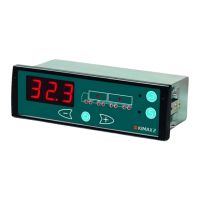
KIMAX2
Menu
Configuration
Calibration
Protecting
calibration
Electrical
installation
Sensor
installation
Additional
information
Frequently Asked Questions
Q 1: Why is the configuration and calibration not done by the manufacturer?
Q 2: What is HFA and why is it changeable?
Q 3: Why do I have to configure CH?
Q 4: Why do I have to calibrate both LO and HI?
Q 5: Why do I have to calibrate each axle?
Q 6: What are the OAA values?
Q 7: What are the AdL and the AdH values?
Q 8: Why are the axle LEDs flashing?
Q 9: Why are my measured values very unstable?
Q 10: Why is my Kimax 2 not responding, when I try to save new values?
Q 11: How can I test my Kimax 2?
A 1: Kimax 2 instruments are pre-configured based on the information given to Sense-Tech Weighing
Systems ApS, when the instrument was ordered. However the calibration cannot be done before
the instrument is installed on the vehicle, since all vehicle types or brands are unique in their
suspension. All instruments are however factory calibrated as a part of the in-house testing
procedures.
A 2: HFA is a setting that tells the instrument whether it is a Master or a Slave instrument and if it is
installed on a truck or trailer. HFA is changeable, because a box can be mounted on either a
truck or a trailer. A Master instrument must however be mounted on a truck and it has to be set
to HFA = 0 or HFA = 1.
A 3: CH is a setting that turns the input channels of the instruments on or off. Furthermore the axle
LEDs are assigned to a specific input channel. For instance if the SG-sensor (or Air pressure
sensor) connected to the first input channel (CH1) is measuring the load of the front axle, then
the first axle LED (LED1) is assigned to the first input channel. Now it will be visualized that the
first sensor is measuring the weight of the front axle.
A 4: LO and HI needs to be calibrated specifically for your vehicle since this will teach the instrument
to display the accurate weight at a given input from the sensors. The reason that there are two
menus for this is purely mathematics. The axle load indicator functions by calculating a straight
line and to do this it needs to get two set of coordinates existing of (x,y), and that is what you
tell the instrument through LO and HI.
A 5: Each axle (or axle group) needs to be calibrated since every axle is unique. Both weight and the
air bellows in your suspension can vary among the other axles.
A 6: The OAA values are sensor input values in percent (0.00-100%). This value tells you if the
sensor is working properly, when the pressure is increasing the OAA value must also go up. If
not, the sensor could be defect.
A 7: The AdL and the AdH values are sensor input values in percent ranging from 0.00-99.9%. These
values are the ones that the instrument is using when it calculates the axle pressure. The values
emerges when you calibrate LO and HI.
A 8: When the measured weight for a given input channel rises above the stored A1 alarm value for
this input channel, the axle LED(s) associated with the channel starts to flash. The LEDs will
stop flashing when the measured weight gets below the stored A1 alarm value or if a new A1
value (higher than the measured weight) is stored for the given input channel.
A 9: The weight values can be very unstable as an effect of a faulty calibration. The most common
mistake is that the LO values were not stored while the vehicle was unloaded and the HI
values were not stored while the vehicle was loaded. Find out which channel behaves
unusually. Try to compare the AdL and AdH values for that particular channel. They will
probably almost be alike. Try to recalibrate the vehicle like described on page 21.
It could also be a defect sensor. Look at the OAA value for the sensor. When the pressure on
the sensor is increasing the OAA value must also go up
A 10: If the Kimax instrument is locked, the display will show –L–, when trying to save values
belonging to this instrument. The values will not be saved. To unlock the instrument follow the
description given on page 25.
A 11: The Kimax instrument can be tested like in the description given in the section Basic test setup
on page 40.


 To Next Page
 Loading...