KING
KMA 20/KR
21
MARKER BEACON
RECEIVER/
ISOLATION
AMPLIFIER
marker
sensitivity
switch
first be
placed
in
high
sensitivity
position
until aural and/or
lamp
indication
is
received.
The
control
switch may be turned
to low
sensitivity
to
reduce
the
duration
of the
indication
and to obtain
a
more accurate
reading of
passage
since the
signal
appears
to
build
and fade
faster
on low
sensitivity.
The
marker
audio
may
now
be turned
off to obtain the
exact
time
of
center passage
from
the light only, since the
imminence of station
passage has
already been indicated. This
suggestion is
especially
appropriate if
he is involved
in
radio
com-
munication with
approach
control
or tower at that moment.
The
high
sensitivity
position may be used to
effectively
give the pilot
an advance indication
that
he
is approaching the outer
marker.
In
order
to expidite the
ILS
approach the pilot may wish
to
retain
higher speed until
he is
nearby
the
outer
marker
inbound.
With
the KMA
20
(KR
21) marker
in high
sensitivity position
the aural tone will begin
about
one
mile
from
the outer
marker. At
this
time, the
pilot
may switch the KM.A
20
(KIl 21)
marker
to
low
sensitivity
and reduce
engine
power for
final
approach
speed,
also
retrim
and perform
cockpit checks. He is
then
prepared
to
begin descent when
the
marker
indicates
actual
passage
over the
outer marker
and
the
glideslope
is intercepted.
3.2 IsotATION
AMPLIFIER
(KMA20)
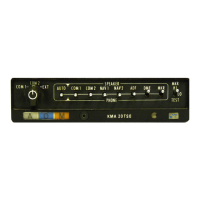
Both
transmitting
and
audio
distribution functions
of the
Silver Crown
radio system
are
controlled
at the front panel of the KMA 20.
Basically
the
functional controls
consist of a microphone
selector
switch and
receiver
audio selector switches.
The microphone
selector switch performs
two tasks. It
routes
microphone keying
and
audio
information
to the appropriate destination
and
secondly,
it switches the output
of
the isolation
amplifier to one
of
two
speakers.
In
the
COMM 1
or COMM 2
positions,
microphone
information
is rounted to
the appropriate transmitter.
In the
HF position
of
the
International
model,
this
information
is
routed
to the
high
frequency
transmitter.
Likewise,
when the
TEL.
position is
sel-
ected, the
keying
and mic audio
is
routed
to
KT 96
King
phone in the
-12
version. In these three
positions
the isolation
amplifier
output
is
fed
to
the
cockpit
speaker.
The EXT position on 00
/07
provides
the
pilot
with
several
capabilities
depending on the option made
at
installation.
In the
EXT position, the
output
of the amplifier
is normally connected to
a
"ramp
hail" speaker or
alternately
to a
passenger
address
system. Should
one
of the
receivers
be
select-
ed in this
mode, the
audio will
be
heard
in the EXT speaker
until the
microphone
is keyed. When
the
microphone is
keyed,
the
receiver
audio
is
muted
and
the
microphone
output
is
fed to
the EXT
speaker output.
The
EXT
position on 09/11
provides
the
pilot
with
a
"ramp
hail"
function. And an added 4 ohm
out-
put is provided for
use as
a passenger
address
system.
A
series
of
toggle
switches
control
the
audio
inputs to
the
isolation amplifier.
Each of
these
con-
trols
can
be
switched
from the
center
off
position
to connect each
receiver's
audio
tothe
input
of
the
isolation
amplifier
which
then routes the audio to
the
speaker
output
in the "up"
position
or
to
external headphones
in the "down"
position.
In
the
PilONE
position,
receiver audio
completely
bypasses
the amplifier
and the
KlVIA 20 performs
only
a
bypass
switching function.
Since individual
control of the
receivers is provided,
the pilot may
listen to
one receiver
with
the speaker
while
the
co-pilot
could
monitor another
receiver
utilizing
headphones.
One
non-switched
audio
input
has been
provided which
can
be
used
for audio
signals
that are
not
to be
switched,
as
Hadar
Altimeter
Au
dio
and
the ring
signal
from the
King
KT
06
KLng Phone.
Page
3-2
Hev. 2,
June, 1976



 To Next Page