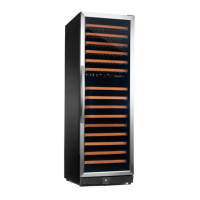
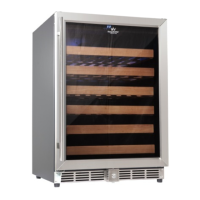
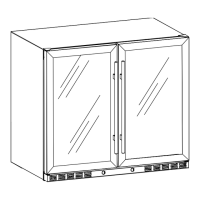
This document serves as a user manual for KingsBottle compressor beverage refrigerators, specifically covering the KBU-50, KBU-100, and KBU-170BX models. It provides comprehensive instructions for installation, operation, maintenance, and troubleshooting to ensure safe and efficient use of the appliance.
Function Description
The KingsBottle beverage refrigerator is designed to cool and store beverages at optimal temperatures. It utilizes a compressor-based cooling system with air-circulated fan cooling to maintain consistent temperatures throughout the cabinet. The front-venting design allows these models to be built into cabinetry, offering flexible installation options. The refrigerator features an intuitive control panel for temperature setting, light control, and other operational adjustments. It is equipped with adjustable shelving to accommodate various bottle sizes and quantities, maximizing storage efficiency. An optional key lock provides added security for the stored contents.
Usage Features
The refrigerator's operation is straightforward, managed through a front-mounted control panel.
- Power Control: An ON/OFF button allows users to easily turn the refrigerator on or off.
- Temperature Setting: The TEMP. SET button displays the desired temperature, while UP/DOWN buttons allow for precise adjustment of the preset temperature value. The TEMP. DISPLAY shows the actual internal temperature.
- Temperature Units: A C/F SWITCH enables users to toggle between Celsius and Fahrenheit temperature displays.
- Lighting Control: The LIGHT button controls the interior light, allowing users to turn it on or off and cycle through various light colors (red, orange, yellow, green, blue, purple, white, and a color-changing mode).
- Brightness Adjustment: By holding the LIGHT button and pressing UP or DOWN, users can adjust the light brightness across five levels (20%, 40%, 60%, 80%, and 100%).
- Storage Optimization: The manual emphasizes the importance of proper loading to optimize cooling performance. Bottles should be dispersed evenly to avoid concentrating weight in one area and should not touch the back of the cabinet or the bottom step. Ensuring adequate air movement within a full cooler enhances efficiency. Shelves should never be adjusted with bottles still on them.
- Shelving Flexibility: The shelving system is designed to accommodate various beverage containers, allowing bottles to be placed either lying down or upright. The manual provides instructions for reconfiguring shelves to maximize capacity for different bottle types, including removing and installing slide rails and shelves. Each shelf has a maximum weight capacity of 55 lbs (25 kgs).
- Compressor Delay: A crucial safety feature is the 6-minute delay for the compressor to start every time the unit is powered on, or after a power interruption, to protect the cooling system.
- Temperature Stability: While the display provides a guide, the actual temperature may fluctuate based on ambient conditions, light usage, and bottle orientation. The unit is designed to keep products within 5°F (2°C) of the set temperature, even in ambient temperatures up to 100°F (38°C). During defrost cycles, the display may show a higher temperature, but this is temporary and does not significantly impact drink temperature.
- Door Lock: For models equipped with a key lock, the keys are provided with the user manual. The lock mechanism is engaged by inserting the key and turning clockwise, ensuring the metal pin is fully engaged. To unlock, the key is turned counterclockwise.
Maintenance Features
Regular maintenance is essential for the longevity and optimal performance of the KingsBottle beverage refrigerator.
- Cleaning: Before cleaning, the appliance must be turned off, unplugged, and all items and shelves removed.
- Interior Cleaning: The interior surfaces should be washed with a solution of warm water and two tablespoons of baking soda per quart of water.
- Shelf Cleaning: Shelves should be washed with a mild detergent solution.
- Electrical Parts: When cleaning areas near controls or electrical parts, excess water should be wrung out from the sponge or cloth to prevent damage.
- Exterior Cleaning: The outside cabinet should be cleaned with warm water and a mild liquid detergent, then rinsed well and wiped dry with a clean, soft cloth.
- Stainless Steel Care: After installation, and every 3-4 months thereafter, a thin layer of olive oil should be applied to all exposed stainless steel areas with a clean rag, then polished and buffed off with another clean rag to a non-oily finish. This helps protect against dirt, corrosive contaminants, and makes future cleaning and fingerprint removal easier. The manual explicitly states that all stainless steel can rust, debunking the myth that it is rust-proof.
- Power Failure Management: In the event of a power outage, the unit's temperature will be maintained for a few hours if the door openings are minimized. For prolonged outages, users should take steps to protect the contents.
- Vacation Care:
- Short Vacations (less than three weeks): The refrigerator can be left operating.
- Long Vacations (several months): All items should be removed, the appliance turned off, and the interior thoroughly cleaned and dried. To prevent mold growth, the door should be left slightly ajar and blocked open.
- Moving the Refrigerator: When moving the unit, all items should be removed, and loose items (especially shelves) should be securely taped down. The adjustable legs should be turned up to the base to prevent damage. The door should be taped shut. During transportation, the appliance must remain upright and protected with a blanket or similar item.
- Energy Saving Tips:
- Location: Position the refrigerator in the coolest area of the room, away from heat-producing appliances and direct sunlight.
- Ventilation: Good ventilation at the rear aids energy efficiency, although these models are designed for built-in installation.
- Temperature Adjustment: During periods of non-usage (e.g., weekdays), setting the temperature higher (e.g., 64°F or 18°C) reduces run time, saves energy, and prevents spoilage.
- Stock Level: Keeping the cooler stocked helps it run more efficiently, as an empty cooler will run longer.


 To Next Page
 General