EasyManua.ls Logo

Kingtec KTD-2 - User Manual

Kingtec KTD-2
7 pages
Print Icon
To Next Page IconTo Next Page
Loading...
Question and Answer IconNeed help?

Do you have a question about the Kingtec KTD-2 and is the answer not in the manual?

Summary

User Instruction

General Guidance and Support

Outlines manual purpose, advises contacting after-sale service, and prohibits unprofessional repair.

Chapter 1. Operation Notice

Operational Parameters and Safety

Covers service voltage, power consumption, heat insulation, sealing, and refrigerant R134a.

Maintenance and Prohibitions

Mandates monthly condenser cleaning and prohibits touching rotating parts.

Chapter 2. Product Features

Key Features and Benefits

Highlights economical, eco-friendly design, stable refrigeration, low noise, and easy operation.

System Security and Design

Details self-protection functions, compressor design, and streamlined exterior materials.

Chapter 3. Unit Component And Working Principle

Unit Components Listing

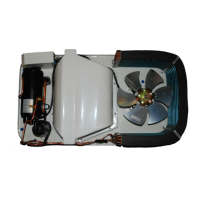
Lists the main parts of the air conditioner system, including compressor, evaporator, and control.

Refrigerant Cycle Operation

Explains the working principle of the refrigerant flow through the system.

Chapter 4. Unit Installation

Assembly and Duct Drawings

Provides dimensional drawings for the air-conditioning assembly and air duct.

Interior Cover Details

Shows the drawing for the interior cover with dimensions.

Chapter 5. Unit Operation

Control Panel Key Functions

Explains the function of each key on the control panel for operation.

Step-by-Step Operating Instructions

Details how to use the power switch, adjust wind speed, temperature, and set voltage.

Chapter 6. Daily Check and Maintenance

Routine Daily Checks

Lists essential daily checks like refrigerant charge, leakage, and filter cleaning.

Critical Maintenance Warnings

Warns against using faulty units, tampering with pressure switches, and improper motor speeds.

Chapter 5. Unit Operation (continued)

Working Mode Descriptions

Details the operation of Air Supply, Strong, ECO, and Sleep modes.

Fault Code Interpretation

Lists and explains error codes displayed for malfunctions.

Chapter 6. Daily Check and Maintenance (continued)

Care and Maintenance Cycle

Provides a table detailing maintenance items, methods, and intervals (daily, weekly, monthly, yearly, hours).

Maintenance Symbol Key

Explains the meaning of symbols used in the maintenance cycle table.

Chapter 7. Trouble Shooting

Loud Noise Issues

Lists phenomena, causes (loose coupling, wearing, low oil), and troubleshooting methods for loud noise.

System Running Abnormalities

Covers issues like high/low pressure, refrigerant charge, fan damage, and dirt jamming.

Chapter 8. Electric Schematic Diagram

Diagram Overview

Presents the electrical schematic diagram of the KTD-2 air-conditioner.

Component Identification

Lists components and their corresponding codes used in the schematic diagram.

Overview

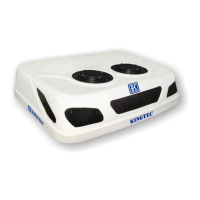
The KTD-2 is a series vehicle air-conditioner designed for engineering machinery, construction machinery, trucks, and special application vehicles. It functions as an air-conditioner operation and maintenance manual, providing comprehensive guidance for its use and upkeep.

Function Description:

The KTD-2 air-conditioner operates by circulating R134a refrigerant. The process begins with low-temperature, low-pressure refrigerant from the evaporator being drawn into the compressor, where it's compressed into high-pressure, high-temperature gas. This gas then flows into the condenser via a vent-pipe, where it cools and condenses into a normal-temperature, high-pressure liquid. This liquid, mixed with gas, then enters the evaporator at low temperature and pressure through a thermo-expansion device. In the evaporator, the refrigerant absorbs heat from the surrounding air, which is then cooled and circulated back into the cabin by the blower fan, reducing the internal temperature.

Important Technical Specifications:

  • Service Voltage: DC12V (specific voltage and parameters should be checked on the label).
  • Refrigerant Type: R134a (environmentally friendly, R12 is not allowed).
  • Total Power Consumption: Less than 45A in normal working environmental temperatures of 95°F.
  • Normal Working Pressure (Manifold Readings):
    • Low-pressure side: 0.15-0.38 Mpa
    • High-pressure side: 0.8-1.9 Mpa
  • Compressor Rotation Speed: Recommended 3000 RPM for normal operation.
  • Protection Features: Includes pressure error protection, power over-voltage or undervoltage protection, motor over-current or overload protection, motor over-temperature protection, and failure checking.
  • Temperature Range: Adjustable from 62.6°F to 86°F in Strong and ECO modes, and fixed at 75.2°F in Sleep mode.
  • Wind Speed: Adjustable from 1 to 5 speeds across all modes (Air Supply, Strong, ECO, Sleep).

Usage Features:

The KTD-2 is designed for ease of operation with an intelligentized microcomputer control system.

  • Economical: It is driven by the vehicle's DC12V battery (or an optional extra battery), eliminating the need to start the main engine, unlike engine belt-driven air-conditioners.
  • Environment Protection: Uses R134a refrigerant, ensuring no pollution.
  • Refrigeration Steady: The compressor maintains a constant revolution, leading to stable system operation and refrigeration.
  • Low Noise: Operates with lower noise compared to similar products, and without the vibration and noise of the main engine when the truck is stopped.
  • Control Panel: Features a power switch, wind speed adjustment buttons (+/-), temperature adjustment buttons (+/-), and a mode key.
  • Modes of Operation:
    • Air Supply Mode: Wind speed adjustable (1-5), temperature not adjustable.
    • Strong Mode: Fixed wind speed at 5, temperature adjustable (62.6°F - 86°F).
    • ECO Mode: Wind speed adjustable (1-5), temperature adjustable (62.6°F - 86°F).
    • Sleep Mode: Wind speed adjustable (1-5), temperature fixed at 75.2°F. The screen turns off after 5 seconds if no fault is detected.
  • Undervoltage and Recovery Value Adjustment: Accessible by long-pressing the "mode key," allowing users to set low-voltage protection and recovery values.
  • Fault Code Display: The control panel flashes a red fault light and displays specific fault codes (EC, EF, E1-E4, E7-E9) to indicate issues such as temperature probe errors, fan short circuits, software errors, high current protection, compressor reversals, low voltage, compressor default phase, compressor temperature protection, and system pressure protection.
  • Design: Features an international popular fiberglass material streamline design for the unit cover, offering a super appearance, light body, high temperature resistance, high strength, and low resistance during travel. Its compact structure integrates well with the vehicle cabin.

Maintenance Features:

Regular checking and maintenance are crucial for extending the unit's service life and reducing breakdowns.

  • Daily Check and Maintenance:
    • Refrigerant Charge: Check for accurate R134a charge. Incorrect charge can significantly impact system pressure.
    • Cooling System Leakage: Inspect joints for oil pollution, indicating refrigerant leakage. Tighten joints or contact service if leakage persists.
    • Air Filter Net: Wash the evaporator filter net weekly. Clean with compressed air or warm water with neutral detergent, then rinse with clean water.
    • Fault Light: Do not use the air conditioner if the failure light is on, as this indicates a fault that could worsen if ignored.
    • Pressure Switch: Short-circuiting the pressure switch is strictly prohibited, as it can damage components and lead to system failure.
  • Care & Maintenance Cycle:
    • Daily: Check refrigerant charge, cooling circulate, and current/voltage.
    • Weekly: Check abnormal noise, compressor over-temp, condenser fin, evaporator fin, and electric switch.
    • Monthly: Check cooling circulate, abnormal noise, compressor over-temp, condenser fin/fan, air-inlet filter, evaporator fin/fan, dry filter, air-return filter, cable, and wiring connection.
    • Season/Half Year/Year/5,000 Hours/10,000 Hours: Specific checks and replacements are recommended for various components, including refrigerant, cooling circulate, abnormal noise, compressor, motor, condenser, evaporator, dry filter, and electrical connections.
  • Troubleshooting Guide: The manual provides a detailed troubleshooting table for common issues like loud noise and bad running (poor cooling effect), linking phenomena to failure causes and recommended solutions. For example, loud noise can be caused by loose couplings, overmuch wearing, or low oil levels, with solutions ranging from tightening to replacement or adding refrigerant oil. Bad running issues, such as high or low pressure, are addressed by checking refrigerant charge, condenser fan, evaporator fin, and capillary, with solutions like discharging excess refrigerant, cleaning components, or maintaining/replacing parts.

Kingtec KTD-2 Specifications

General IconGeneral
BrandKingtec
ModelKTD-2
CategoryAir Conditioner
LanguageEnglish

Related product manuals