
 Need help?
Do you have a question about the KitchenAid TILT-HEAD STAND MIXER and is the answer not in the manual?
Safety alert symbols, warnings, and essential precautions for safe operation.
Key safety precautions when using electrical appliances.
Voltage, frequency, and grounding requirements for safe electrical connection.
Details on warranty period, what KitchenAid pays for, and exclusions.
Procedures for obtaining a replacement mixer in the US, DC, and Canada.
Steps for obtaining service in Puerto Rico and internationally.
Information on how to purchase replacement parts and additional accessories.
Solutions for common issues, error diagnosis, and when to seek professional help.
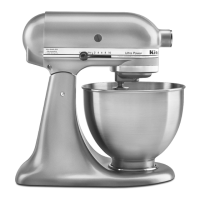
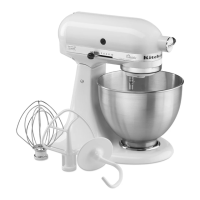
Identification and description of the main components of the tilt-head stand mixer.
Instructions for attaching bowls, beaters, and operating the mixer safely.
Guidance on attaching and using the pouring shield for controlled ingredient addition.
Overview of various attachments and their recommended uses for different mixtures.
Advice on adjusting mixing times and using the speed control for optimal results.
General guidance on operating the tilt-head stand mixer.
Instructions for cleaning the mixer and its parts.
How to adjust the beater height for proper bowl clearance.
Detailed guide on recommended speeds for various mixing tasks.
Practical advice for converting recipes, adding ingredients, and specific mixing methods.
Specific instructions and stages for whipping egg whites and cream.
Information about mixer attachment points and general features.
Step-by-step guide for attaching and removing mixer attachments.
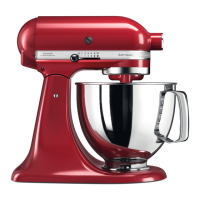
This document describes the KitchenAid® Tilt-Head Stand Mixer, a versatile kitchen appliance designed for a variety of mixing tasks, from light whipping to heavy dough kneading. It emphasizes ease of use, durability, and efficient performance, often outperforming other electric stand mixers in speed and thoroughness.
The KitchenAid® Tilt-Head Stand Mixer is primarily used for mixing, beating, whipping, and kneading ingredients in a bowl. It features a motor head that tilts back for easy access to the bowl and attachments. The mixer is designed to handle a wide range of recipes, including cakes, cookies, mashed potatoes, breads, and whipped cream. It also supports various attachments (sold separately) that expand its functionality, such as an ice cream maker, pasta roller and cutter set, and grain mill. The power shaft and hub socket for attachments are designed with a square shape to prevent slipping during operation, ensuring efficient power transmission.
The mixer is equipped with a Speed Control Knob, allowing users to select from a range of speeds, including "Stir," "Slow Mixing," "Mixing/Beating," "Beating/Creaming," "Fast Beating/Whipping," and "Fast Whipping." The speed control lever should always be set to the lowest speed for starting to prevent splashing, then gradually moved to the desired higher speed. The manual provides a detailed Speed Control Guide to help users select the appropriate speed for different tasks and ingredients. For instance, "Stir" is used for slow stirring and combining, while "Fast Whipping" (Speed 10) is ideal for whipping small amounts of cream or egg whites. It's important not to exceed Speed 2 when preparing yeast dough to avoid damaging the mixer.
The Tilt-Head Stand Mixer is designed for easy assembly and disassembly. To attach the bowl, the motor head is tilted back, the bowl is placed on the clamping plate, and then gently turned clockwise. To remove, the bowl is turned counterclockwise. Attaching beaters (flat beater, wire whip, or dough hook) involves slipping them onto the beater shaft, pressing upward, and turning to the right to hook them over a pin. Removal is the reverse process.
A Pouring Shield (if included) can be used to simplify adding ingredients and prevent splashing. It slides over the bowl and is centered, with the bottom rim fitting within the bowl. For best results, the shield should be rotated so the motor head covers the "u" shaped gap, and ingredients are poured through the pouring chute.
The mixer's motor head can be locked into position during operation by placing the locking lever in the "LOCK" position. It should always be kept in the "LOCK" position when using the mixer.
When converting recipes for use with the KitchenAid® Stand Mixer, users should note that it mixes faster and more thoroughly than most other electric stand mixers. Therefore, mixing times in traditional and non-packaged recipes may need to be adjusted to avoid overbeating, often being half as long as with other mixers. Ingredients should be added to the side of the bowl, not directly into the moving beater. For liquid mixtures, lower speeds are recommended initially to avoid splashing, increasing speed only after the mixture thickens. Solid materials like nuts, raisins, or candied fruits should be folded in during the last few seconds of mixing on "Stir" speed, ensuring the batter is thick enough to prevent them from sinking.
Regular cleaning is essential for maintaining the mixer. The bowl, white flat beater, and white dough hook are dishwasher-safe and can also be cleaned thoroughly in hot, sudsy water. The wire whip, however, should be hand washed and dried immediately, not in a dishwasher. It's crucial to unplug the Stand Mixer before cleaning. The mixer itself should be wiped with a soft, damp cloth, and household or commercial cleaners should not be used. The mixer should never be immersed in water. The beater shaft should be wiped frequently to remove any accumulated residue.
The Stand Mixer is factory-adjusted so the flat beater just clears the bottom of the bowl. If the beater hits the bowl or is too far away, the clearance can be easily corrected. This involves turning the speed control to OFF, unplugging the mixer, tilting the motor head back, and then turning a screw (A) slightly counterclockwise to raise the beater or clockwise to lower it. Proper adjustment ensures the flat beater does not strike the bottom or side of the bowl, preventing wear on the beater coating or whip wires. If the screw is over-adjusted, the motor head may not lock when lowered.
The manual also addresses common troubleshooting issues, such as the mixer warming up during heavy loads (which is normal), a pungent odor (common with new electric motors), and what to do if the flat beater hits the bowl. If the mixer malfunctions or fails to operate, users are advised to check if it's plugged in, if the circuit fuse is working, and to turn it off for 10-15 seconds before restarting. If the problem persists, allowing it to cool for 30 minutes is suggested. For issues that cannot be resolved with these steps, users are directed to contact KitchenAid Customer Satisfaction Centers or Authorized Service Centers.
 General
| Speeds | 10 |
|---|---|
| Bowl Material | Stainless steel |
| Tilt-Head Design | Yes |
| Power Hub | Yes |
| Brand | KitchenAid |
| Capacity | 4.5 quarts |
| Power | 275 watts |
| Type | Stand mixer |
| Attachments Included | Flat beater, dough hook, wire whip |
| Color Options | Multiple |




 To Next Page