EasyManua.ls Logo

Kitchenarm KA8520 - Page 8

Kitchenarm KA8520
48 pages
Print Icon
To Next Page IconTo Next Page
To Previous Page IconTo Previous Page
Loading...
QUICK
GUIDE
FOR
DAILY
USE
Please
read
through
the
manual
before
the
first
use
to
get
yourself
familiarized
with
KitchenArm
bread
maker
and
some
important
baking
principles.
You
will
find
the
manual
easy
to
read
with
helpful
tips
and
information.
(a)
Please
pay
special
attention
to
the
specific
menu
instructions
session
for
your
selected
menu
to
use
and
the
"BE
CORRECT
FOR
THE
FIRST
BREAD"
session.
(b)
Please
strictly
follow
your
selected
recipe
and
its
tips
in
the
recipe
book.
(c)
Please
refer
to
the
FAQ
session
of
the
recipe
book
and
the
TROUBLE
SHOOTING
session
of
the
manual
if
you
encounter
any
problems.
(d)
Please
contact
KitchenArm
life-time
customer
service
if
you
need
more
assistance.
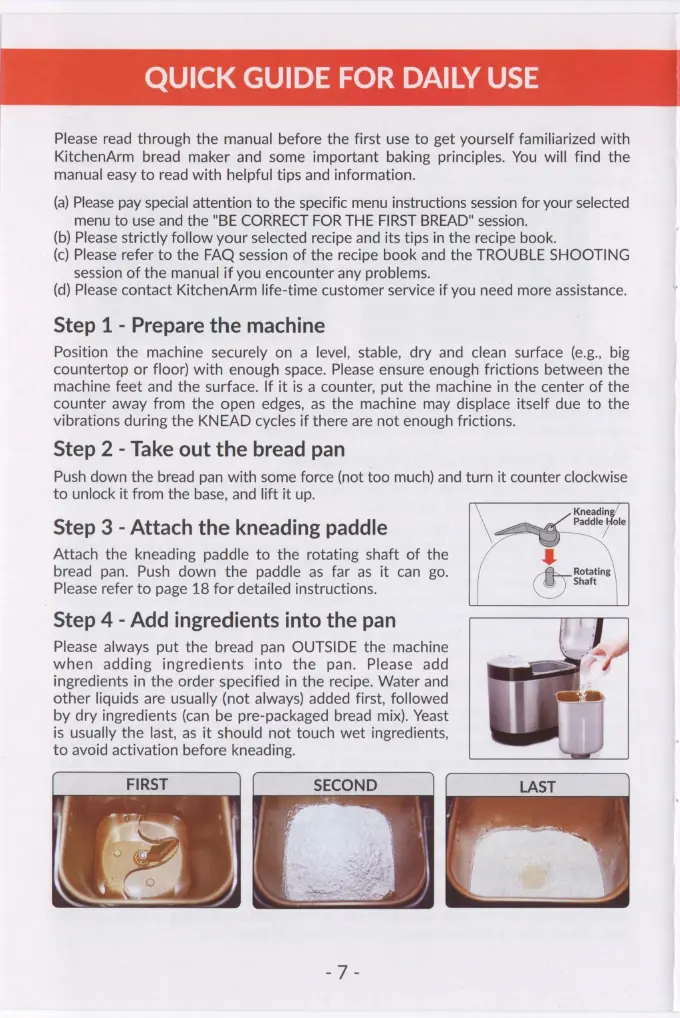
Step
1
-
Prepare
the
machine
Position
the
machine
securely
on
a
level,
stable,
dry
and
clean
surface
(e.g.,
big
countertop
or
floor)
with
enough
space.
Please
ensure
enough
frictions
between
the
machine
feet
and
the
surface.
If
it
is
a
counter,
put
the
machine
in
the
center
of
the
counter
away
from
the
open
edges,
as
the
machine
may
displace
itself
due
to
the
vibrations
during
the
KNEAD
cycles
if
there
are
not
enough
frictions.
Step
2
-
Take
out the
bread
pan
Push
down
the
bread
pan
with
some
force
(not
too
much)
and
turn
it
counter
clockwise
to
unlock
it
from
the
base,
and
lift
it
up.
Kneadin;
Step
3
-
Attach
the
kneading
paddle
ie
ae
Attach
the
kneading
paddle
to
the
rotating
shaft
of
the
bread
pan.
Push
down
the
paddle
as far as
it
can
go.
ome
Please
refer
to
page
18
for
detailed
instructions.
Step
4
-
Add
ingredients
into
the
pan
Please
always
put
the
bread
pan
OUTSIDE
the
machine
when
adding
ingredients
into
the pan.
Please
add
ingredients
in
the
order
specified
in
the
recipe.
Water
and
other
liquids
are
usually
(not
always)
added
first,
followed
by
dry
ingredients
(can
be
pre-packaged
bread
mix).
Yeast
is
usually
the
last,
as
it
should
not
touch
wet
ingredients,
to
avoid
activation
before
kneading.
SECOND