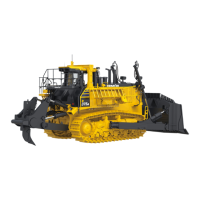
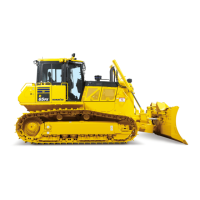
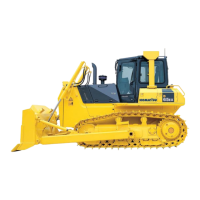
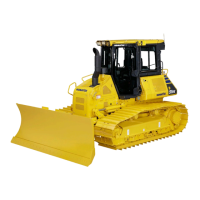
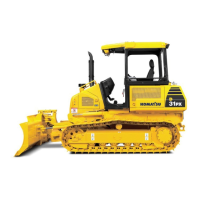
This document serves as an Operation & Maintenance Manual for the Komatsu D85EX-18 and D85PX-18 Bulldozers, with serial numbers starting from 22001 and up. It provides essential information for safe and effective operation, inspection, and maintenance of these machines.
Function Description
The Komatsu D85EX-18 and D85PX-18 bulldozers are designed primarily for earth-moving tasks. Their main uses include:
- Dozing work
- Leveling work
- Cutting or ditching into hard or frozen ground
- Felling trees and removing stumps
- Pushing work
- Ripping work
The machines are equipped with an engine technology that conforms to EU Stage IV emission regulations, combining a Komatsu Diesel Particulate Filter (KDPF) and Komatsu’s Urea Selective Catalytic Reduction (SCR) system. The KDPF captures diesel particulate matter or soot from exhaust gas, performing automatic purification (regeneration) to maintain filtering performance. The Urea SCR system decomposes toxic nitrogen oxides (NOx) into harmless nitrogen and water by spraying Diesel Exhaust Fluid (DEF) into the exhaust gas.
Important Technical Specifications
The manual provides detailed specifications for both D85EX-18 and D85PX-18 models, including:
D85EX-18 (Sigma power tilt power pitch dozer):
- Operating weight (excluding operator): 30120 kg
- Blade equipment weight (including blade cylinder): 3830 kg
- Ripper equipment weight (multi-shank ripper): 2500 kg
- Drawbar equipment weight: - kg
- Engine model: KOMATSU SAA6D125E-7 diesel engine
- Rated horsepower (SAE J1995 gross): 199 kW / 1900 min⁻¹
- Rated horsepower (ISO 14396): 199 kW / 1900 min⁻¹
- Rated horsepower (ISO 9249 / SAE J1349 net): 197 kW / 1900 min⁻¹
- Overall length (A): 7325 mm
- Overall height (B): 3322 mm
- Overall width (C): 3573 mm
- Travel speed (Forward 1st/2nd/3rd (Low)/3rd): 3.3/6.1/7.8/10.1 km/h
- Travel speed (Reverse 1st/2nd/3rd (Low)/3rd): 4.4/8.0/9.2/13.0 km/h
- Sigma power tilt power pitch dozer, multi-shank ripper, 610 mm single
D85PX-18 (Straight tilt dozer):
- Operating weight (excluding operator): 28990 kg
- Blade equipment weight (including blade cylinder): 3370 kg
- Ripper equipment weight (multi-shank ripper): - kg
- Drawbar equipment weight: 300 kg
- Engine model: KOMATSU SAA6D125E-7 diesel engine
- Rated horsepower (SAE J1995 gross): 199 kW / 1900 min⁻¹
- Rated horsepower (ISO 14396): 199 kW / 1900 min⁻¹
- Rated horsepower (ISO 9249 / SAE J1349 net): 197 kW / 1900 min⁻¹
- Overall length (A): 6435 mm
- Overall height (B): 3322 mm
- Overall width (C): 4355 mm
- Travel speed (Forward 1st/2nd/3rd (Low)/3rd): 3.3/6.0/7.8/10.0 km/h
- Travel speed (Reverse 1st/2nd/3rd (Low)/3rd): 4.4/7.9/9.2/12.7 km/h
- Straight tilt dozer, drawbar, 910 mm single shoe
Usage Features
The bulldozers feature a comprehensive machine monitor that displays various operational parameters and warnings. Key monitor features include:
- Warning Display: Indicates the urgency of abnormalities (L01 to L04), with L04 being the most serious, requiring immediate action.
- Pilot Display: Shows the actuation status of various functions like preheating, fan reverse rotation, air conditioner, and work equipment lock.
- Meter Display: Includes gauges for power train oil temperature, ECO gauge/drawbar pull, engine coolant temperature, fuel level, and DEF level.
- Speed Range Display: Shows current gear speed and shift mode (automatic or manual).
- Guidance Display: Provides tips for energy-saving operation, such as idling stop guidance, hydraulic relief deterrence, E mode recommendations, and overload prevention.
- User Menu: Allows operators to adjust screen settings, clock, language, and access SCR information and maintenance records.
Control levers and pedals include:
- Starting Switch: Used to start and stop the engine, with OFF, ON, START, and HEAT (preheating) positions.
- Fuel Control Dial: Controls engine speed and output, from Low idle (MIN) to High idle (MAX).
- Cigarette Lighter: Also serves as a 120W (24V x 5A) power source.
- Wiper Switch: Operates windshield wipers for left door, front window, right door, and rear window, with intermittent operation.
- Horn Switch: Located on the blade control lever.
- Headlamp Switch: Controls headlamps and monitor illumination (night/day mode).
- Rear Lamp Switch: Controls rear lamps.
- Room Lamp Switch: Controls the interior room lamp.
- Engine Shutdown Secondary Switch: An emergency switch to stop the engine if the primary switch fails.
- Parking Brake Lever: Locks or frees the parking brake.
- Work Equipment Lock Lever: Locks or frees the blade and ripper operations.
- Joystick (Steering, Directional and Gear Shift Lever): Controls forward/reverse travel, steering, and gear shifting (PCCS lever).
- Brake Pedal: Applies the brakes.
- Decelerator Pedal: Reduces engine speed or stops the machine.
- Blade Control Lever: Controls blade lifting, holding, lowering, tilting, and pitching (if equipped).
- Ripper Control Lever: Operates the ripper (if equipped), including lifting, holding, lowering, and tilting.
Maintenance Features
The manual emphasizes regular maintenance to ensure safety and prolong machine life. Key maintenance aspects include:
- Service Meter Reading: Daily check to determine maintenance intervals.
- Komatsu Genuine Parts and Lubricants: Recommendation to use genuine parts and lubricants of specified viscosity.
- Cleanliness: Importance of keeping the machine clean, especially electrical components, and preventing impurities in oil, fuel, and coolant.
- KOWA (Komatsu Oil Wear Analysis): A service for periodic oil sampling and analysis to detect wear and problems early.
- Defined Life Parts: Critical safety and fire prevention parts that require periodic replacement (every 2 or 3 years, or 4000 hours, depending on the part).
- Maintenance Schedule: Detailed tables for initial 250 hours, every 250 hours, every 500 hours, every 1000 hours, every 2000 hours, every 4000 hours, every 4500 hours, every 8000 hours, and every 9000 hours.
Specific maintenance procedures include:
- Air Cleaner: Checking, cleaning, and replacing elements.
- Cooling System: Cleaning the inside, checking coolant level, and adding coolant.
- Track Tension: Checking and adjusting.
- Track Shoe Bolts: Checking looseness and tightening.
- Idler Oil Level and Clearance: Checking and adjusting.
- Universal Joint: Lubricating.
- Cutting Edge and End Bit: Inverting and replacing.
- Radiator, Oil Cooler, Aftercooler Fins, and Air Conditioner Condenser Net: Checking and cleaning.
- Fuel Filler Port Strainer: Cleaning.
- Hydraulic Tank Breather: Cleaning.
- Fuel Tank Breather: Cleaning.
- Alternator and Air Conditioner Compressor Belt: Checking and adjusting tension.
- Undercarriage Oil: Checking.
- Door Damper: Replacing.
- Door Hinge: Lubricating.
- Door Latch and Lock Striker: Checking.
- Window Washer Fluid: Checking level and adding fluid.
- Wiper Blade: Replacing.
- Hydraulic Circuit: Bleeding air and releasing pressure.
- Engine Oil Pan: Changing oil and replacing engine oil filter cartridge.
- Fuel Prefilter Cartridge: Replacing.
- Power Train Oil Filter Element: Replacing.
- Air Conditioner Fresh/Recirc Filters: Replacing.
- Power Train Case: Changing oil, cleaning pump strainer and scavenging pump strainer.
- Final Drive Case: Changing oil.
- Fuel Main Filter Cartridge: Replacing.
- Engine Intake Pipe Clamps: Checking tightening points.
- Power Train Case Breather: Cleaning.
- Hydraulic Tank Breather Element: Replacing.
- DEF Tank Breather Element: Replacing.
- ROPS Mount Bolts: Checking for looseness.
- Damper Case: Changing oil and cleaning damper breather.
- Pivot Bearing Oil: Checking and adding.
- Accumulator (for control circuit): Checking and releasing nitrogen gas charge pressure, replacing.
- Alternator and Starting Motor: Checking.
- Engine Valve Clearance: Checking and adjusting.
- KCCV Filter Element: Replacing.
- DEF Filter: Replacing.
- Water Pump: Checking.
- Engine High-Pressure Piping Clamp: Checking for looseness and hardening of rubber, replacing.
- Fuel Spray Prevention Cap: Checking for missing caps and hardening of rubber, replacing.
- Main Frame and Work Equipment (Blade and Ripper): Checking.
- DEF Tank: Cleaning.
- DEF Hose: Replacing.
- Fuel Doser: Cleaning.
The manual also includes precautions for cold weather operation, long-term storage, and troubleshooting common issues. It emphasizes safety warnings, such as wearing protective equipment, stopping the engine before maintenance, and being aware of high-temperature parts and high-pressure systems.

 Need help?
 General

 To Next Page