Need help?
Do you have a question about the Komatsu HD1500-5 and is the answer not in the manual?
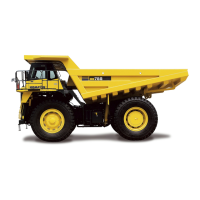
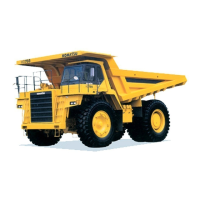
This document is an Operation & Maintenance Manual for the Komatsu HD1500-5 Dump Truck, serial numbers A30072-A30076. It provides comprehensive information for operators and service technicians to ensure safe and efficient operation and maintenance of the truck.
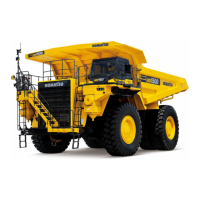
The Komatsu HD1500-5 is a dump truck designed for heavy-duty hauling operations. The manual emphasizes that operators and maintenance personnel must read and understand its contents, including all safety notices, warnings, and cautions, before operating or maintaining the machine. The primary goal is to ensure the truck operates safely and efficiently.
Safety is a paramount concern, with a dedicated section outlining rules and features. The manual stresses that only trained and authorized personnel should operate and maintain the machine. Key safety rules include avoiding loose clothing and jewelry, wearing appropriate personal protective equipment (hard hat, safety glasses, safety shoes, mask, gloves), and never wearing oily clothes due to flammability. Unauthorized modifications are strongly discouraged, as they can create hazards and void Komatsu's responsibility for injury or damage.
When leaving the operator's seat, the manual instructs to move the shift control lever to NEUTRAL, apply the parking brake, lower the dump body to FLOAT, stop the engine, lock compartments, and take the keys. Mounting and dismounting should always be done facing the machine, maintaining three-point contact with hand-holds and steps. Steps and hand-holds must be kept clean of oil, grease, or mud.
Fire prevention is addressed by advising against open flames near flammable fluids, stopping the engine and not smoking during refueling, and securing all fuel and oil tank caps. Refueling and oiling must occur in well-ventilated areas. Precautions with high-temperature fluids are highlighted, requiring the engine to cool and pressure to dissipate before opening systems like the radiator or oil tanks to prevent burns. Asbestos dust hazard prevention includes never using compressed air for cleaning, using water to control dust, working with the wind to one's back, and using an approved respirator.
The Rollover Protection Structure (ROPS) is designed to protect the operator in case of a rollover and must be properly installed and maintained. Unauthorized modifications or repairs to the ROPS are strictly prohibited as they compromise its strength. The manual also advises against using unauthorized attachments.
The operator's cab is designed for comfort and efficiency, featuring wide visibility, an integral 4-post ROPS/FOPS structure, tinted safety-glass windshield, power-operated side windows, a fully adjustable seat with lumbar support, and an adjustable/tilt steering wheel. Controls are within easy reach, and an electronic display/monitoring panel keeps the operator informed of truck operating circuits. Audible alarms and indicator lights warn of system malfunctions.
The steering wheel telescopes and tilts for operator comfort. The horn button is in the center of the steering wheel. The turn signal lever also controls high/low headlight beams and windshield wipers/washer fluid.
The retarder control lever, located on the right side of the steering column, modulates retarding/braking effort to the front and rear oil disc brakes. The service brake pedal provides single-function, foot-operated hydraulic braking. The auxiliary brake switch applies full, unmodulated hydraulic brake pressure to all wheels and the parking brake, intended for emergency use only when the truck is not moving.
The instrument panel includes a center electronic display panel and left/right control/indicator pods. Key features include:
The manual provides detailed lubrication and service schedules: 10-hour (daily), 250-hour, 500-hour, 1000-hour, and 2000-hour inspections. It specifies lubricant types and capacities for various systems including the crankcase, cooling system, hydraulic system, differential case, final drive case, fuel tank, and transmission case.
Quick Fill Service Center: Located on the left side of the truck below the hydraulic tank, it allows for faster filling of system fluids and grease. Maximum fill pressures are specified for engine crankcase, hydraulic tank, coolant, and grease.
Automatic Lubrication System: The Lincoln Automatic Lubrication System is a pressurized lubricant delivery system controlled by an electric timer. It delivers controlled amounts of lubricant to designated lube points. Key components include a hydraulically powered reciprocating cylinder and pump, a grease reservoir (29 L / 7.7 gal or 27 kg / 60 lb capacity), and a vent valve. The system operates within a hydraulic supply pressure range of 2.1 - 20.1 MPa (300-3000 psi) and a maximum output pressure of 24.1 MPa (3500 psi).
Payload Meter II (PLM II™): This on-board weighing system displays and records payload weight, time, distance, and travel speed for each cycle. It uses four suspension pressures and an inclinometer to determine the load. The system stores up to 2900 cycles of data and retains it even when power is off, backed up by an internal battery. Data can be downloaded to a personal computer. The PLM II™ can be calibrated to ensure accuracy, especially after suspension servicing or major truck changes.
Radio / Cassette Player: The cab is equipped with an AM/FM stereo radio with a cassette player. It supports satellite radio (XM and Sirius) with a subscription and external receiver. Features include volume, bass, treble, fade, balance controls, preset stations, weatherband, and program type search (PTY). The cassette player works best with 30-90 minute tapes and has automatic equalization and metal tape sensing. It requires cleaning every 35 hours of cassette play.
Torque Specifications: The manual includes detailed torque tables for metric (Class 10.9) and SAE (Grade 5, 8, and 9) cap screws and nuts, T-bolt type hose clamps, split flange clamp bolts, flared tube and hose fittings, JIC 37° swivel nuts, O-ring boss fittings, and O-ring face seal fittings. It also provides common conversion multipliers for metric-to-English and English-to-metric units, and temperature conversions. The manual specifies that standard torque values should be used unless otherwise stated, and that special friction-reducing lubricants should not be used with standard torque values.
This comprehensive manual serves as a critical resource for anyone operating or maintaining the Komatsu HD1500-5 Dump Truck, ensuring safe, efficient, and reliable performance.

 To Next Page
 General