P~r
En~etn.ù~~sri-.e~ser
Viseur
Àvstândssokaren
Visor
~
0
l
1-+
~o
l
====
=
00
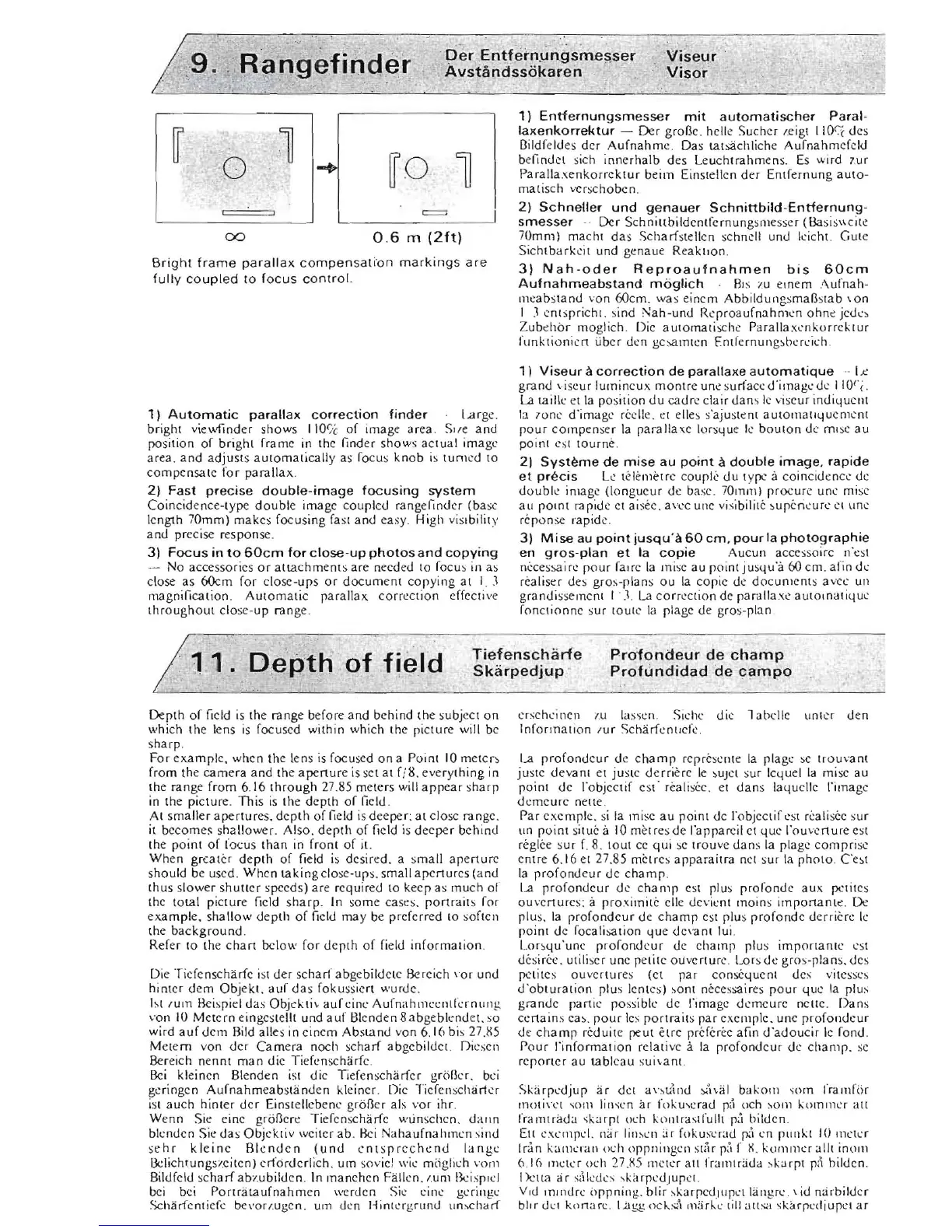
0 .6 m
(2ft)
Bri
ght
fr
ame
parallax
compensaüon
markings
are
full
y
coupled
to
focus
control.
1)
Automatic
parallax
correction
linder
l.arge.
bright
viewfinder
shows
110
<;
'è
of
image
area.
Sile
and
pos
ition
of
bright
frame
in
th
e
lïnder
sho
ws
actual
image
area.
and
adjust
s
aUlOmatically
as
focus
knob
is
tumcd
ta
compe
nsa te
for
parnllax.
2)
Fast
precise
double
-i
mage
focusing
system
Coincidence-type
do
uble
ima
ge
couplcd
rangelïnder
(base
length
70mm)
makes
focusing
fast
and
e
asy.
Hi
gh
viSlbility
and
pre
cise
respon
se.
3)
Focus
in
to
60cm
for
close-up
photos
and
copying
-
~
No
accessorics
or
attachments
are
necded
10
fo
cus
in
as
close
as
60cm
for
close-ups
or
document
copying
at
1 .
.1
magnification.
Automatic
parallax
correction
effeclive
t
hro
ugho
ut
close-up
rnnge
1)
Entfernungsmesser
mit
automatischer
Paral-
laxenkorrektur
-
Der
grolle
. he
Ile
Suche
r I.eigt
II0
rt
des
llildfeldes
der
A
ufnahm
e
Das
tatsachliche
Aufnahmefcid
be
lïndet
sich
innerhalb
des
Leu
ch
trahm
ens. Es wird
'ur
Parallaxenkorrcktur
beirn
Einstellen
der
Entfernung
auto-
matisch vcrschobcn.
2)
Schneller
und
genauer
Schnittbild-Entfernung-
smesser
Der
SchnÎttbildcmfcrnungsmcsscr
(Basis\\cj(~
70m01)
machl
das
Scharf$lellen
s
chnell
und
lcicht.
Gute
Sichtb
ark
cit
und
genaue
Re
aktlon
.
3)
Nah-oder
Reproaufnahmen
bis
60cm
Aulnahmeabstand
moglich
RIS
ru
elOem
!\ufnah-
meabstancJ
\."on
6Oc
m.
w3s
eincm AbbildungsmaGs
lab
\On
1
.1
cn!Sprich l.
sind
Nah-u
nd
Reproaufnahmen
ohnc
jcde>
Zubchbr
moglich
. Die aU
loma
ti
sche
Paralla
.\e
nk
orrektur
funktionicn
über den gc:-amtcn
F.n
trernung~ben:Îch
.
1)
Viseur
à
correction
de
parallaxe
automatique
..
I.e:
grand
\-is
cur
lumÎn
eu
x mOntre
une
surface
dïmagL' tic
110((
.
La ta
ilk
el la
position
du
cad
re
clair
tians
le
viseur
indiquent
la
70ne
d'image
rédi
e. et elles
s'ajusten
t
autOmatl4ucmL~nI
pour
compen
se
r la
par
allaxe
l
or~
4ue
le
bOUlon
de
mi
se
au
point est
tourne
.
2)
Système
de
mise
au
point
à
double
image,
rapide
et
précis
Le
t"km""e
cou
p'"
du
type il
co
incid
ence
de
tloubli,? image (longueur de base.
70
mlll) procu
re
une mise
au
pOtOt
rapid
e
ct
ai
sée.
3VC'C
une
visibil ité
~urêri('urc
Ct
une
réponse
rapide.
3)
Mise
au
point
jusqu'à
60
cm
,
pour
la
photographie
en
gros-plan
et
la
copie
Aucun accessoire n'cs!
nccessairc p
our
faIre
la
mise au pointjus<..ju'â. 6Oc
m.afindc
rcaliser
des
gro
s
-plans
Ou
la
copie
d~
documents
aVC(
un
grand
i
ssemc
nI
l '
J.
La
corrc
clion
de
parall
axe
autolnatiquc
f
onc
ti
onne
sur
toute
la plage
de
gros-plan
.
. .
Tiefenschiirfe
Proiondeur
de
champ
11 .D.
epth
·
of
f,eld
Skiirpedjup
Profundidad
de
campo
Depth
of
fi
e
ld
is
the
rnnge
before
and
behind
the
subjeci
on
which
the
l
ens
is focused
within
which
the
picture
will
bc
sharp
.
F
or
example,
when
the
lens
is
focused
on
a
Point
10
metcr
,
from
the
camera
and
the
aperture
isset
at
fiS.
everything
in
the
range
from
6.16
through
27.85
meters
will
ap
pea
r s
harp
in the
picture.
This
is
the
depth
of
field .
At
smaller
apertures,
depth
of
lïeld
isd
e
eper:
at
close
rnnge.
il
become~
shall
ower.
Aiso.
depth
of
field
is
decper
beh
ind
the
point
of
locu
s
than
in front
of
il.
When
greatcr
depth
of
lïeld
is
d
esired,
a
small
aperture
s
hould
be
used.
When
taking
close-ups.
small
apertures
(and
thus
s
lower
shutt
er
speeds)
are
r
eq
uired
ta
keep
as
much
01
'
the
total
picture
field
sharp.
In
sorne
cases
.
portra
its
for
exa
mple.
shallow
depth
of
field
may
be
pr
efer
red to s
often
the
background.
Refer
tO
th
e
chart
bclo,,"
for
depth
of
field
information.
Die
Ticfenscharfe
ist
der
sc
harf
abgebildete
Rereich
\'or
und
hinter
dem
Objekt.
auf
da
s
fokussicrt
wurde.
hl/um
Hei
spit:l
das
Objè"kli\. aufcint.' Aufn<lhlllccn
lkrnull
g
von
10
Metern
eingeSlelit
und
aur
Blenden
8abgeblendet.
so
wird
auf
dem
Rild alles in
einem
Abstand
v
on
6.16
bis 2
7.X
5
Metern
vo
n
der
Camera
noch scha
rf
abg
ebild
et.
Diesen
Bereich
nennt
man
die
Tiefenscharfc.
Rei
kieinen
Blenden
ist
die
Tiefe
nschiirf
er
griilkr.
bei
gcr
ing
e n
Aufnahmeabstiind
en
kleiner. Dic
lïefenschârler
is
t
auch
hinter
der
EinsteliebenL'
grofler
ais
vo
r ihr.
W
enn
Sie
ein
e
groncr
t:
Tief
cnsch
arf
c
wunschcn.
Jalln
blenden
Sic
das
Objektiv
weiter
ab
.
Rei
Nahaufnahmcn
si
nd
sehr
kleine
Bl
ende
n
(und
c
ntspr
ec
hcnd
lange
l3clic
hwngsl.c
itcn)
c
r1
0r
Jcrlich
.
um
sov
ie)
wiL'
m(iglich
VOIl1
Bildfeld sc
harf
abzubild
en. In
manehen
Fa
ll
en.l.uOl
Ileisp,el
bei
bti
Ponrataufnahmen
wcrucn
Si~
cin~
gcringc
Sdüincnlie(c
be
\'or/.ugcn.
um
dcn
Hintl."rgrunù
un:-.charf
crscheincn I.U las'icn. S
id
H..'
die
labelle
unter
den
Informati
on
lu
r
Scharfcnuck.
La
profondeur
de
champ
reprcscllte
la
plage sc t
ro
uva nt
ju~tc
devant et juste derrière
le
~UJ
CI
sur 1c4uel
la
mise au
point
de
l'objectif
est'
realisée. et
dans
laquclle
l'im
age
demeure
nette
.
Par
exemple,
sÎ
la
mise
au
point
de
l'objeclif
est
réalisec
sur
un point situe à
10
mèlresde
l'appare
il
ct 4
UC
"ou
vc
nure
est
regl
ée
sur
f.
8.
tout
cc
qui
sc
trouve
dans
la
plage
comprise
e
ntr
e 6.
16
et 27.85 m
et
res
apparaitra
net
sur
la
photo
.
Ce
S!
la
prof
ondeur
de
champ
.
La
prof
ond
eur
de
c
hamp
est plus
pr
ofonde
aux
peliles
ouvertu
re
s:
à pro.ximiu:: clic tlevit.:nt moins
importante.
De
plus.
la
profondeur
de
champ
est plus
prof
onde
d
erriè
re
le
poinl
de
focali
satio
n
que
de
\'ant lui.
I..or~qu'une
profondeur
tic ehamp plus
importa
nie
L'st
tlésirée, utilis
er
une petite
ouv
ert ure. Lors
de
gros
-pl
a ns, des
petites
ouverture
s (ct
par
consé
quent
tics vitesses
tI'
ob
luration
plus l
ente
s)
~om
necessaires
pour
que
la plus
grande
parti
e
possible
de
l'image
demeure
nclle
.
Dans
certains
ea~.
pour
le
s
portraits
par
exemple. une
profondeur
de
champ
rcdui
te
peut
ê tre prcférée
afin
d'adoucir
le
fond.
Pour
linf
ormation
relati ve il la
profond
eur
de
cha
mp.
sc
reponer
au
tableau
sui\·ant.
Ska
rp\.
."dj
up
ar
dct
a\'~llinti
:,
.ti.\al
baj..;olll
'io
rn
l''ramfür
11101i\"t.~1
....
om
)j[hCn
ar
l''oku
...
cratl
ptl
och
:-.0111
Kummer
aU
fram!rada
'ik
arrt
lll"
h knllirasifulh
p~l
biltlen.
Elt ('.'(cmpel. Ilar
li!l
:"le
ll
a r
fokuS"era
ti
r:\
en
punkl
1
(j
Illcl
er
Ir<in
kJIllL'ran oeh oppni1lgen stih
pt\
f
X.
kuml1ler alll inolll
6.
1()
ITH:lcr
oeh
27,X5
Illcter
ail
I"rulIllratia
:-,k<.Hpt
p:\
hiJtlen.
Della
ar
sù
kJ
L"s
:"I
k~lrpL'tlJUrCt.
VIJ
mlll(jrL"
üppning.
blir
:"I
karreO.1lJpL't
l
angn
:. \
itl
mirbiltlcr
bllr
(
.k!
ko
n
arc.
1
..à,g,g
ock.s;,·1
nùr~
""l
ilf
atlsa
skarrcdiu
pCI
ar


 To Next Page
 Loading...