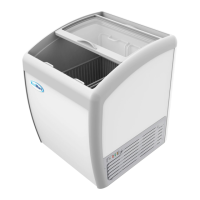
This document is a user's manual for KoolMore Ice Cream Display Freezers, specifically covering models MCF-6C, MCF-9C, and MCF-12C. It provides essential information for the safe and effective operation, maintenance, and troubleshooting of these units.
Function Description:
The KoolMore Ice Cream Display Freezer is designed for the storage and/or display of packaged food, primarily ice cream and other frozen products. Its main function is to maintain a consistently low temperature to keep food frozen and suitable for consumption or sale. The display feature allows for easy viewing of products, making it ideal for commercial settings. The unit utilizes R290, a flammable refrigerant, and is designed with specific operational guidelines to ensure safety and optimal performance.
Important Technical Specifications:
While specific detailed technical specifications like dimensions, power consumption, or compressor type are not explicitly listed, the manual does provide crucial operational parameters. The units use R290 refrigerant. The temperature control allows for adjustment, with "4" being a suitable position for maintaining frozen products and "MAX" providing the strongest cooling for fast freezing. It's recommended not to keep the knob at "MAX" for more than 4-5 hours. The freezer requires a 4-inch clearance around its cabinet walls for proper air circulation. In case of power voltage issues, a power-regulator of more than 1000W might be needed if the voltage drops below 98V or exceeds 132V.
Usage Features:
- Transportation and Set Up: The unit should not be transported on an incline greater than 45 degrees. After unpacking, it must be installed in a well-ventilated, dry area, away from direct sunlight and corrosive materials, with a 4-inch clearance for air circulation. It needs to be placed on a stable surface to prevent vibration and noise. Before loading food, the temperature control should be set to the lowest point (highest number) for several hours until it reaches 0 degrees Fahrenheit.
- Temperature Control: The temperature is adjusted via a control knob. Turning the knob clockwise lowers the temperature (higher number corresponds to lower temperature). Position "4" is generally recommended for maintaining frozen products. The "MAX" position is for rapid freezing but should not be used for extended periods (more than 4-5 hours).
- Food Storage: Only cold or frozen packaged food should be placed inside the freezer. Non-packaged foods must be in plastic bags or containers. The freezer should not be overloaded; space must be left between products for proper air circulation.
- Safety Precautions: Flammable, explosive, or corrosive products must never be stored in the freezer. In case of a power cut, a 5-minute wait is required before restarting to protect the compressor. Mechanical devices should not be used for defrosting, and refrigerant tubing must not be punctured.
Maintenance Features:
- Regular Cleaning: The freezer should be cleaned regularly. Before cleaning, the power must be turned off, and all products removed. The interior should be cleaned with water and a neutral detergent. Boiling water, acid, chemical diluents, petrol, oil, or dirt-removing powder should not be used. After cleaning, the interior must be dried.
- Door Seal Maintenance: The door seal should be cleaned with light soap water, and a little talcum powder applied after natural drying to extend its service life.
- Exterior Cleaning: The exterior surface can be cleaned with a soft cloth, water, or a mild detergent. Care must be taken to keep the power supply away from water during cleaning.
- Defrosting: Defrosting is recommended when ice buildup on the freezer walls reaches 1½ inches for optimal performance. The process involves:
- Lowering the freezer temperature to the lowest setting for 6 hours.
- Removing all products.
- Powering off the freezer.
- Removing ice buildup from the freezer walls. Sharp metal tools or steel brushes should not be used to avoid damage.
- Drying the freezer walls with a clean cloth.
- Plugging the freezer back in.
- Waiting for the unit to reach the proper temperature before returning products.
- Troubleshooting: The manual includes a troubleshooting guide for common issues such as the indicator not being on, the compressor not starting or running properly, insufficient cooling, or excessive noise. Solutions range from adjusting the plug, restoring power, using a power-regulator, reducing door open times, adjusting product placement for ventilation, defrosting, cleaning the condenser, adjusting door seals, moving to a stable surface, tightening fixings, or separating pipes.
- Normal Operation Sounds: The manual clarifies that the sound of water flowing (refrigerant), dew formation on the surface in high humidity, and the condenser and compressor being hot during operation are normal and not indicative of issues.
Warranty:
The product comes with a one-year warranty valid only in the United States, covering defects in material and workmanship. Warranty claims require the model number, serial number, proof of purchase, date of installation, and details of the alleged defect. The warranty does not cover issues arising from improper installation or use, lack of maintenance (e.g., cleaning the condenser coil), outdoor or mobile applications, use outside the US, negligence, improper handling, or overloading that prevents proper airflow. Normal wear parts like light bulbs and gaskets are also excluded. The warranty is non-transferable. For service, customers can contact support via email or phone.


 To Next Page
 General