
 Need help?
Do you have a question about the Korg padKONTROL and is the answer not in the manual?
Guides users through software installation and USB connection for initial device setup.
Provides basic checks and troubleshooting steps to ensure sound output after setup.
Explains the sensitive trigger pads, their responsiveness, and illuminated feedback features.
Details the X-Y pad's functionality for controlling effects like Roll and Flam.
Describes the two assignable knobs and their role in controlling various functions.
Introduces the process of accessing and navigating the device's settings for customization.
Covers detailed pad configuration: note, MIDI channel, switch type, and velocity response.
Explains how to configure the X-Y pad's function, including pitch bend, aftertouch, and CC messages.
Details how to assign functions and CC values to the two assignable knobs.
Introduces the concept of scenes for saving and recalling custom setups.
Explains how to select and load one of the 16 available scene locations.
Details the procedure for saving custom configurations as scenes.
Provides instructions on how to reset the device to its original factory presets.
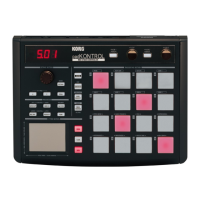
The Korg padKONTROL is a MIDI studio controller designed for intuitive and expressive control over software instruments, effects, and other MIDI-compatible devices. It features 16 velocity-sensitive trigger pads, an X-Y pad, and two assignable knobs, all housed in a sleek, illuminated design.
The core of the padKONTROL's functionality revolves around its 16 trigger pads. Each pad can be assigned to control a different note or Continuous Controller (CC) message, making it versatile for triggering drum sounds, samples, loops, video clips, or even switching software instrument parameters. The pads offer eight dynamic curves, allowing users to customize their response to touch, ranging from soft to hard, or set to a fixed velocity for consistent output. This adaptability ensures that the controller can accommodate various playing styles, from hard hitters to touch-typists. Each pad also supports two switch types: "momentary" for triggering single events like notes, and "toggle" for switching functions on and off, such as reverb or other effects.
A standout feature is the integrated X-Y pad, inspired by Korg's KAOSS Pad technology. This pad enables dynamic control over effects like "Roll" and "Flam." When "Roll" is activated, moving a finger vertically on the X-Y pad adjusts the volume of the repeated drum hit, while horizontal movement controls the repeat rate. Similarly, for "Flam," vertical movement controls the flam's volume, and horizontal movement adjusts the interval between the two simulated drum hits. The X-Y pad can also be set to transmit MIDI CC messages, pitch bend, or aftertouch, offering broad control over external parameters. A "Hold" button allows users to sustain the current X-Y pad effect, freeing their hands for other controls.
Two assignable knobs at the top of the unit further enhance its control capabilities. These knobs can be mapped to any MIDI controller function, such as delay, panning, filter cutoff, resonance, reverb, or delay controls, allowing users to sculpt their sound in real-time. The padKONTROL also includes a footswitch jack, providing additional options for note entry and control, expanding its utility in live performance or studio settings.
The device supports two MIDI outputs simultaneously, allowing it to control two different software applications or hardware devices at once. For example, users can assign the top rows of pads to control a drum kit in one software and the bottom rows to control a synthesizer in another, or even use a row for transport controls (rewind, play/stop, record, fast forward) in a sequencer.
The padKONTROL features 16 "Scene" locations where users can save and recall their custom settings. Additionally, it comes with 30 preloaded scenes, providing a quick starting point for various applications. USB connectivity provides bus power and allows the padKONTROL to function as an external MIDI interface. The illuminated pads and buttons, combined with its clean styling, make it a professional addition to any studio.
Getting started with the padKONTROL involves installing the included editor/librarian software and connecting the device via USB. The software allows for detailed customization of pad assignments, velocity curves, MIDI channels, and port settings. For immediate use, the pads are set to send on MIDI channel 10 by default, and users can quickly verify sound output by hitting a pad. The bright LED display provides instant visual feedback, showing the velocity level of each pad strike.
The padKONTROL operates in two modes: "Play" and "Setting." In "Play" mode, users interact with their assigned controls. Switching to "Setting" mode (by pressing ENTER/SETTING) allows for customization. In "Setting" mode, users can edit individual pad settings by touching a pad, or modify all pads at once by pressing the PROG CHANGE/WRITE/ALL PAD key. The data knob is used to scroll through available MIDI notes, CC messages, velocity curves, and other parameters.
The X-Y pad's "Roll" and "Flam" functions are activated by pressing the corresponding keys and then placing a finger on the pad while holding down a trigger pad (e.g., pad #14 for a snare drum). The "Hold" button can then be pressed to sustain the effect. The assignable knobs are configured in "Setting" mode by pressing KNOB 1 ASSIGN or KNOB 2 ASSIGN and using the data wheel to select the desired function.
Saving and loading custom configurations is managed through "Scenes." To load a scene, users hold the SCENE key and hit one of the 16 pads. To save a scene, users hold the SCENE button, press WRITE/PROG CHANGE/ALL PAD, select a scene location using the data knob or by hitting a pad, and then press the blinking ENTER key.
The included editor/librarian software offers a visual interface for tweaking and customizing settings. Users can click on a pad, knob, or the X-Y pad area within the software to access detailed editing options for note assignments, CC messages, velocity, MIDI channels, polarity, and affected pads. The librarian function allows users to organize, load, and transmit scene sets to the padKONTROL, including preloaded scenes and custom configurations.
The padKONTROL is designed for ease of use and customization, with maintenance primarily focused on software management and data backup. The editor/librarian software plays a crucial role in this, allowing users to save their custom scenes to their computer. This is particularly important before performing a factory reset, as restoring factory settings will overwrite any user-programmed scenes.
To restore factory settings, users hold down the SCENE key and press the FIXED VELOCITY/PRELOAD key. Then, they use the ENCODER to select "ALL" and press the SETTING/ENTER key. The device will display "Lod" during the loading process. Korg explicitly warns users to back up their work using the Editor/Librarian program before restoring factory data to prevent loss of custom settings.
The device's USB bus power capability simplifies setup by eliminating the need for an external power adapter when connected to a computer. The robust design, with illuminated pads and buttons, suggests durability for regular studio use. Regular software updates for the editor/librarian, if provided by Korg, would ensure ongoing compatibility and performance.
 General
| Pad color | White |
|---|---|
| Number of pads | 16 |
| MIDI-keyboard number of keys | 0 keys |
| Display type | LED |
| Display digits | 3 digits |
| Built-in display | Yes |
| Product color | Black |
| Interface | USB |
| Power source type | DC, USB |
| Bundled software | padKONTROL Editor/Librarian |
 Weight and Dimensions
| Depth | 234 mm |
|---|---|
| Width | 314 mm |
| Height | 55 mm |
| Weight | 960 g |



 To Next Page