30
Emptying
Since the Minipool contains a relatively small amount
of water, the concentration of pollutants such as oils,
creams, perspiration, dirt, etc., can be very high. For
this reason, water should be changed at least every
two or three months depending on use.
The following “formula” can be used to assess
approximately how often to empty the tub:
Capacity (litres) /
Number of bathers (daily average) /
12 (experimental constant).
In our case:
1,200 litres (tub) + 120 litres (compensation tank)
with an average of 3 people per day.
(1200+120) / 3 / 12 = 36,6
Empty every 36 days
CAUTION:
Even in the event of prolonged idle periods of the
minipool, we recommend emptying it, as long
periods without water treatment are harmful for
your minipool.
Before emptying, make sure the values of
chemical additives dissolved in water will not be
dierent from those allowed.
If in doubt, contact your local authorities.
DO NOT DRAIN THE WATER INTO A SEPTIC TANK.
PROCEDURE:
1 Switching off the electric
power supply.
2 Before emptying the tub,
clean the lter cartridge (see
attached instructions).
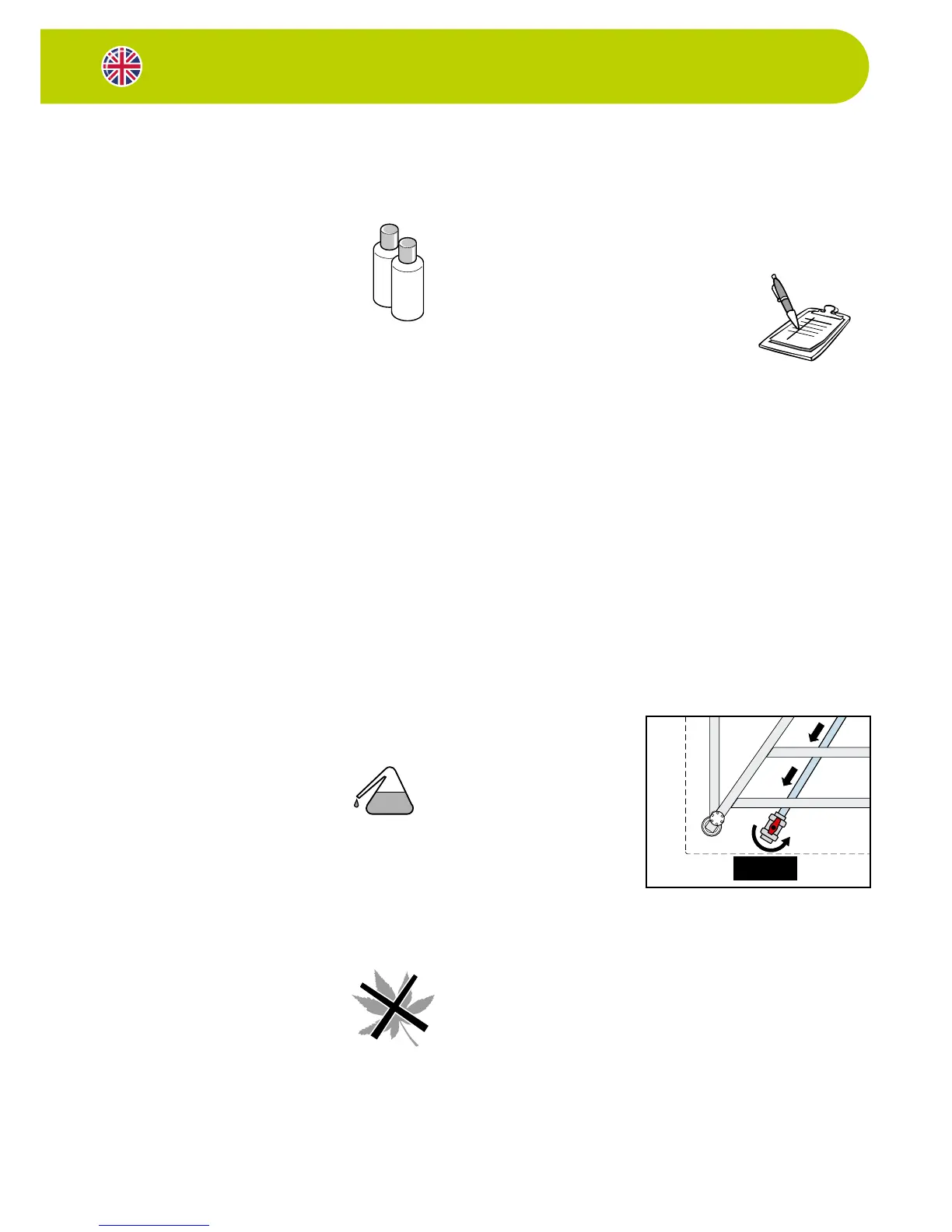
3 Open the two draining valves
(see gure).
4 Once the pool has drained
completely, clean it with a
suitable product.
5 Refill the tank with water as from paragraph
“Initial lling”.
“CHEMICAL” treatment
To solve pollution due to micro-organisms in the
water, a sucient amount of disinfectant (chlorine,
bromine, oxygen, etc. ) to prevent bacteria and
micro-organisms from proliferating and to destroy
those introduced in the ways previously described.
Moreover, an adequate circulation system must en-
sure that the disinfectant is evenly distributed throu-
ghout the pool water and in the compensation tank.
”BODY” treatment
To solve pollution problems due to inert solid sub-
stances, the pool must be equipped with a lter that
retains all the substances suspended in the water.
A suitably sized pump will allow circulate of the
water through the pool, the compensation tank
and the lter.
Maintenance
Sanitizing a whirlpool means keeping it free from
living micro-organisms, including bacteria and
algae. Sanitizing includes the chemical destruction
of micro-organisms and the retention of impurities
with the lter.
EVERBROM and SURCHLOR D are among the most
eective disinfectants available for whirlpools.
SURCHLOR D is used in quick dissolving tablets for
the intensive treatment and to quickly increase the
concentration of disinfectant.
EVERBROM is used for daily maintenance as it is
eective as a sanitizer in a pH range higher than
SURCHLOR D, it is not quickly consumed with
high water temperatures, it does not give rise to
unpleasant odours or it does not irritate the eyes.
Add EVERBROM PASTIGLIE to maintain the ideal
concentration of disinfectant: 2-3 ppm in the
circulation pump lter or in the overow duct.
Check this periodically with the appropriate tester.
CAUTION:
Do not use the tub for bathing until the EVERBROM
level is not less than 6 ppm or the chlorine level
not less than 5 ppm.
Keep circulation, the blower and the whirlpool
running to allow a more rapid distribution of the
disinfectant.
GB - Instructions for use and maintenance
Quadrat
OPEN


 To Next Page
 Loading...