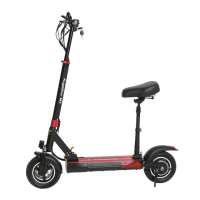
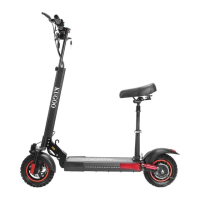
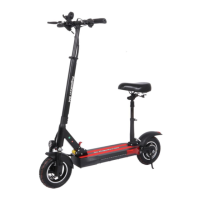
This document serves as a user manual for an electric scooter, providing comprehensive information on its operation, maintenance, and safety precautions. The scooter is presented as an environmentally-friendly, high-tech personal transport solution, emphasizing its excellent shock absorption, streamlined design, portability, flexibility, and high levels of safety and reliability.
Function Description
The electric scooter is designed for personal transportation, offering a convenient and efficient way to travel. It features a robust braking system to ensure safety, and its motor provides propulsion for various terrains. The scooter is equipped with a dashboard that displays essential information such as battery level, current speed, and gear selection. Users can adjust the speed through a regulating handle and shift gears using dedicated buttons on the dashboard. For night riding, the scooter includes front and back LED lights to enhance visibility. The design incorporates a folding mechanism, making it portable and easy to store when not in use.
Usage Features
The manual stresses the importance of understanding the scooter's performance before use. It is not to be lent to inexperienced individuals, juveniles, pregnant women, or the disabled. Users are advised to check the braking system, tire pressure, and battery charge before each ride. The scooter operates with a power switch that illuminates the dashboard upon activation, indicating it's ready for use. Speed is controlled via a regulating handle, which should be rotated slowly and adjusted to a safe speed. The dashboard features a five-bar battery level indicator, with each bar representing a percentage range of charge, and a five-gear indicator for speed control. The fastest speed is achieved in the third gear, while the first gear is for the slowest speed.
Safety is a paramount concern, with numerous warnings against improper use. Riders must avoid overhead obstacles, irregular surfaces at high speeds, and slopes steeper than 20 degrees for extended periods. Accelerating downhill, using only the front brake at high speeds, and riding up/down steps or over obstacles are prohibited. The manual also warns against standing on the footboard after the scooter is powered off, riding in the rain, or with a single hand or foot. Violent rotation of the handle at high speeds, riding in water deeper than 2cm, and riding with both hands off the handle are also forbidden. Carrying passengers is strictly prohibited as the scooter is designed for a single rider.
The manual provides detailed instructions for safe riding practices, including observing traffic rules, riding in non-motor lanes, and maintaining a proper speed, especially in adverse weather conditions. It advises against frequent braking and starting to prolong battery life. In emergencies, both left and right power-cut brake handles should be held tightly to ensure immediate stopping. For double-motor scooters, a double-wheel braking system is provided, while single-motor versions have a rear-wheel braking system.
Charging the scooter requires connecting the charger's output to the battery unit and then to an AC 220V/50HZ power supply. The charging indicator will illuminate, and the scooter should be powered off during the 5-10 hour charging period. It is recommended to charge the scooter daily if possible, and the charging process is automatic, with the indicator turning green when fully charged. Users are warned against using non-dedicated chargers, placing inflammables near the charger, or covering it during operation.
Maintenance Features
Proper maintenance is crucial for the longevity and safe operation of the electric scooter. The battery unit, composed of sealed 18650 li-ion batteries, requires specific care. It should be fully charged before the first use and recharged promptly when the battery level is low. For long-term storage, the battery unit should be fully charged and ideally charged/discharged once a week. Only the dedicated charger should be used to avoid undermining the battery's service life. Metal contacts on the charger socket should not be touched with hands or metal objects to prevent short-circuits.
The motor, a brushless low-speed high-power type, is designed for high efficiency, low noise, and large mileage. Under normal circumstances, it does not require particular maintenance. However, if going uphill with a heavy load, the scooter should be restarted in case of a locked rotor to prevent motor or controller damage.
Routine maintenance includes rotating the speed regulating handle slowly, avoiding direct washing of the scooter to prevent short-circuits in electrical parts, and turning off the main power switch when parking. For complex road conditions like mountain roads, off-road tires should be used. Brake pads need to be replaced when 1/3 worn out or when braking effectiveness is compromised. Contaminants on the brake disc or other surfaces should be removed. The electric part of the power-cut brake should be checked for proper connection and loose fasteners, with timely adjustments made as needed. Periodical examinations and maintenance are recommended every six months.
The manual also includes a troubleshooting section to help users identify and resolve common issues such as speed regulating handle malfunctions, the dashboard not turning on, the scooter not running normally, and short trip distances. For problems that cannot be solved with the provided solutions, users are advised to contact the sales or after-sale service department and refrain from arbitrarily disassembling the product. Disassembling important parts within the warranty period will void the warranty.


 To Next Page
 General