This document is a service manual for the Genius SW-M2.1 350 speaker system, providing comprehensive information for its operation, maintenance, and troubleshooting. It covers various aspects from basic usage instructions to detailed technical specifications and electrical schematics, aiming to assist users and service personnel in understanding and managing the device effectively.
Function Description
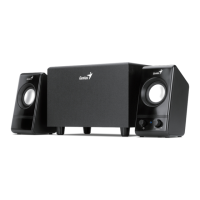
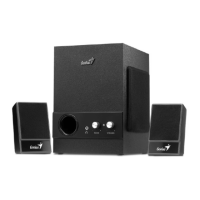
The Genius SW-M2.1 350 is a 2.1 channel speaker system, comprising a subwoofer and two satellite speakers. Its primary function is to reproduce audio from various input sources, offering both bass and stereo sound output. The system includes controls for master volume and bass adjustment, allowing users to tailor the audio output to their preferences. A phone output jack is also integrated, likely for headphone connectivity. The internal architecture, as depicted in the block diagram, shows a signal input leading to a master volume control, which then splits into paths for bass adjustment and the main power amplifiers (TEA2025B ICs). One amplifier drives the bass output, while another handles the L/R stereo output for the satellite speakers. A power supply unit provides the necessary power to all components.
Important Technical Specifications
The manual provides detailed specifications for both the satellite speakers and the subwoofer, ensuring precise performance metrics are available for service and quality control.
Satellite Speakers:
- Rated Output Power @THD 10%: 2W per channel (R and L), with a limit of ≥1.5W. This indicates the maximum power output before significant distortion.
- Sensitivity (1KHz) @Rated O/P Power: 450mV (R) and 440mV (L), with a tolerance of ±45mV. This measures the input voltage required to achieve the rated output power.
- Sensitivity (1KHz) @1W O/P Power: 180mV (R and L), with a tolerance of ±30mV. This specifies the input voltage needed for 1W output.
- Max Input Level @1% THD: 350mV (R and L), with a tolerance of ±45mV. This is the maximum input voltage the system can handle before reaching 1% total harmonic distortion.
- Distortion @1kHz 1W OUT: 0.7% (R and L), with a limit of ≤1%. This indicates the level of harmonic distortion at 1W output.
- Frequency Response (1KHz -3DB) LOW: 290Hz (R) and 285Hz (L), with a tolerance of ±30Hz. This defines the lower end of the frequency range.
- Frequency Response (1KHz -3DB) HI: 108KHz (R) and 103KHz (L), with a tolerance of ±30KHz. This defines the upper end of the frequency range.
- S/N @Rated O/P Power: 75dB (R) and 77dB (L), with a limit of ≥70dB. This is the signal-to-noise ratio at rated output power, indicating audio clarity.
- Channel Unbalance @Ref O/P Power: 0.3dB (R and L), with a limit of ≤1dB. This measures the difference in output level between the two channels.
- Channel Separation (One Channel In; Other Channel Input Shorting): ≥40dB. This indicates how well the channels are isolated from each other.
- Hum Noise (Volume Max; Input Shorting): 47dB (R) and 46dB (L).
- Hum Noise (Volume Max; Input Shorting): 0.6mV (R and L), with a limit of ≤2mV. This measures the residual hum noise with maximum volume and shorted input.
- Hum Noise (Volume Min Input Shorting): 0.4mV (R and L), with a limit of ≤1mV. This measures the residual hum noise with minimum volume and shorted input.
Subwoofer:
- Rated Output Power @100HZ (10%THD): 6W, with a limit of ≥5W. This is the maximum power output for the subwoofer.
- Sensitivity (100Hz) @Rated O/P Power: 150mV, with a tolerance of ±30mV.
- Sensitivity (100Hz) @1W O/P Power: 50mV, with a tolerance of ±15mV.
- Max Input Level @1% THD: 80mV, with a tolerance of ±10mV.
- Distortion @100Hz 1W OUT: 0.7%, with a limit of ≤1%.
- Frequency Response (100Hz -3DB) LOW: 25Hz, with a tolerance of +5Hz.
- Frequency Response (100Hz -3DB) HI: 210Hz, with a tolerance of ±20Hz.
- S/N Ratio @100HZ Rated O/P Power: 70dB, with a limit of ≥70dB.
- Hum Noise (Volume Max; Input Shorting): 1.8mV, with a limit of ≤2mV.
- Hum Noise (Volume Min Input Shorting): 0.7mV, with a limit of ≤1mV.
Usage Features
The manual emphasizes safe and proper usage of the speaker system. Key usage features and recommendations include:
- Placement: The speaker should be placed on a level surface and kept away from harmful or corrosive atmospheres (smoke, vibration, salt, oil, smog).
- Protection from Impact: Users are advised not to throw or strike the speaker to prevent damage.
- Foreign Object Prevention: It's crucial to prevent foreign objects from entering the subwoofer via the inverted tube, as this could lead to electric shock or fire.
- Heat Dissipation: The speaker should be positioned away from other electric appliances to ensure better heat dissipation, which is vital for its longevity and performance.
- Controls: The system features a master volume control and a bass adjustment knob, allowing users to customize their listening experience. There is also a power switch and an LED indicator for operational status.
- Connectivity: The system supports standard audio input and provides a phone output for private listening.
Maintenance Features
The service manual is primarily focused on maintenance and troubleshooting, offering a structured approach to resolving common issues.
- Troubleshooting Flowcharts: The manual provides detailed flowcharts for various problems, including "Power/LED indicator failure," "No sound," "No L/R output," "No bass," "Noise and cacophony," "LED indicator failure," and "No phone output." These flowcharts guide service personnel through a systematic diagnostic process, from verifying the problem to analyzing the reason, defining a service plan, replacing defective parts, and re-testing.
- Component-Level Diagnosis: For each problem, potential causes are listed at a component level (e.g., defective power cord, damaged circuit board, faulty potentiometers, damaged ICs, broken copper foil, defective speakers). This allows for precise identification of the problematic part.
- Repair/Replacement Strategy: The recommended actions for troubleshooting typically involve "Check/repair" or "Replace/repair/replace," indicating that components can either be fixed or swapped out if necessary.
- List of Parts: A comprehensive "List of Parts" is provided for both the subwoofer and satellite speakers. This list includes reference numbers, descriptions (e.g., KNOB, FRONT PANEL, SPEAKER, SCREW), and part numbers. This is invaluable for ordering replacement parts and ensuring compatibility during repairs.
- Assembly Rendering: Exploded views of both the subwoofer and satellite speakers are included under "Assembly Rendering." These diagrams visually depict how the various components fit together, aiding in disassembly and reassembly during maintenance.
- Electric Schematic Diagram: A detailed "Electric Schematic Diagram" is provided, illustrating the internal wiring and component connections. This is crucial for advanced troubleshooting, allowing technicians to trace signals, check voltage points, and identify electrical faults.
- Safety Precautions: The manual emphasizes preventing foreign matters like water or other chemical liquids from entering the product during maintenance, highlighting the importance of careful handling.
In summary, the Genius SW-M2.1 350 service manual is a comprehensive guide designed to support the entire lifecycle of the speaker system, from initial setup and safe operation to detailed troubleshooting and repair procedures. Its structured approach and detailed information make it an essential resource for both end-users and service technicians.

 Need help?
 General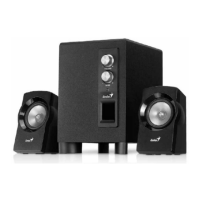




 To Next Page
