Need help?
Do you have a question about the Lakeland 26920 and is the answer not in the manual?
Details key physical parts of the air fryer, including vents, control panel, drawers, and trays for user understanding.
Explains the on/off power button, standby mode activation, and selection of crisper drawers.
Guides on using icons to increase/decrease temperature and set cooking times.
Lists and describes the available pre-programmed cooking functions for various foods.
Instructions for plugging in, switching on, and managing standby mode.
Step-by-step guide for selecting and operating individual crisper drawers.
How to modify temperature and time settings using specific control icons.
Explains the meaning of various illuminated indicators on the display for drawers, time, and temperature.
Details the available pre-programmed cooking options for specific food types.
Essential safety rules for using the appliance, including electrical safety and user limitations.
Lists what not to do, such as using on wet surfaces, immersing in water, or using external timers.
Alerts users about hot surfaces marked with a symbol to prevent burns.
Precautions regarding hot steam from vents and safe handling of hot drawers and trays.
Steps for unpacking the appliance and cleaning it before first use.
Instructions for correctly inserting the crisper tray into the drawer.
How to turn the appliance on, activate standby, and manage power states.
Detailed steps for selecting and operating the large crisper drawer.
How to change temperature and time settings for cooking.
Detailed steps for selecting and operating the small crisper drawer.
Procedures for adjusting temperature or time while cooking is active.
How to safely open the drawer to check or shake food during the cooking cycle.
Instructions for operating both crisper drawers simultaneously.
Explanation of the memory function and how the appliance handles power loss.
Guidance on checking food, shaking ingredients, and making adjustments.
Steps for safely removing cooked food, managing steam, and cooling the unit.
Tips on avoiding greasy foods, reheating, and cutting food evenly for best results.
Recommended methods for preparing potatoes for crispy chips.
A reference table for cooking times, temperatures, and shake frequency for various foods.
Guidance on cooking pre-cooked frozen foods, including checking packet instructions.
Ingredients and detailed steps for preparing crispy spiced chickpeas.
Ingredients and instructions for making courgette fritters in the air fryer.
Ingredients and cooking steps for preparing teriyaki salmon.
Answers to common problems encountered during operation, such as power or cooking issues.
Detailed guide on how to clean all parts of the air fryer safely and effectively.
Provides key technical data like power, voltage, frequency, and weight.
Information regarding the appliance's plug, earthing requirements, and fuse replacement.
Guidance on environmentally friendly disposal and recycling of the appliance.
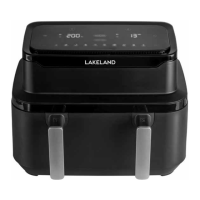
The Lakeland Dual Air Fryer, model 26920, is a versatile kitchen appliance designed to cook food in a healthier way, using little or no oil. It features a top grill that circulates hot air to cook food evenly from all directions, making it suitable for meat, fish, poultry, seafood, and baked goods. The appliance is particularly effective for frozen foods like French fries and scampi, and can fry up to 500 grams of homemade chips with minimal oil. It aims to reduce the mess and odors associated with traditional deep fat fryers.
The Dual Air Fryer operates with an LED touchscreen control panel and a clear countdown timer. Its dual option allows for cooking different foods simultaneously. The appliance is equipped with two crisper drawers: a large crisper drawer (5) and a small crisper drawer (7), each with its own handle (6 and 8 respectively) and non-stick tray (9 and 10). The cooking cavity and heating element (11) are located within the main unit. Air vents (1) and an air intake (4) ensure proper airflow during operation.
The control panel (3) includes several icons for intuitive operation:

 To Next Page
 General