EasyManua.ls Logo

Lakeland 63483 - User Manual

Lakeland 63483
44 pages
Print Icon
To Next Page IconTo Next Page
Loading...
INSTRUCTION BOOKLET
Model: 63483
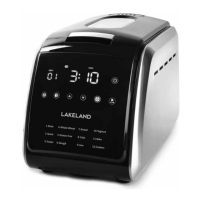
TOUCHSCREEN
BREAD MAKER

Questions and Answers

  • J
    Jessica MartinezSep 4, 2025
    How to prevent my Lakeland Bread Maker bread from being sticky and difficult to slice?
    • B
      Bryan WoodSep 4, 2025
      If bread from your Lakeland Bread Maker doesn't slice well and is sticky, it might be because it was sliced while hot. Allow bread to cool for at least 30 minutes before slicing to allow steam to escape. Also, ensure you're using a good quality bread knife.
  • W
    williejacksonSep 18, 2025
    What does “H HH” mean on my Lakeland Bread Maker display?
    • E
      Elizabeth LewisSep 18, 2025
      If the display screen of your Lakeland Bread Maker shows 'H HH', the temperature inside is too high, indicating the machine is still hot from the previous baking procedure. Press START/STOP and unplug the machine. Remove the baking pan and let it cool at room temperature. Then, reinsert the plug and start again.
  • B
    Brenda MckinneySep 16, 2025
    Why is there a burning odor when I use my Lakeland 63483?
    • P
      Patricia BallSep 16, 2025
      If you notice a burning odor when operating your Lakeland Bread Maker, it's likely due to ingredients spilled inside the baking chamber. Take care when adding ingredients to the bread pan, as spillage into the chamber can cause burning.
  • M
    Mrs. Laura Gonzales DDSSep 14, 2025
    How to remove kneading paddles stuck in my Lakeland 63483 Bread Maker pan?
    • S
      sharrisSep 14, 2025
      If the kneading paddles of your Lakeland Bread Maker cannot be removed from the pan, you must add enough water to cover the kneading paddles and then leave to soak for 10 minutes. After soaking, twist kneading paddles slightly to loosen.
  • E
    Emily SinghSep 13, 2025
    Why does my Lakeland Bread Maker have a dark, thick crust?
    • M
      Martha CareySep 13, 2025
      If your Lakeland Bread Maker produces a loaf with a dark and thick crust, it's likely because you selected the DARK crust color. Next time, use the MEDIUM or LIGHT setting.
  • J
    John RiveraSep 12, 2025
    Why aren't the ingredients mixing in my Lakeland Bread Maker?
    • G
      Gary GutierrezSep 12, 2025
      If the ingredients in your Lakeland Bread Maker aren't mixing, it could be because the bread maker was not started. After selecting a program, press the START/STOP button to begin. Another reason might be forgetting to put the kneading paddles in the bread pan. Always ensure the kneading paddle is correctly positioned on the drive shaft at the bottom of the bread pan before adding ingredients.
  • J
    jessica06Sep 9, 2025
    Why is the crust on my Lakeland 63483 bread too light?
    • H
      Hannah BrownSep 9, 2025
      If the crust of your bread from the Lakeland Bread Maker is too light, it could be that the bread was not baked long enough; carry out a BAKE cycle to darken the crust. Alternatively, a LIGHT crust color may have been selected; choose DARK or MEDIUM crust color next time.
  • C
    Claire LewisSep 7, 2025
    What to do if my Lakeland Bread Maker is not operating or the kneading paddles aren't moving?
    • W
      Willie WalshSep 7, 2025
      If your Lakeland Bread Maker is not operating or the kneading paddles are not moving, check the following: Ensure the bread maker is switched on. Verify the bread pan is correctly located and locked in place. If a time delay is selected, the bread maker will not start until the set time.
  • N
    Nathaniel ScottSep 6, 2025
    Why are my Lakeland 63483 Bread Maker loaves uneven and shorter at one end?
    • J
      Jeffrey MillerSep 6, 2025
      If loaves from your Lakeland Bread Maker are uneven and shorter at one end, it indicates the dough is too dry. Increase liquid by 15ml, 3tsp.
  • B
    Billy KimAug 21, 2025
    Why doesn't my Lakeland Bread Maker bread rise enough?
    • S
      Sean RamirezAug 21, 2025
      If your Lakeland Bread Maker produces bread that doesn't rise enough, several factors could be at play. Wholemeal breads naturally rise less than white breads due to lower gluten content, which is normal. Ensure you're using the correct type of flour, specifically strong bread flour, and the right type of yeast, such as fast-action 'easy blend' yeast. Measure the yeast accurately and check its expiration date. Liquids should be at room temperature to avoid killing or failing to activate the yeast. Also, verify that sugar and yeast remain separate until the kneading cycle begins. Finally, avoid opening the lid during the rising cycle to prevent warm air from escaping. If the issue persists, consider increasing the liquid by 15ml (3tsp).

Summary

PRODUCT FEATURES

Product Components

Lists and describes the main parts and accessories of the bread maker, including the viewing window, lid, and paddles.

SAFETY CAUTIONS

General Safety Guidelines

Provides essential safety precautions for operating the bread maker, focusing on preventing injury.

WARNING - HOT SURFACES

Handling Hot Components

Details specific warnings and advice for safely handling hot surfaces and components.

THE CONTROL PANEL AND PROGRAMMES

Control Panel Layout and Functions

Explains the layout, buttons, and display elements of the bread maker's control panel for user interaction.

Processing Phases and Lock

Describes the bread making process phases and the function of the control panel lock for security.

ASSEMBLY AND FIRST USE

Initial Setup and Operation

Provides step-by-step instructions for assembling and performing the initial operation of the bread maker.

INSTRUCTIONS FOR USE

Measuring Ingredients

Details the correct methods for accurately measuring liquid and dry ingredients for bread recipes.

Adding Flavourings and Ingredients

Explains methods for incorporating additional flavourings and ingredients into bread dough.

MAKING A LOAF: KEY CONSIDERATIONS

Ingredient Order and Preparation

Details the essential steps and correct order for adding ingredients to the bread pan for baking.

PROGRAMME CYCLE TIME TABLE

Programme Timings and Options

A table detailing programme durations, ingredient addition times, and crust colour selection options.

GUIDE TO BREAD MAKING INGREDIENTS

Flour Types and Characteristics

Information on various wheat and non-wheat flours and their characteristics for bread making.

Salt and Sweeteners

Explains the function of salt and the use of various sweetener options in bread recipes.

INGREDIENT GUIDANCE

Fats, Oils, and Liquids

Guidance on incorporating fats, oils, and various liquid ingredients for successful bread making.

Yeast and Its Use

Provides instructions and tips for using different types of yeast effectively in bread recipes.

ADAPTING YOUR OWN RECIPES

Custom Recipe Adjustments

Provides guidelines for adapting existing personal recipes to suit the bread maker's functions.

HINTS AND TIPS FOR BETTER BREAD

General Baking Advice

Offers practical tips for achieving better bread quality, covering measurement, ingredients, and environment.

RECIPES AND BREAD MIXES

Using Packet Bread Mixes

Guidance on using pre-made bread mixes with the bread maker, including important precautions.

PROGRAMME 1 - BASIC

Basic Bread Recipe

Core recipe and method for making a standard white bread loaf.

PROGRAMME 2 - QUICK

Quick Bread Recipe

Recipe for fast preparation of white, wheat, and rye bread.

PROGRAMME 3 - SWEET

Sweet Bread Recipe

Recipe for a delicious sweet bread, ideal for breakfast treats.

PROGRAMME 4 - WHOLE-WHEAT

Whole-Wheat Bread Recipe

Recipe for whole-wheat bread, noting its denser texture with all wholemeal flour.

PROGRAMME 5 - GLUTEN FREE

Gluten-Free Loaf Recipe

Recipe for a gluten-free loaf featuring a dense texture and lower rise.

PROGRAMME 6 - DOUGH

Pizza Dough Preparation

Instructions for making pizza dough and suggestions for pizza toppings.

PROGRAMME 7 - KNEAD

Pasta Dough Preparation

Method for preparing pasta dough, including variations for spinach and tomato pasta.

PROGRAMME 8 - CAKE

Tea Loaf Recipe

Recipe for baking a tea loaf, including instructions for adding mixed fruit.

PROGRAMME 9 - JAM

Strawberry Jam Recipe

Recipe for making strawberry jam, including tips on setting and testing.

PROGRAMME 10 - YOGHURT

Yoghurt Preparation

Instructions for making yoghurt, including time adjustments and storage warnings.

PROGRAMME 11 - BAKE

Sun-Dried Tomato Bread Recipe

Recipe for a sun-dried tomato, cheese, and olive bread using the bake function.

PROGRAMME 12 - CUSTOM

Customisable Bread Settings

Information on setting personalised timings for kneading, rising, and baking phases.

TROUBLESHOOTING

Loaf Size and Shape Issues

Solutions for common issues with bread size and shape, such as poor rising or density.

BREAD TEXTURE PROBLEMS

Addressing Texture Issues

Solutions for common bread texture problems like density, openness, or unevenness.

CRUST AND PAN PROBLEMS

Crust Colour and Pan Issues

Solutions for crust colour problems and difficulties with removing the bread from the pan.

MACHINE AND DISPLAY ISSUES

Operation and Error Displays

Solutions for operational faults, ingredient mixing issues, and warning displays like "H HH" or "E:EO".

CARE AND CLEANING

Cleaning Procedures and Maintenance

Guidelines for cleaning the bread maker, its parts, and general maintenance tips.

TECHNICAL INFORMATION

Electrical Connections and Fuse

Technical specifications, electrical safety, and fuse replacement details for the appliance.

Recycling Electrical Waste

Guidance on responsible disposal and recycling of the bread maker.

Lakeland 63483 Specifications

General IconGeneral
BrandLakeland
Model63483
CategoryBread Maker
LanguageEnglish

Related product manuals