EasyManua.ls Logo

LEGRAND GFCI - User Manual

LEGRAND GFCI
2 pages
Print Icon
To Next Page IconTo Next Page
Loading...
To prevent severe shock or
electrocution, always turn the
power OFF at the service panel
before working with wiring.
Use this GFCI receptacle with
copper or copper-clad wire. Do
not use it with aluminum wire.
Do not install this GFCI receptacle
on a circuit that powers life
support equipment because if
the GFCI trips, it will shut down
the equipment.
For installation in wet locations,
protect the GFCI receptacle with
a weatherproof cover that will
keep both the receptacle and any
plugs dry.
Must be installed in accordance
with national and local electrical
codes.
3. Should you install it?
Installing a GFCI receptacle can be
more complicated than installing a
conventional receptacle.
Make sure that you:
Understand basic wiring principles
and techniques.
Can interpret wiring diagrams.
Have circuit wiring experience.
Are prepared to take a few minutes
to test your work, making sure that
you have wired the GFCI receptacle
correctly.
6. Identify cables/wires
IMPORTANT:
Do not install the GFCI receptacle
in an electrical box containing (a)
more than 4 wires (not including the
grounding wires) or (b) cables with
more than two wires (not including the
grounding wire). Contact a qualified
electrician if either (a) or (b) is true.
If you are replacing an old
receptacle, pull it out of the electrical
box without disconnecting the wires.
If you see one cable (2-3 wires), it
is the LINE cable. The receptacle is
probably in position C (see diagram
to the right). Remove the receptacle
and go to step 7A.
If you see two cables (4-6 wires),
the receptacle is probably in position
A or B (see diagram to the right).
Follow steps a-e of the procedure
to the right.
Procedure: box with two cables
(4-6 wires)
(a)  Detach one cable’s white and hot 
wires from the receptacle and cap
each one separately with a wire
connector. Make sure that they are
from the same cable.
(b) Re-install the receptacle in the
electrical box, attach the faceplate,
then turn the power ON at the
service panel.
(c) Determine if power is flowing to the
receptacle. If so, the capped wires
are the LOAD wires. If not, the
capped wires are the LINE wires.
(d) Turn the power OFF at the service
panel, label the LINE and LOAD
wires, then remove the receptacle.
(e) Go to step 7B.
Placement in circuit:
The GFCI’s place in the circuit 
determines if it protects other
receptacles in the circuit.
Sample circuit:
Placing the GFCI in position A will
also provide protection to “load side”
receptacles B and C. On the other
hand, placing the GFCI in position C
will not provide protection to
receptacles A or B. Remember that
receptacles A, B, and C can be in
different rooms.
1. What is a GFCI?
A GFCI receptacle is different from
conventional receptacles. In the event
of a ground fault, a GFCI will trip and
quickly stop the flow of electricity to
prevent serious injury.
Definition of a ground fault:
Instead of following its normal safe
path, electricity passes through a
person’s body to reach the ground. 
For example, a defective appliance
can cause a ground fault.
A GFCI receptacle does not protect
against circuit overloads, short circuits,
or shocks. For example, you can still
be shocked if you touch bare wires
while standing on a non-conducting
surface such as a wood floor.
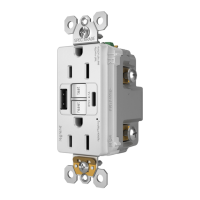
Self-Test GFCI Receptacle with
SafeLock Protection
This is a Self-Test GFCI Receptacle
with SafeLock™ Protection; it
conducts an automatic test every three
seconds, ensuring it’s always ready 
to protect. If the device fails the test,
the indicator light flashes to signal
that the GFCI should be replaced.
It also has our proven SafeLock
Protection feature: if critical
components are damaged and
protection is lost, power to this
receptacle, and any downstream
receptacles, will be disconnected.
5. Turn the power OFF
Plug an electrical device, such as
a lamp or radio, into the receptacle
on which you are working. Turn the
lamp or radio on. Then, go to the
service panel. Find the breaker or fuse
that protects that receptacle. Place
the breaker in the OFF position or
completely remove the fuse. The lamp
or radio should turn OFF.
Next, plug in and turn ON the lamp or
radio at the receptacle’s other outlet 
to make sure the power is OFF at
both outlets. If the power is not OFF,
stop work and call an electrician to
complete the installation.
2. The GFCI’s features
ABC
LINE
LOAD
Service
Panel
LOAD
LINE LINE
FRONT VIEW
Screw (terminal) colors:
Green = grounding terminals
Silver = white terminals
Brass = hot terminals
BACK VIEW
Installing and
Testing a
GFCI Receptacle
!
CAUTION
P.O. Box 4822 (800) 223-4185
Syracuse, NY 13221 www.legrand.us
For covering patents, see www.legrand.us/patents
Nº 341082
Please read this leaflet
completely before
getting started.
Receptacle
Outlet
Reset button:
See step 8
Indicator
Light
TEST button:
See step 8
Outlet
Mounting
bracket
LINE
Hot terminal
(Brass):
Connection
for the LINE
cable’s black 
wire
LOAD
Hot terminal
(Brass):
Connection
for the LOAD
cable’s black 
wire
A yellow sticker
covers the LOAD
terminals.
Do not remove the
sticker at this time.
Grounding terminal
(Green): Connection
for bare copper or
green wire
LINE
White terminal
(Silver): Connection
for the LINE cable’s 
white wire
LOAD
White terminal
(Silver): Connection
for the LOAD cable’s 
white wire
4. LINE vs. LOAD
A cable consists of 2 or 3 wires.
LINE cable:
Delivers power from the service
panel (breaker panel or fuse box)
to the GFCI. If there is only one
cable entering the electrical box, it
is the LINE cable. This cable should
be connected to the GFCI’s LINE 
terminals only.
LOAD cable:
Delivers power from the GFCI to
another receptacle in the circuit. This
cable should be connected to the
GFCI’s LOAD terminals only. The 
LOAD terminals are under the yellow
sticker. Do not remove the sticker at
this time.
Question and Answer IconNeed help?

Do you have a question about the LEGRAND GFCI and is the answer not in the manual?

Summary

Installing and Testing a GFCI Receptacle

What is a GFCI?

Explains GFCI function, ground faults, and limitations for preventing injury.

GFCI Features and Placement

Details GFCI front/back views, indicator lights, and placement options in a circuit.

Installation Prerequisites and Safety

Covers necessary skills, wiring experience, and safety steps like turning off power.

Understanding LINE and LOAD Cables

Differentiates between LINE and LOAD cables and their connection points on the GFCI.

Wire Identification and Connection

Guides on identifying and connecting LINE and LOAD wires based on cable configurations.

GFCI Testing Procedure

Outlines steps to test GFCI functionality, including reset and trip operations.

GFCI Installation Troubleshooting

Provides solutions for common issues like reversed connections or no power.

Overview

The Pass & Seymour GFCI Receptacle is a safety device designed to prevent severe shock or electrocution by quickly stopping the flow of electricity in the event of a ground fault. Unlike conventional receptacles, a GFCI (Ground Fault Circuit Interrupter) detects when electricity deviates from its normal safe path, such as passing through a person's body to reach the ground, and trips to cut off power. It is crucial to understand that a GFCI receptacle does not protect against circuit overloads, short circuits, or shocks from touching bare wires while standing on a non-conducting surface.

Function Description:

The primary function of this GFCI receptacle is to provide ground fault protection. It continuously monitors the electrical current flowing through a circuit. If it detects an imbalance, indicating a ground fault, it rapidly trips, interrupting the power supply within milliseconds. This rapid response is critical in preventing serious injury or death from electrical shock.

This particular model is a Self-Test GFCI Receptacle with SafeLock Protection. This means it conducts an automatic internal test every three seconds to ensure its readiness to protect. If the device fails this self-test, an indicator light will flash to signal that the GFCI needs to be replaced. The SafeLock Protection feature further enhances safety: if critical components are damaged and protection is lost, the device will automatically disconnect power to itself and any downstream receptacles, preventing unsafe operation.

Usage Features:

The GFCI receptacle includes several user-friendly features for operation and safety:

  • Receptacle Outlets: Standard outlets for plugging in electrical devices.
  • TEST Button: Used to manually trip the GFCI to verify its functionality. Pressing this button should cut off power to the outlets and any downstream receptacles, and the RESET button should pop out.
  • RESET Button: Used to restore power after the GFCI has tripped, either manually or due to a ground fault. The RESET button should stay in when pressed to restore power.
  • Indicator Light: Provides visual feedback on the GFCI's status. For the Self-Test model, a flashing indicator light signals a failed self-test and the need for replacement.
  • Mounting Bracket: For secure installation within an electrical box.
  • Screw Terminals: Clearly labeled terminals for wiring connections:
    • LINE Hot Terminal (Brass): For connecting the black (hot) wire from the incoming power (service panel).
    • LINE White Terminal (Silver): For connecting the white (neutral) wire from the incoming power.
    • LOAD Hot Terminal (Brass): For connecting the black (hot) wire to downstream receptacles. These terminals are initially covered by a yellow sticker and should only be used if you intend to provide GFCI protection to other receptacles in the circuit.
    • LOAD White Terminal (Silver): For connecting the white (neutral) wire to downstream receptacles, also covered by the yellow sticker.
    • Grounding Terminal (Green): For connecting the bare copper or green grounding wire.

Installation Considerations:

  • LINE vs. LOAD: Proper identification of LINE (incoming power from the service panel) and LOAD (outgoing power to other receptacles) cables is critical for correct installation and functionality. The yellow sticker covering the LOAD terminals must remain in place if you do not intend to protect downstream receptacles.
  • Wiring: The GFCI is designed for use with copper or copper-clad wire only, not aluminum wire. Wiring connections should be made securely using either the back wire holes or by wrapping the wire clockwise around the screw terminals.
  • Placement in Circuit: The GFCI's position in the circuit determines which other receptacles, if any, will receive ground fault protection. If connected to the LINE terminals only, it protects only itself. If connected to both LINE and LOAD terminals, it protects itself and all downstream receptacles connected to the LOAD terminals.
  • Wet Locations: When installed in wet locations, the GFCI receptacle must be protected by a weatherproof cover that keeps both the receptacle and any plugs dry.
  • Not for Life Support: This GFCI should not be installed on circuits powering life support equipment, as a trip would shut down the equipment.

Maintenance Features:

  • Monthly Testing: Users are advised to press the TEST button (and then the RESET button) every month to ensure proper operation of the GFCI. This manual test verifies that the device can trip and reset correctly.
  • Self-Test Feature: The integrated Self-Test with SafeLock Protection automatically checks the GFCI's functionality every three seconds. This continuous monitoring provides an added layer of safety, as it alerts the user to any internal failures that might compromise protection.
  • Indicator Light for Failure: A flashing indicator light serves as a clear visual cue that the GFCI has failed its self-test and needs to be replaced. This eliminates the guesswork and ensures timely replacement of a faulty device.
  • SafeLock Protection: If critical internal components are damaged, leading to a loss of ground fault protection, the SafeLock feature will automatically cut off power to the receptacle and any downstream devices. This prevents the use of a compromised GFCI, enhancing overall safety.
  • Troubleshooting Guide: The manual provides troubleshooting steps for common issues, such as the RESET button not staying in, no power, or the indicator light not behaving as expected during testing. This guides users through checking wiring connections, identifying LINE/LOAD reversals, and ensuring secure connections.

The GFCI receptacle is an essential safety device for modern electrical systems, providing critical protection against ground faults. Its self-testing and SafeLock features further enhance its reliability and user safety, making it a vital component in homes and workplaces.

LEGRAND GFCI Specifications

General IconGeneral
TypeGFCI Outlet
Amperage15A or 20A
Tamper-ResistantYes
Trip Level5mA
ColorWhite
Wire ConnectionSide or Back Wire
Weather ResistantYes
CertificationUL Listed

Related product manuals