9
LEHLE GmbH · Germany · www.lehle.com · support@lehle.com
PRECONDITIONS FOR PASSIVE SPLITTING
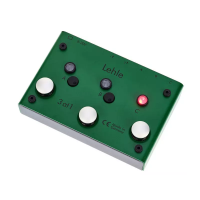
The LEHLE P-SPLIT STEREO is a passive
splitter which can be used to split high-
impedance signals to high-impedance
inputs. There are certain preconditions
which must be met to ensure that this is
accomplished without problems and no
loss of sound.
HIGH-IMPEDANCE SIGNAL SOURCES
AND INPUTS
Passive magnetic pickups as generally
used - in the form of single-coil and hum-
bucker pickups, on electric guitars and
basses - supply high-impedance signals.
High-impedance signals have an output
impedance in a range of 10 kΩ (10,000
Ω); the higher this figure, the more sensi-
tive the signal is to interference.
High-impedance inputs are found on
guitar and bass amplifiers, and on sound
cards with a “Hi-Z” input; “Z” stands for
the impedance, which is the physical ex-
pression for the internal resistance of a
signal source or a signal input, and thus
defines its low/high-impedance perfor-
mance.
High-impedance signals are generally
transmitted unbalanced and are relative-
ly susceptible to interference. Long cable
routings audibly attenuate high frequen-
cies. Electromagnetic interference from
the environment then becomes more no-
ticeable than in the case of low-imped-
ance and balanced signals. There are,
nonetheless, very many musicians who
swear by the sound of an electric guitar
or bass with passive pickups connected
directly to a tube amplifier via a good
cable.
The input impedance of high-impedance
inputs is generally 1 MΩ (1,000,000 Ω)
or more. Here, too, the input becomes
more sensitive, the higher this figure is.
LOW-IMPEDANCE SIGNAL SOURCES
AND INPUTS
Keyboards, active pickups, preamp out-
puts, sound cards and mixers supply low-
impedance signals. The output imped-
ance of such signals is typically 100 Ω to
around 600 Ω.
Low-impedance inputs predominate in
the line input of mixing desks, power
amps and sound cards with no Hi-Z in-
puts, and also in microphone inputs and
in virtually all balanced inputs. Low-im-


 To Next Page
 Loading...